• Produktbild: Population Growth, Income Distribution, and Economic Development
  • Produktbild: Population Growth, Income Distribution, and Economic Development

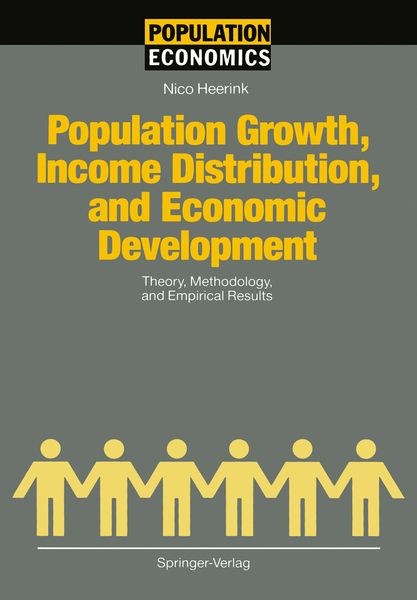
Population Growth, Income Distribution, and Economic Development Theory, Methodology, and Empirical Results

Aus der Reihe Population Economics

Fr. 137.00

inkl. gesetzl. MwSt., Versandkostenfrei


Beschreibung

Produktdetails

Einband

Taschenbuch

Erscheinungsdatum

13.12.2011

Verlag

Springer Berlin

Seitenzahl

401

Maße (L/B/H)

24.4/17/2.3 cm

Gewicht

721 g

Auflage

Softcover reprint of the original 1st ed. 1994

Sprache

Englisch

ISBN

978-3-642-78573-3

Beschreibung

Produktdetails

Einband

Taschenbuch

Erscheinungsdatum

13.12.2011

Verlag

Springer Berlin

Seitenzahl

401

Maße (L/B/H)

24.4/17/2.3 cm

Gewicht

721 g

Auflage

Softcover reprint of the original 1st ed. 1994

Sprache

Englisch

ISBN

978-3-642-78573-3

Herstelleradresse

Springer-Verlag KG
Sachsenplatz 4-6
1201 Wien
AT

Email: GPSR Kontakt

Noch keine Bewertungen vorhanden

Verfassen Sie die erste Bewertung zu diesem Artikel

Helfen Sie anderen Kundinnen und Kunden durch Ihre Meinung.

Kundinnen und Kunden meinen

Bewertungen (0)

  • Produktbild: Population Growth, Income Distribution, and Economic Development
  • Produktbild: Population Growth, Income Distribution, and Economic Development
  • 1 Introduction.- 1.1 Purpose of the study.- 1.2 Previous research on the subject.- 1.3 Approach of the present study.- 1.4 Outline of the study.- 1.5 Composition of the sample.- 1.6 Data and data quality.- I: Methodological Issues.- 2 Inequality measures in macro-analyses.- 2.1 Introduction.- 2.2 Aggregation of nonlinear micro-relationships and measures of inequality.- 2.2.1 Introduction.- 2.2.2 Alternative formulations of the nonlinearity bias.- 2.2.3 The nonlinearity bias and basic properties of inequality measures.- 2.2.4 The nonlinearity bias and auxiliary properties of inequality measures.- 2.2.5 The nonlinearity bias for the logarithmic function.- 2.2.6 Aggregation of ratios.- 2.2.7 Summary and conclusions.- 2.3 Application to income distributions.- 2.3.1 Introduction.- 2.3.2 Relationship of the nonlinearity bias to social welfare functions.- 2.3.3 Estimation from grouped data: I.- 2.3.4 Estimation from grouped data: II.- 2.3.5 Summary.- 2.4 Conclusion.- 3 Cross-national regression analysis.- 3.1 Introduction.- 3.2 Interpretation of the estimates.- 3.2.1 Introduction.- 3.2.2 Impact of omitted lagged variables.- 3.2.3 Impact of the omission of other explanatory variables.- 3.2.4 Summary and conclusions.- 3.3 Econometric problems.- 3.3.1 Introduction.- 3.3.2 Heteroscedasticity.- 3.3.3 Multicollinearity.- 3.3.4 Errors in the variables.- 3.3.5 Summary.- 3.4 Conclusion.- II: Partial Studies.- 4 Fertility.- 4.1 Introduction.- 4.2 Review of the literature on the impact of income inequality.- 4.3 Impact of household income on fertility.- 4.3.1 Proximate determinants of fertility.- 4.3.2 Easterlin’s synthesis framework.- 4.3.3 Direct impact of income on intervening variables.- 4.3.4 Indirect impact of income on intervening variables.- 4.3.5 Shape of the income-fertility relationship.- 4.3.6 Conclusions.- 4.4 Macro-level evidence on the shape of the income-fertility relationship.- 4.5 Regression results.- 4.6 Summary.- 5 Mortality.- 5.1 Introduction.- 5.2 Review of the literature on the impact of income inequality.- 5.3 Impact of household income on mortality.- 5.3.1 Causes of death and proximate determinants of mortality.- 5.3.2 Impact of household income on proximate determinants.- 5.3.3 Shape of the income-mortality relationship.- 5.3.4 Conclusions.- 5.4 Macro-level evidence on the shape of the income-mortality relationship.- 5.5 Regression results.- 5.6 Summary.- 6 Age structure of the population.- 6.1 Introduction.- 6.2 Demographic relationships in cross-national regression analyses.- 6.3 Long-term impact of fertility and mortality on the age structure.- 6.4 Regression results.- 6.5 Summary and conclusions.- 7 Income (in)equality.- 7.1 Introduction.- 7.2 Review of the literature on demographic determinants.- 7.3 Equality of personal incomes.- 7.3.1 Age-income profiles.- 7.3.2 Age and the equality of personal incomes.- 7.3.3 Numerical assesments of the age effect.- 7.3.4 Gender and the equality of personal incomes.- 7.3.5 Conclusions.- 7.4 Equality of household incomes.- 7.4.1 Household size and the equality of household incomes.- 7.4.2 Numerical assesments of the household size effect.- 7.4.3 Age and gender and the equality of household incomes.- 7.4.4 Conclusions.- 7.5 Regression results.- 7.6 Summary.- 8 Total income.- 8.1 Introduction.- 8.2 Properties of the Cobb-Douglas production function.- 8.3 Some non-conventional sources of growth.- 8.4 Regression results.- 8.5 Summary.- 9 Basic needs fulfilment.- 9.1 Introduction.- 9.2 Review of the literature on the impact of income inequality.- 9.3 Impact of household income on basic needs fulfilment.- 9.4 Regression results.- 9.5 Summary.- 10 Labour force participation.- 10.1 Introduction.- 10.2 Impact of income (in)equality.- 10.2.1 Review of the literature.- 10.2.2 Impact of household income on labour force participation.- 10.2.3 Macro-level evidence on the shape of the income-labour force participation relationship.- 10.2.4 Conclusion.- 10.3 Impact of population age and sex structure.- 10.4 Regression results.- 10.5 Summary.- 11 Consumption and saving.- 11.1 Introduction.- 11.2 Impact of income (in)equality.- 11.2.1 Impact of household income on consumption.- 11.2.2 Implications for relationship betweeen income equality and consumption.- 11.2.3 Review of empirical studies.- 11.3 Impact of population age and sex structure.- 11.3.1 Savings and the dependency ratio.- 11.3.2 Consumption and equivalence scales.- 11.3.3 An Integration.- 11.4 Regression results.- 11.5 Summary.- 12 Other dependent variables in the model.- 12.1 Introduction.- 12.2 Inequality of land holdings.- 12.3 Average household size.- 12.4 Share of labour force in agriculture.- 12.5 Population per physician.- 12.6 Summary.- III: The Simultaneous-Equations Model.- 13 Model specification and regression results.- 13.1 Introduction.- 13.2 Specification of the model.- 13.2.1 Structural equations.- 13.2.2 Identities.- 13.2.3 Properties of the model.- 13.3 Regression results.- 13.4 Conclusion.- 14 Summary.- Appendix A: Data sources.- Appendix B: The entire model.