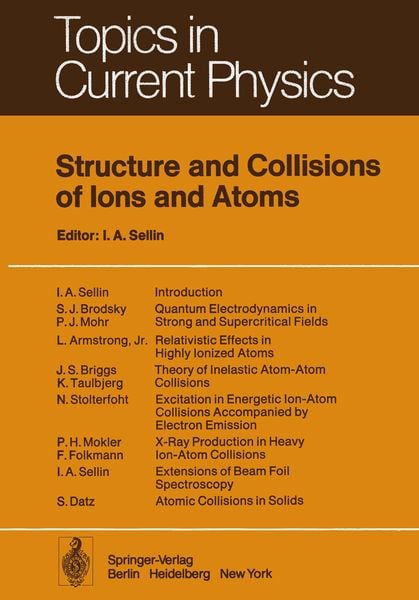
Produktbild: Structure and Collisions of Ions and Atoms
Band 5

Structure and Collisions of Ions and Atoms

Fr. 72.90

inkl. gesetzl. MwSt., Versandkostenfrei


Beschreibung

Produktdetails

Einband

Taschenbuch

Erscheinungsdatum

04.01.2012

Herausgeber

I.A. Sellin

Verlag

Springer Berlin

Seitenzahl

350

Maße (L/B/H)

24.4/17/2 cm

Gewicht

635 g

Auflage

Softcover reprint of the original 1st ed. 1978

Sprache

Englisch

ISBN

978-3-642-81212-5

Beschreibung

Produktdetails

Einband

Taschenbuch

Erscheinungsdatum

04.01.2012

Herausgeber

I.A. Sellin

Verlag

Springer Berlin

Seitenzahl

350

Maße (L/B/H)

24.4/17/2 cm

Gewicht

635 g

Auflage

Softcover reprint of the original 1st ed. 1978

Sprache

Englisch

ISBN

978-3-642-81212-5

Herstelleradresse

Springer-Verlag KG
Sachsenplatz 4-6
1201 Wien
AT

Email: GPSR Kontakt

Noch keine Bewertungen vorhanden

Verfassen Sie die erste Bewertung zu diesem Artikel

Helfen Sie anderen Kundinnen und Kunden durch Ihre Meinung.

Kundinnen und Kunden meinen

Bewertungen (0)

  • Produktbild: Structure and Collisions of Ions and Atoms
  • 1. Introduction.- 2. Quantum Electrodynamics in Strong and Supercritical Fields.- 2.1 The Electrodynamics of High-Z Electronic Atoms.- 2.1.1 Lamb Shift in Hydrogenlike Ions.- 2.1.2 Lamb Shift in Heliumlike Ions.- 2.1.3 Quantum Electrodynamics in High-Z Neutral Atoms.- 2.1.4 High-Z Atoms and Limits on Nonlinear Modifications of QED.- 2.1.5 Wichmann-Kroll Approach to Strong-Field Electrodynamics.- 2.2 The Electrodynamics of High-Z Muonic Atoms.- 2.2.1 General Features.- 2.2.2 Vacuum Polarization.- 2.2.3 Additional Radiative Corrections.- 2.2.4 Nuclear Effects.- 2.2.5 Electron Screening.- 2.2.6 Summary and Comparison With Experiment.- 2.2.7 Muonic Helium.- 2.2.8 Nonperturbative Vacuum Polarization Modification and Possible Scalar Particles.- 2.3 Quantum Electrodynamics in Heavy-Ion Collisions and Supercritical Fields.- 2.3.1 Electrodynamics for Z?>1.- 2.3.2 Spontaneous Pair Production in Heavy-Ion Collisions.- 2.3.3 Calculation of the Critical Internuclear Distance.- 2.3.4 Calculation of the Spontaneous Positron Production Rate.- 2.3.5 Induced Versus Adiabatic Pair Production.- 2.3.6 Vacancy Formation in Heavy-Ion Collisions.- 2.3.7 Nuclear Excitation and Other Background Effects.- 2.3.8 Radiative Corrections in Critical Fields.- 2.3.9 Coherent Production of Photons in Heavy-Ion Collisions.- 2.3.10 Self-Neutralization of Matter.- 2.3.11 Very Strong Magnetic Field Effects.- 2.4 Conclusion.- References.- 3. Relativistic Effects in Highly Ionized Atoms.- 3.1 Background.- 3.2 Interactions.- 3.2.1 Relativistic Interactions.- The Dirac Equation.- Two-Body Interactions.- The Central Field Approximation.- 3.2.2 Nonrelativistic Interactions.- 3.3 Transition Operators.- 3.3.1 The Interaction.- 3.3.2 Effective Transition Operators.- 3.3.3 Dipole Oscillator, Line, and Momentum Strengths.- 3.4 Calculation of Wave Functions and Energies.- 3.4.1 1/Z Expansion.- 3.4.2 Parametric Potentials.- 3.4.3 Hartree-Fock.- 3.5 Results.- References.- 4. Theory of Inelastic Atom-Atom Collisions.- 4.1 Quantum-Mechanical Treatment of Nuclear Motion.- 4.1.1 Expansion in a Finite Basis.- 4.1.2 The First Born Approximation for Excitation and Ionization.- 4.1.3 Incident Bare Nucleus.- 4.1.4 Incident Neutral Atom or Ion Carrying Electrons.- 4.1.5 Comments on the Validity of the PWBA.- 4.1.6 The Binary Encounter Approximation.- 4.1.7 Charge Exchange in Fast Collisions.- 4.1.8 Slow Collisions of Atoms.- 4.2 Classical Treatment of Nuclear Motion.- 4.2.1 Coupled Equations in the Impact Parameter Method.- 4.2.2 Expansion in Target Eigenfunctions.- 4.2.3 Eigenfunction Expansions on More Than One Center.- 4.2.4 Molecular Eigenfunction Expansion.- References.- 5. Excitation in Energetic Ion-Atom Collisions Accompanied by Electron Emission.- 5.1 Historical Background.- 5.2 General Considerations.- 5.3 Outer-Shells.- 5.3.1 Target Ionization.- 5.3.2 Projectile Ionization.- 5.4 Inner-Shells.- 5.4.1 Auger Spectra.- 5.4.2 Direct Excitation.- 5.4.3 Electron Promotion.- 5.4.4 Vacancy Sharing.- References.- 6. X-Ray Production in Heavy Ion-Atom Collisions.- 6.1 Measurement of X-Rays.- 6.1.1 Atomic Transitions, Fluorescence Yields, and Lifetimes.- 6.1.2 X-Ray Detectors.- 6.1.3 High Resolution X-Ray Data.- 6.2 Direct Ionization.- 6.2.1 Coulomb Excitation, Simple Description.- 6.2.2 Perturbation Improvements for Coulomb Ionization.- 6.2.3 Impact Parameter Dependent Direct Ionization.- 6.2.4 Electron Capture.- 6.2.5 Complex Excitation.- 6.3 Quasi-Molecular Excitation, Z1 ~ Z2.- 6.3.1 The Electron Promotion Model.- 6.3.2 K-Shell Ionization.- 6.3.3 Impact Parameter Dependence.- 6.3.4 L- and M-Shell Excitation.- 6.4 Quasi-Molecular Radiation.- 6.4.1 General Considerations.- 6.4.2 The Double Collision Mechanism — The L-MO Radiation.- 6.4.3 The Quasi-Atomic Approximation — The M-MO Radiation.- 6.4.4 Collision Broadening Effects — The K-MO Radiation.- 6.4.5 MO Emission Characteristics and Anisotropies.- 6.5 Bremsstrahlung and Radiative Electron Capture.- 6.5.1 Electron Bremsstrahlung.- 6.5.2 Nucleus-Nucleus Bremsstrahlung.- 6.5.3 Radiative Electron Capture.- References.- 7. Extensions of Beam Foil Spectroscopy.- 7.1 Extension of the Dynamic Range of Lifetime Measurements Using the Beam-Foil Technique.- 7.2 Target Ion Recoil Spectroscopy.- 7.3 Projectile Electron Spectroscopy and Lifetime Measurements.- References.- 8. Atomic Collisions in Solids.- 8.1 Channeling.- 8.1.1 Atomic Interactions from Planar Channeling Measurements.- 8.1.2 Hyperchanneling.- 8.2 Charge State Distributions.- 8.2.1 Effects of Channeling.- 8.3 Stopping Power.- 8.4 Inner-Shell Ionization.- 8.4.1 Exit Channel Effects.- 8.4.2 Level Shifting Effects.- 8.4.3 Solid-State Effects on Vacancy Lifetimes.- 8.4.4 Effects on the Relaxation of Target Atom Vacancies.- 8.4.5 Relation of Inner-Shell Vacancies to Emergent Charge State Distributions.- References.