• Produktbild: Non-Adaptive and Adaptive Control of Manipulation Robots
  • Produktbild: Non-Adaptive and Adaptive Control of Manipulation Robots
Band 5

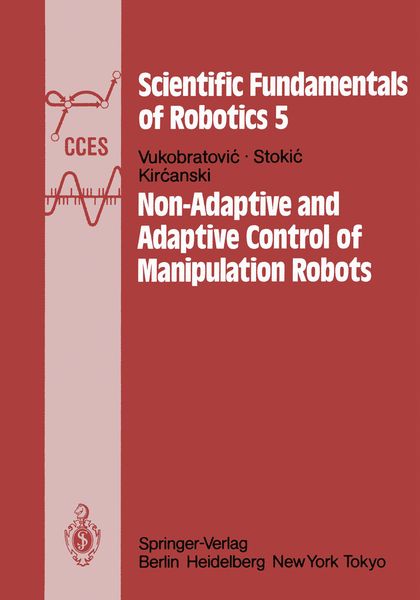
Non-Adaptive and Adaptive Control of Manipulation Robots

Fr. 137.00

inkl. gesetzl. MwSt., Versandkostenfrei


Beschreibung

Produktdetails

Einband

Taschenbuch

Erscheinungsdatum

22.12.2011

Verlag

Springer Berlin

Seitenzahl

384

Maße (L/B/H)

24.4/17/2.2 cm

Gewicht

681 g

Auflage

Softcover reprint of the original 1st ed. 1985

Sprache

Englisch

ISBN

978-3-642-82203-2

Beschreibung

Produktdetails

Einband

Taschenbuch

Erscheinungsdatum

22.12.2011

Verlag

Springer Berlin

Seitenzahl

384

Maße (L/B/H)

24.4/17/2.2 cm

Gewicht

681 g

Auflage

Softcover reprint of the original 1st ed. 1985

Sprache

Englisch

ISBN

978-3-642-82203-2

Herstelleradresse

Springer-Verlag GmbH
Tiergartenstr. 17
69121 Heidelberg
DE

Email: ProductSafety@springernature.com

Kundinnen und Kunden meinen

0 Bewertungen

Informationen zu Bewertungen

Zur Abgabe einer Bewertung ist eine Anmeldung im Konto notwendig. Die Authentizität der Bewertungen wird von uns nicht überprüft. Wir behalten uns vor, Bewertungstexte, die unseren Richtlinien widersprechen, entsprechend zu kürzen oder zu löschen.

Die Bewertungen sind nach Format, Anzahl Sterne und Datum sortiert.

Verfassen Sie die erste Bewertung zu diesem Artikel

Helfen Sie anderen Kund*innen durch Ihre Meinung

Kundinnen und Kunden meinen

0 Bewertungen filtern

  • Produktbild: Non-Adaptive and Adaptive Control of Manipulation Robots
  • Produktbild: Non-Adaptive and Adaptive Control of Manipulation Robots
  • 1 Computer-Assisted Generation of Robot Dynamic Models in Analytical Form.- 1.1. Introduction.- 1.2. A closed form dynamic model of a robotic manipulator.- 1.3. Analytical representation of the variables of dynamic model.- 1.4. Construction of real-time program code.- 1.5. Example.- References.- 2 Non-Adaptive Control of Manipulation Robots with Variable Parameters.- 2.1. Introduction.- 2.2. Mathematical model of manipulation robots and control task definition.- 2.2.1. Mathematical model.- 2.2.2. Control task definition.- 2.3. Survey of non-adaptive control algorithms.- 2.3.1. Optimal control synthesis.- 2.3.2. Optimal regulator.- 2.3.3. “Inverse problem” technique.- 2.3.4. Force feedback.- 2.3.5. Decoupled control.- 2.3.6. Decentralized control.- 2.3.7. Other approaches.- 2.4. Synthesis of local controllers.- 2.4.1. Optimal servosystems.- 2.4.2. Robust servo-controllers.- 2.4.3. Synthesis of local controller by pole-placement method.- 2.4.4. Local control task.- 2.5. Stability analysis of manipulation robots.- 2.6. Global control synthesis.- 2.7. Example.- Conclusion.- References.- Appendix 2A Analysis of the Influence of Actuator Models Complexity on Manipulator Control synthesis.- Appendix 2B Practical Stability of Manipulation Robots.- 3 Adaptive Control Algorithms.- 3.1. Introduction.- 3.2. Centralized adaptive control of robot manipulators.- 3.2.1. Self-tuning control strategy.- 3.2.2. Centralized reference model-following control.- 3.2.3. Indirect centralized adaptive control.- 3.3. Decentralized adaptive control strategy for mechanical manipulators.- 3.3.1. Self-tuning local controllers.- 3.3.2. Decentralized reference model-following control.- 3.3.3. Indirect decentralized adaptive control.- References.- 4 Computer-Aided Control Synthesis.- 4.1. Introduction.- 4.2. Software package for computer aided synthesis.- 4.2.1. Block for setting data on manipulator structure.- 4.2.2. Block for calculating desired kinematic trajectory.- 4.2.3. Block for setting dynamic parameters.- 4.2.4. Block for setting data on actuators.- 4.2.5. Block for synthesis of nominal dynamics.- 4.2.6. Block for setting control task.- 4.2.7. Block for local control synthesis.- 4.2.8. Block for stability analysis of decentralized control.- 4.2.9. Block for global control synthesis.- 4.2.10. Block for adaptive control synthesis.- 4.2.11. Block for discrete-time control synthesis.- 4.2.12. Block for simulation.- 4.3. Example.- Conclusion.- References.- 5 Implementation of Control Algorithms.- 5.1. Introduction.- 5.2. Concept of general purpose controller.- 5.3. Numerical complexity of control laws.- 5.3.1. Numerical complexity of dynamic models.- 5.3.2. Numerical complexity of non-adaptive decentralized control laws.- 5.3.3. Numerical complexity of adaptive control laws.- 5.4. Parameter identification.- 5.5. Microprocessor implementation of non-adaptive control laws.- References.