• Produktbild: Beam-Foil Spectroscopy
  • Produktbild: Beam-Foil Spectroscopy
Band 1

Beam-Foil Spectroscopy

Fr. 72.90

inkl. gesetzl. MwSt., Versandkostenfrei


Beschreibung

Produktdetails

Einband

Taschenbuch

Erscheinungsdatum

13.12.2011

Herausgeber

S. Bashkin

Verlag

Springer Berlin

Seitenzahl

318

Maße (L/B/H)

24.4/17/1.9 cm

Gewicht

581 g

Auflage

1976

Sprache

Englisch

ISBN

978-3-642-81054-1

Beschreibung

Produktdetails

Einband

Taschenbuch

Erscheinungsdatum

13.12.2011

Herausgeber

S. Bashkin

Verlag

Springer Berlin

Seitenzahl

318

Maße (L/B/H)

24.4/17/1.9 cm

Gewicht

581 g

Auflage

1976

Sprache

Englisch

ISBN

978-3-642-81054-1

Herstelleradresse

Springer-Verlag GmbH
Tiergartenstr. 17
69121 Heidelberg
DE

Email: ProductSafety@springernature.com

Kundinnen und Kunden meinen

0 Bewertungen

Informationen zu Bewertungen

Zur Abgabe einer Bewertung ist eine Anmeldung im Konto notwendig. Die Authentizität der Bewertungen wird von uns nicht überprüft. Wir behalten uns vor, Bewertungstexte, die unseren Richtlinien widersprechen, entsprechend zu kürzen oder zu löschen.

Die Bewertungen sind nach Format, Anzahl Sterne und Datum sortiert.

Verfassen Sie die erste Bewertung zu diesem Artikel

Helfen Sie anderen Kund*innen durch Ihre Meinung

Kundinnen und Kunden meinen

0 Bewertungen filtern

  • Produktbild: Beam-Foil Spectroscopy
  • Produktbild: Beam-Foil Spectroscopy
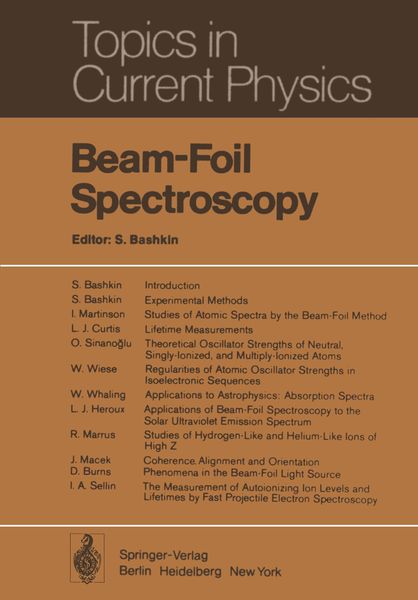
  • 1. Experimental Methods.- 1.1 Accelerators.- 1.2 Ion Sources.- 1.3 Beam Requirements and Limitations.- 1.4 Mass Analyzers.- 1.5 Target Chambers.- 1.6 Targets.- 1.7 Analytical Devices.- 1.8 Detectors.- 1.9 Detection Geometry and Line Width.- 1.10 Beam Monitors.- 1.11 External Fields.- 1.12 Concluding Remarks.- References.- 2. Studies of Atomic Spectra by the Beam-Foil Method.- 2.1 Experimental Methods.- 2.2 Results of Spectral Studies.- 2.2.1 Previously Incompletely-Studied Systems.- 2.2.2 Hydrogen-Like Levels.- 2.2.3 Displaced Terms.- 2.2.4 Multiply-Excited States.- References.- 3. Lifetime Measurements.- 3.1 Lifetime Studies as a Basic Area of Atomic Physics.- 3.1.1 The Need for Lifetime Measurements.- 3.1.2 Lifetime Measurements Prior to the Development of the Beam-Foil Technique.- 3.2 Definitions of Basic Quantities.- 3.2.1 Instantaneous Populations.- 3.2.2 Transition Probabilities and Oscillator Strengths.- 3.3 Measurement of Beam-Foil-Excited Decay Curves.- 3.3.1 Strengths and Limitations of the Beam-Foil Technique.- 3.3.2 Details of Beam-Foil Apparatus and Measurement Procedures.- 3.3.3 Cascade Repopulation — A Tractable Problem.- 3.4 Time Dependence of the Measured Decay Curves.- 3.4.1 Solution of the Driven Coupled Linear Rate Equations.- 3.4.2 A Quantitative Indicator of Level Repopulation -The Replenishment Ratio.- 3.4.3 Intensity Relationships for an Aligned Source.- 3.4.4 Distortions Which Preserve the Mean-Life Content of a Decay Curve.- 3.5 Mean-Life Extraction by Exponential Fits to Individual Decay Curves.- 3.5.1 Maximum Likelihood Method.- 3.5.2 Non-Linear Least Squares Method.- 3.5.3 Differentiation and Integration of Decay Curves.- 3.5.4 Expansion About a Close-Lying Mean Life.- 3.5.5 Fourier-Transform Methods.- 3.5.6 Method of Moments.- 3.6 Mean-Life Extraction by Joint Analysis of Cascade-Related Decay Curves.- 3.6.1 Ambiguities in the Assignment of Fitted Mean Lives.- 3.6.2 Constrained Fits.- 3.6.3 Linearly-Fitted Normalizations of Cascade-Related Decay Curves.- 3.7 Cascade-Free Methods.- 3.7.1 Beam-Foil Coincidence Techniques.- 3.7.2 Use of Alignment to Discriminate Against Cascades.- 3.7.3 Laser Excitation.- 3.8 Concluding Remarks.- References.- 4. Theoretical Oscillator Strengths of Neutral, Singly-Ionized, and Multiply-Ionized Atoms: The Theory, Comparisons with Experiment, and Critically-Evaluated Tables with New Results.- 4.1 The Non-Closed-Shell Many-Electron Theory.- 4.2 A Spectroscopic Interpretation of the Charge Wave Function.- 4.3 NCMET Calculations,.- 4.3.1 The L2, S2 Symmetry of ?c.- 4.3.2 Dipole Length vs. Dipole Velocity.- 4.3.3 Semi-Internal Orbital Variations (Type A, Lowest-of-Symmetry, States).- 4.4 States Not Lowest of Their Symmetry.- 4.4.1 Neutral and Singly-Ionized Atoms.- 4.4.2 Variational Collapse and Its Avoidance.- 4.5 New Oscillator Strengths for Intershell (KL ? KL’[M]) Transitions to Pre-Rydberg Levels (V ? pR).- 4.6 Further Examination of Remaining Correlation Effects on Oscillator Strengths with NCMET.- 4.7 Conclusion.- References.- 5. Regularities of Atomic Oscillator Strengths in Isoelectronic Sequences.- 5.1 Theoretical Basis.- 5.1.1 Definitions.- 5.1.2 Nuclear Charge-Dependence of the f-Value.- 5.1.3 Investigation of Lim 1/Z ? 0.- 5.2 Discussion of Established Trends.- 5.2.1 Basic Trends.- 5.2.2 Curves With a Maximum.- 5.2.3 Curves With a Minimum.- 5.2.4 Anomalous Curves.- 5.3 Oscillator-Strength Distributions in a Spectral Series Along an Isoelectronic Sequence.- 5.4 Relativistic Effects and Corrections.- 5.5 Summary.- References.- 6. Applications to Astrophysics; Absorption Spectra. By Ward Whaling.- 6.1 Branching Ratios.- 6.1.1 Light Sources.- 6.1.2 Spectrometers.- 6.1.3 Spectrometer Cali bration.- 6.1.4 Selection of Branches to be Measured.- 6.2 Curve-of-Growth Analysis.- 6.2.1 Construction of a Curve-of-Growth.- 6.2.2 Internal-Consistency Test.- 6.2.3 Comparison of Transition Probabilities for Different Transitions.- 6.2.4 Solar-Abundance Determination.- 6.3 Beam-Foil-Spectroscopy Measurements Needed for Astrophysical Applications.- References.- 7. Applications of Beam-Foil Spectroscopy to the Solar Ultraviolet Emission Spectrum.- 7.1 Ionization Balance in the Chromosphere and Corona.- 7.2 Excitation Balance in the Chromosphere and Corona.- 7.3 Line-Ratio Measurements of Electron Temperature.- 7.4 Line-Ratio Measurements of Electron Density.- 7.5 The Determination of Chromospheric-Coronal Abundances.- 7.6 Beam-Foil Measurements Needed for Diagnostic Methods.- References.- 8. Studies of Hydrogen-Like and Helium-Like Ions of High Z.- 8.1 The Lamb Shift in the One-Electron System.- 8.1.1 Quenching Measurements on Fast Ion Beams of High Z.- 8.1.2 Lamb Shift in Hydrogen Using Separated Oscillating Fields.- 8.2 Lamb Shift in Two-Electron Systems.- 8.3 Radiative Decay of the 2S1/2 Metastable State of the One-Electron System.- 8.3.1 Theory.- 8.3.2 Experiments.- 8.4 Forbidden Radiative Decay in the n=2 State of the Two-Electron System.- 8.4.1 Radiative Decay from 2 1S0.- 8.4.2 Radiative Decay from 2 3S1.- 8.4.3 Radiative Decay from 2 3P2.- 8.4.4 Radiative Decay from 2 3P1.- 8.5 Study of Doubly-Excited Configurations in the Two-Electron System.- References.- 9. Coherence, Alignment, and Orientation Phenomena in the Beam-Foil Light Source.- 9.1 General Theoretical Considerations.- 9.1.1 The Emission Process.- 9.1.2 Symmetry Considerations.- 9.2 Alignment and Linear Polarization.- 9.2.1 Zero-Field Measurements.- 9.2.2 Electric Field.- 9.2.3 Magnetic Field.- 9.3 Orientation and Circular Polarization.- 9.3.1 Zero Field.- 9.3.2 Magnetic Field Measurements.- 9.3.3 The Quadratic Stark Effect.- References.- 10. The Measurement of Autoionizing Ion Levels and Lifetimes by Fast Projectile Electron Spectroscopy.- 10.1 The Fast-Projectile Electron Spectroscopy (FPES) Method.- 10.1.1 Choice of an Analyzer.- 10.1.2 Properties of a Cylindrical-Mirror Analyzer Suitable for FPES.- 10.1.3 Kinematic Modification of Analyzer Optimization Criteria.- 10.1.4 Relativistic Corrections to Analyzer Performance.- 10.1.5 Broadening from Transverse Velocity Spread.- 10.1.6 Further Kinematic Considerations: Sample Estimates of Net Line Widths Observed in FPES.- 10.1.7 Summary of the Advantages of FPES.- 10.2 Examples of FPES.- 10.2.1 Spectra of Long-Lived States of the Li-Like, Be-Like, and B-Like Ions.- 10.2.2 Spectra of Long-Lived Core-Excited States of Sodium-Like Chlorine.- 10.2.3 Core-Excited States of the Neutral and Nearly-Neutr?l Alkali Metals.- 10.2.4 Electron Background in FPES with Foil Targets.- 10.2.5 Electron Background in FPES with Gas Targets.- 10.3 The Measurement of Auger Lifetimes by FPES.- 10.3.1 Auger Lifetimes of Metastable Lithium-Like Ions.- 10.3.2 Examples of Lifetimes from Optical Decay Channels of Auger-Emitting Levels.- References.- APPENDIX (Up-dated bibliography).