Produktbild: Dissipative Systems in Quantum Optics
Band 27

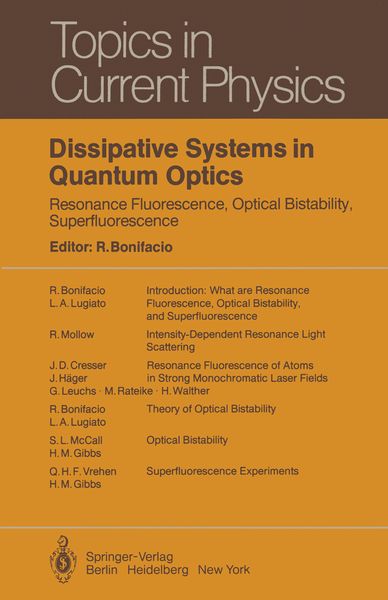
Dissipative Systems in Quantum Optics Resonance Fluorescence, Optical Bistability, Superfluorescence

Fr. 72.90

inkl. gesetzl. MwSt., Versandkostenfrei


Beschreibung

Produktdetails

Einband

Taschenbuch

Erscheinungsdatum

08.12.2011

Herausgeber

R. Bonifacio

Verlag

Springer Berlin

Seitenzahl

154

Maße (L/B/H)

24.4/17/1 cm

Gewicht

309 g

Auflage

Softcover reprint of the original 1st ed. 1982

Sprache

Englisch

ISBN

978-3-642-81719-9

Beschreibung

Produktdetails

Einband

Taschenbuch

Erscheinungsdatum

08.12.2011

Herausgeber

R. Bonifacio

Verlag

Springer Berlin

Seitenzahl

154

Maße (L/B/H)

24.4/17/1 cm

Gewicht

309 g

Auflage

Softcover reprint of the original 1st ed. 1982

Sprache

Englisch

ISBN

978-3-642-81719-9

Herstelleradresse

Springer-Verlag KG
Sachsenplatz 4-6
1201 Wien
AT

Email: GPSR Kontakt

Noch keine Bewertungen vorhanden

Verfassen Sie die erste Bewertung zu diesem Artikel

Helfen Sie anderen Kundinnen und Kunden durch Ihre Meinung.

Kundinnen und Kunden meinen

Bewertungen (0)

  • Produktbild: Dissipative Systems in Quantum Optics
  • 1. Introduction: What are Resonance Fluorescence, Optical Bistability, and Superfluorescence..- 1.1 General Remarks.- 1.2 Resonance Fluorescence.- 1.3 Superfluorescence.- 1.4 Optical Bistability.- References.- 2. Intensity-Dependent Resonance Light Scattering.- 2.1 General Method of Solution.- 2.1.1 Approximations and Limiting Assumptions.- 2.1.2 Optical Bloch Equations.- 2.1.3 The Use of a c-Number Incident Field.- 2.1.4 Spectrum of Scattered Field.- 2.2 The Closed Two-Level System.- 2.2.1 Radiative Relaxation.- 2.2.2 Collisional Relaxation.- 2.2.3 General Solution for the Closed Two-Level System.- 2.3 The Open Two-Level System.- 2.3.1 Spectrum for Transitions Involving Other Levels.- 2.3.2 Effect of Atomic Decay on the Laser-Coupled Spectrum.- References.- 3. Resonance Fluorescence of Atoms in Strong Monochromatic Laser Fields.- With 28 Figures.- 3.1 Overview.- 3.2 Theoretical Treatments of Interaction of Atoms with Intense Monochromatic Fields.- 3.2.1 Simple AC Stark Effect: Spectrum.- 3.2.2 Simple AC Stark Effect: Total Scattered Intensity, Intensity Correlations, and Photon Antibunching.- 3.2.3 Variants of the AC Stark Effect.- 3.3 Experiments on the Interaction of Atoms with Intense Monochromatic Fields.- 3.3.1 Emission Spectrum.- 3.3.2 Total Emitted Intensity: Level Crossing Experiments.- a) Level Crossing Experiment.- b) Theoretical Considerations.- c) Measurements.- 3.3.3 Intensity Correlation: Photon Antibunching.- References.- 4. Theory of Optical Bistability.- 4.1 Background.- 4.2 Theory of Absorptive OB in a Ring Cavity.- 4.2.1 Semiclassical Theory.- a) Exact Treatment of the Stationary Situation.- b) Mean-Field Approach: Steady-State Analysis.- c) Mean-Field Approach: Transient Behavior.- d) Complete Linear Stability Analysis.- e) Self-Pulsing in Optical Bistability.- 4.2.2 Quantum-Statistical Theory.- a) Spectrum of Transmitted Light.- b) Photon Statistics of the Transmitted Light.- 4.3 Theory of Mixed Absorptive-Dispersive OB in a Ring Cavity.- References.- 5. Optical Bistability.- 5.1 Background.- 5.1.1 Early Work on Absorptive Optical Bistability.- 5.1.2 First Observation of Optical Bistability; Discovery of Dispersive Optical Bistability.- 5.1.3 Hybrid Optical Bistability.- 5.2 Models of Optical Bistability in a Fabry-Perot Cavity.- 5.2.1 Boundary Conditions.- 5.2.2 Nonlinear Medium.- 5.2.3 Conditions for Dispersive Bistability.- 5.3 Experimental Findings.- 5.3.1 Na Vapor.- 5.3.2 Ruby.- 5.3.3 Kerr Materials.- 5.3.4 Thermal Optical Bistability.- 5.3.5 Semiconductors.- 5.4 Future Prospects.- 5.4.1 Optical Processing and Computing.- 5.4.2 Theoretical Limits on Minimum Size.- 5.4.3 Approaching Theoretical Limits.- 5.4.4 Comparison with Other Technologies.- 5.4.5 Quantum Aspects.- 5.4.6 Preferred Wavelengths.- References.- 6. Superfluorescence Experiments.- 6.1 Background.- 6.2 Experimental Parameters.- 6.2.1 Conditions for Superfluorescence.- 6.2.2 Experimental Techniques.- 6.2.3 Survey of Experiments.- 6.2.4 Details of the Cesium Experiment.- 6.3 Single Pulses.- 6.3.1 Observations of Single Pulses in Cesium.- 6.3.2 Maxwell-Bloch Equations and Ringing.- 6.3.3 Comparison with Computer Simulations.- 6.3.4 Multiple-Pulse SF and Transverse Effects.- 6.4 The Initiation of Superfluorescence.- 6.4.1 Theory.- 6.4.2 Direct Measurement of ?0.- 6.4.3 Quantum Fluctuations.- 6.5 Sample Dimensions.- 6.5.1 Sample Length.- 6.5.2 Fresnel Number and Spatial Coherence.- 6.6 Level Degeneracies.- 6.6.1 Quantum Beats from Coupled Transitions.- 6.6.2 Beats from Independent Transitions.- 6.6.3 Polarization Effects.- 6.7 Summary.- References.