• Produktbild: Hyperfine Interactions of Radioactive Nuclei
  • Produktbild: Hyperfine Interactions of Radioactive Nuclei
Band 31

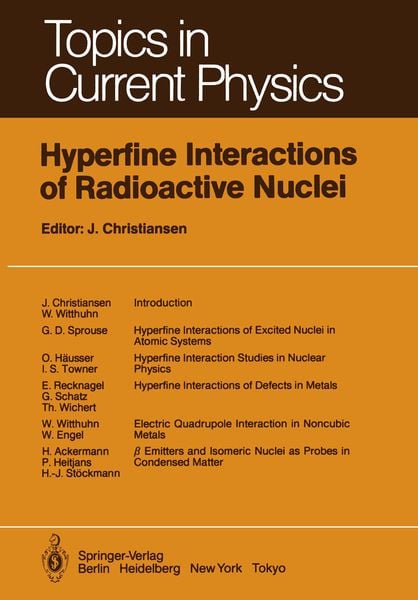
Hyperfine Interactions of Radioactive Nuclei

Fr. 72.90

inkl. gesetzl. MwSt., Versandkostenfrei


Beschreibung

Produktdetails

Einband

Taschenbuch

Erscheinungsdatum

22.12.2011

Herausgeber

J. Christiansen

Verlag

Springer Berlin

Seitenzahl

368

Maße (L/B/H)

24.4/17/2.1 cm

Gewicht

668 g

Auflage

Softcover reprint of the original 1st ed. 1983

Sprache

Englisch

ISBN

978-3-642-81971-1

Beschreibung

Produktdetails

Einband

Taschenbuch

Erscheinungsdatum

22.12.2011

Herausgeber

J. Christiansen

Verlag

Springer Berlin

Seitenzahl

368

Maße (L/B/H)

24.4/17/2.1 cm

Gewicht

668 g

Auflage

Softcover reprint of the original 1st ed. 1983

Sprache

Englisch

ISBN

978-3-642-81971-1

Herstelleradresse

Springer-Verlag KG
Sachsenplatz 4-6
1201 Wien
AT

Email: ProductSafety@springernature.com

Kundinnen und Kunden meinen

0 Bewertungen

Informationen zu Bewertungen

Zur Abgabe einer Bewertung ist eine Anmeldung im Konto notwendig. Die Authentizität der Bewertungen wird von uns nicht überprüft. Wir behalten uns vor, Bewertungstexte, die unseren Richtlinien widersprechen, entsprechend zu kürzen oder zu löschen.

Die Bewertungen sind nach Format, Anzahl Sterne und Datum sortiert.

Verfassen Sie die erste Bewertung zu diesem Artikel

Helfen Sie anderen Kund*innen durch Ihre Meinung

Kundinnen und Kunden meinen

0 Bewertungen filtern

  • Produktbild: Hyperfine Interactions of Radioactive Nuclei
  • Produktbild: Hyperfine Interactions of Radioactive Nuclei
  • 1. Introduction.- 1.1 Perturbed Angular Distribution Techniques.- 1.1.1 Magnetic Hyperfine Interaction.- 1.1.2 Electric Quadrupole Hyperfine Interaction.- 1.1.3 The Stroboscopic Method.- 1.2 Perturbed Angular Correlation Techniques.- 1.3 Nuclear Magnetic Resonance on ?-Emitting Nuclei.- References.- 2. Hyperfine Interactions of Excited Nuclei in Atomic Systems.- 2.1 Free Atoms in Flight-The Recoil Distance Method.- 2.1.1 Calculation of the Perturbation Function GKK(t).- 2.1.2 Fine-Structure Beats.- 2.1.3 Hyperfine Interactions in Free Atoms.- 2.1.4 Hydrogenlike Atoms.- 2.1.5 He-Like Atoms.- 2.1.6 Li-Like Atoms.- 2.1.7 Na-Like Atoms.- 2.1.8 Other Atomic Systems in Vacuum.- 2.2 Atoms in Gases.- 2.2.1 Fast Atoms in Gases.- 2.2.2 Statistical Approach.- 2.2.3 Nuclear Spin Dependence.- 2.2.4 Relaxing the Condition 1/2?C «1.- 2.2.5 The Approach to Thermal Equilibrium-Chemical Effects.- 2.2.6 Thermalized Atoms in Rare-Gas Hosts.- 2.2.7 Pressure Dependence of the Alignment.- 2.2.8 Magnetic Field Dependence.- 2.3 Magnetic Decoupling Measurements in Vacuum.- 2.3.1 Fields Parallel to the Quantization (Beam) Axis.- 2.3.2 Strong Magnetic Fields Transverse to the Beam Direction.- 2.4 New Methods and Future Directions.- References.- 3. Hyperfine Interaction Studies in Nuclear Physics.- 3.1 Overview.- 3.2 Hyperfine Hamiltonian and Nuclear Moments.- 3.2.1 Atomic Isotope Shifts and Nuclear Mean-Square Radii.- 3.2.2 Quadrupole Interactions and Nuclear Quadrupole Moments.- a) Quadrupole Interactions in Atoms.- b) Quadrupole Interaction Non-Cubic Lattices.- c) Calibration of Electric Field Gradients.- 3.2.3 Magnetic Interactions and Nuclear Magnetic Moments.- a) Magnetic Interactions in Atoms.- b) Magnetic Interactions in Solids.- 3.3 Laser Spectroscopy and Hyperfine Structure of Exotic Nuclear States.- 3.4 Nuclear Moments of High-Spin States.- 3.4.1 The Deformation of High-Spin Yrast Isomers.- 3.4.2 The g Factors of Collective High-Spin States.- 3.5 Magnetic Moments of Simple Shell-Model Configurations.- 3.5.1 Meson Exchange Currents.- 3.5.2 First-Order Core Polarization.- 3.5.3 High-Spin Isomers of Two-Particle Configuration.- 3.5.4 Single-Particle States in Other Mass Regions.- 3.5.5 Core-Polarization Blocking.- 3.5.6 Second-Order Core Polarization.- 3.5.7 Magnetic Moments of ? Emitters.- 3.6 Hyperfine Interactions in Nuclear ? Decay.- 3.6.1 Theoretical Position.- 3.6.2 Experimental NMR Techniques for ? Emitters.- 3.6.3 Experimental Results.- 3.6.4 Discussion.- References.- 4. Hyperfine Interactions of Defects in Metals.- 4.1 Relevant Solid State and Nuclear Physics Aspects.- 4.1.1 Defects in Metals.- a) Defects After Irradiation.- b) Defects in Thermal Equilibrium.- c) Vacancy and Interstitial Configurations.- d) Migration of Defects.- e) Interaction of Lattice Defects with Impurity Atoms.- f) Some Experimental Aspects in the Determination of Defect Properties.- 4.1.2 Hyperfine Interaction Parameters.- a) Electric Hyperfine Interaction.- b) Magnetic and Combined Hyperfine Interaction.- 4.1.3 Nuclear Probes.- 4.2 Hyperfine Investigations of Defects.- 4.2.1 Experiments with Radioactive Sources.- a) Diamagnetic fcc Metals.- b) Diamagnetic bcc Metals.- c) Ferromagnetic Cubic Metals.- d) Hcp Metals.- e) Summary.- 4.2.2 In-Beam Experiments.- a) Cubic Metals.- b) Noncubic Metals.- c) Summary of Nuclear Reaction Experiments.- References.- 5. Electric Quadrupole Interaction in Noncubic Metals.- 5.1 Electric Quadrupole Hyperfine Interaction.- 5.2 Experimental Methods.- 5.2.1 Energy Methods.- a) Specific Heat Measurements.- b) Nuclear Orientation.- c) Mossbauer Effect.- 5.2.2 Precession Methods.- a) Nuclear Resonance Methods.- b) Perturbed Angular Correlation (Distribution) Methods.- 5.3 Experimental Data and Systematic Trends.- 5.3.1 The Universal Correlation.- 5.3.2 The Temperature Dependence of the EFG.- 5.3.3 The Pressure Dependence of the EFG.- 5.3.4 Impurity Valence Effects of the EFG.- 5.4 The EFG in Metals.- 5.4.1 Anti shielding.- 5.4.2 The Lattice Sum.- 5.4.3 Wave Function Approaches.- a) Wannier Functions.- b) Augmented Plane Waves.- c) Orthogonalized Plane Waves.- d) Fermi Surface Electrons.- 5.4.4 Potential Approaches.- 5.4.5 Temperature Dependence.- a) Fermi Surface Electrons.- b) Wave Function Approach.- c) Potential Approach.- 5.4.6 Pressure and Concentration Dependence.- 5.5 Conclusion.- 5.6 Appendix.- Table of Experimental Data on Quadrupole Interaction in Noncubic Metals.- References.- 6. ? Emitters and Isomeric Nuclei as Probes in Condensed Matter.- 6.1 Theory.- 6.1.1 Hamiltonian and Energy Levels.- 6.1.2 Reorientation in Electromagnetic Fields.- 6.1.3 Relaxation.- a) Nuclear Relaxation by Magnetic Coupling to Conduction Electrons.- b) Relaxation by Fluctuating Nuclear Dipole-Dipole Interactions.- c) Quadrupolar Relaxation Induced by Atomic Motion.- d) Relaxation by Quadrupolar Spin-Phonon Coupling.- 6.2 Experimental Methods.- 6.2.1 Experiments Using ? Emitters.- a) Probe Creation by Capture of Polarized Thermal Neutrons.- b) Probe Creation by Fast Particle Reactions with Selected Recoil Angle.- c) Probe Creaction by Reactions with Polarized Fast Particles.- d) Probe Creation by Fast Particle Reactions and Subsequent Polarization in the Stopper.- 6.2.2 Experiments Using Isomeric ? Emitters.- 6.3 Metals.- 6.3.1 Static Interactions, NMR Spectra.- a) Magnetic Energy Splitting.- b) Energy Splitting in the Presence of Quadrupole Interactions.- 6.3.2 Relaxation of Nuclear Orientation.- a) Solid Metals.- b) Liquid Metals.- 6.4 Insulators.- 6.4.1 Static Interactions, NMR Spectra.- a) Lithium Compounds.- b) Fluorine Compounds.- c) Probe Nuclides in the Mass Number Range 24 ? A ? 39.- d) Indium and Silver Compounds.- 6.4.2 Relaxation of Nuclear Orientation.- a) Lithium and Fluorine Compounds.- b) Indium and Silver Compounds.- 6.5 Tabular Summary.- References.