• Produktbild: ARMA Model Identification
  • Produktbild: ARMA Model Identification

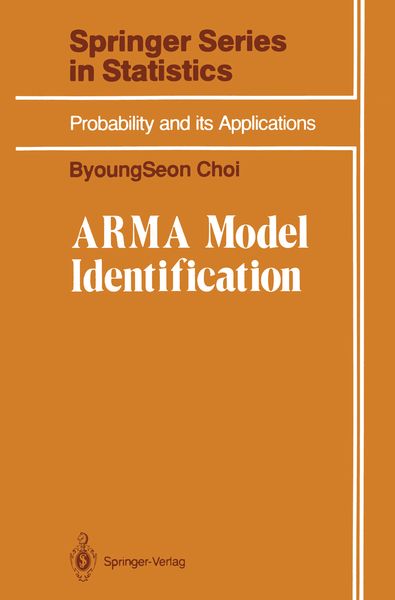
ARMA Model Identification

Fr. 72.90

inkl. gesetzl. MwSt., Versandkostenfrei


Beschreibung

Produktdetails

Einband

Taschenbuch

Erscheinungsdatum

19.03.2012

Verlag

Springer Us

Seitenzahl

200

Maße (L/B/H)

23.5/15.5/1.2 cm

Gewicht

335 g

Auflage

Softcover reprint of the original 1st ed. 1992

Sprache

Englisch

ISBN

978-1-4613-9747-2

Beschreibung

Produktdetails

Einband

Taschenbuch

Erscheinungsdatum

19.03.2012

Verlag

Springer Us

Seitenzahl

200

Maße (L/B/H)

23.5/15.5/1.2 cm

Gewicht

335 g

Auflage

Softcover reprint of the original 1st ed. 1992

Sprache

Englisch

ISBN

978-1-4613-9747-2

Herstelleradresse

Springer-Verlag KG
Sachsenplatz 4-6
1201 Wien
AT

Email: GPSR Kontakt

Noch keine Bewertungen vorhanden

Verfassen Sie die erste Bewertung zu diesem Artikel

Helfen Sie anderen Kundinnen und Kunden durch Ihre Meinung.

Kundinnen und Kunden meinen

Bewertungen (0)

  • Produktbild: ARMA Model Identification
  • Produktbild: ARMA Model Identification
  • 1 Introduction.- 1.1 ARMA Model.- 1.2 History.- 1.3 Algorithms.- 1.3.1 AR Parameters.- 1.3.2 MA Parameters.- 1.4 Estimation.- 1.4.1 Extended Yule-Walker Estimates.- 1.4.2 Maximum Likelihood Estimates.- 1.5 Nonstationary Processes.- 1.5.1 Sample ACRF of a Nonstationary Process.- 1.5.2 Iterated Least Squares Estimates.- 1.6 Additional References.- 2 The Autocorrelation Methods.- 2.1 Box and Jenkins’ Method.- 2.2 The Inverse Autocorrelation Method.- 2.2.1 Inverse Autocorrelation Function.- 2.2.2 Estimates of the Spectral Density.- 2.2.3 Estimates of the IACF.- 2.2.4 Identification Using the IACF.- 2.3 Additional References.- 3 Penalty Function Methods.- 3.1 The Final Prediction Error Method.- 3.2 Akaike’s Information Criterion.- 3.2.1 Kullback-Leibler Information Number.- 3.2.2 Akaike’s Information Criterion.- 3.3 Generalizations.- 3.4 Parzen’s Method.- 3.5 The Bayesian Information Criterion.- 3.5.1 Schwarz’ Derivation.- 3.5.2 Kashyap’s Derivation.- 3.5.3 Shortest Data Description.- 3.5.4 Some Comments.- 3.6 Hannan and Quinn’s Criterion.- 3.7 Consistency.- 3.8 Some Relations.- 3.8.1 A Bayesian Interpretation.- 3.8.2 The BIC and Prediction Errors.- 3.8.3 The AIC and Cross-Validations.- 3.9 Additional References.- 4 Innovation Regression Methods.- 4.1 AR and MA Approximations.- 4.2 Hannan and Rissanen’s Method.- 4.2.1 A Three-Stage Procedure.- 4.2.2 Block Toeplitz Matrices.- 4.2.3 A Modification of the Whittle Algorithm.- 4.2.4 Some Modifications.- 4.3 Koreisha and Pukkila’s Method.- 4.4 The KL Spectral Density.- 4.5 Additional References.- 5 Pattern Identification Methods.- 5.1 The 3-Pattern Method.- 5.1.1 The Three Functions.- 5.1.2 Asymptotic Distributions.- 5.1.3 Two Chi-Squared Statistics Ill.- 5.2 The R and S Array Method.- 5.2.1 The R and S Patterns.- 5.2.2 Asymptotic Distributions.- 5.2.3 The RS Array.- 5.3 The Corner Method.- 5.3.1 Correlation Determinants.- 5.3.2 Asymptotic Distribution.- 5.4 The GPAC Methods.- 5.4.1 Woodward and Gray’s GPAC.- 5.4.2 Glasbey’s GPAC.- 5.4.3 Takemura’s GPAC.- 5.5 The ESACF Method.- 5.6 The SCAN Method.- 5.6.1 Eigen-analysis.- 5.6.2 The SCAN Method.- 5.7 Woodside’s Method.- 5.8 Three Systems of Equations.- 5.9 Additional References.- 6 Testing Hypothesis Methods.- 6.1 Three Asymptotic Test Procedures.- 6.2 Some Test Statistics.- 6.3 The Portmanteau Statistic.- 6.4 Sequential Testing Procedures.- 6.5 Additional References.