
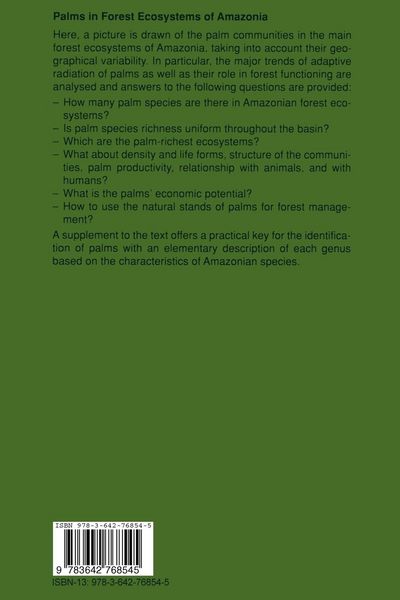
• Produktbild: Palms in Forest Ecosystems of Amazonia
  • Produktbild: Palms in Forest Ecosystems of Amazonia
Band 95

Palms in Forest Ecosystems of Amazonia

Aus der Reihe Ecological Studies

Fr. 137.00

inkl. gesetzl. MwSt., Versandkostenfrei


Beschreibung

Produktdetails

Einband

Taschenbuch

Erscheinungsdatum

07.01.2012

Verlag

Springer Berlin

Seitenzahl

226

Maße (L/B/H)

23.5/15.5/1.4 cm

Gewicht

376 g

Auflage

Softcover reprint of the original 1st ed. 1992

Sprache

Englisch

ISBN

978-3-642-76854-5

Beschreibung

Produktdetails

Einband

Taschenbuch

Erscheinungsdatum

07.01.2012

Verlag

Springer Berlin

Seitenzahl

226

Maße (L/B/H)

23.5/15.5/1.4 cm

Gewicht

376 g

Auflage

Softcover reprint of the original 1st ed. 1992

Sprache

Englisch

ISBN

978-3-642-76854-5

Herstelleradresse

Springer-Verlag KG
Sachsenplatz 4-6
1201 Wien
AT

Email: GPSR Kontakt

Noch keine Bewertungen vorhanden

Verfassen Sie die erste Bewertung zu diesem Artikel

Helfen Sie anderen Kundinnen und Kunden durch Ihre Meinung.

Kundinnen und Kunden meinen

Bewertungen (0)

  • Produktbild: Palms in Forest Ecosystems of Amazonia
  • Produktbild: Palms in Forest Ecosystems of Amazonia
  • 1 Amazonian Palm Flora - General Considerations.- 1.1 Richness of Amazonian Palm Flora.- 1.2 The Major Groups of the Amazonian Palms.- 1.3 Palm Distribution in Amazonia.- 1.3.1 Spruce’s Palm Regions.- 1.3.2 Distribution of Genera in Amazonia.- 1.3.3 Distribution of Species in Amazonia.- 1.4 Conclusion.- 2 Life Forms of Amazonian Palms.- 2.1 Growth Models of Amazonian Palms.- 2.2 What Kind of Plants Are the Amazonian Palms?.- 2.2.1 Description of Palm Life Forms.- 2.2.2 Basal Branching.- 2.2.3 Leaves.- 2.2.4 Stems.- 2.2.5 Roots.- 3 Palm Communities in the Forest Ecosystems of Amazonia.- 3.1 Introduction.- 3.2 Methods.- 3.3 Unflooded Forests.- 3.3.1 Terra Firme Forests.- 3.3.2 Forests on Sandy Soils.- 3.4 Flooded Forests.- 3.4.1 Seasonal Swamp Forests.- 3.4.2 Forests on Alluvial Soils Periodically Flooded by Whitewater.- 3.4.3 Forests Periodically Flooded by Blackwater.- 3.4.4 Permanently Flooded Swamp Forests.- 3.4.5 Conclusions: Palms in Flooded Forests.- 3.5 Montane Forests.- 3.6 Secondary Forest.- 3.7 Savannahs.- 3.8 Inselbergs.- 3.9 Conclusion.- 3.9.1 Palm Diversity.- 3.9.2 Palm Density.- 3.9.3 Life Forms and Ecosystems.- 3.9.4 Key to Amazonian Forest Ecosystems Based on Their Palms.- 4 Palm Distribution as a Function of Soil Drainage, Topography, Forest Architecture and Dynamics, and Human Activities.- 4.1 Introduction.- 4.2 Soil Drainage and Topography.- 4.2.1 Distribution of Palm Species Along a Catena.- 4.2.2 Topography and Water Drainage in White-Sandy Soils.- 4.2.3 The Distribution of Jessenia bataua subsp. bataua.- 4.3 Forest Architecture and Dynamics.- 4.3.1 Sylvigenesis.- 4.3.2 A Comparison of Two Amazonian Terra Firme Forests.- 4.3.3 Arborescent Forms and Chablis.- 4.4 Topography, Soil Drainage, and Forest Architecture and Dynamics.- 4.4.1 Topography and Forest Architecture and Dynamics.- 4.4.2 Palms and Forest Architecture and Dynamics.- 4.4.3 Palms and Topography.- 4.4.4 Conclusion: Topography, Water, and Light.- 4.5 Human Activities.- 4.5.1 Palms Transported by Humans.- 4.5.2 Palms as Indicators of Human Activities.- 4.5.3 Palms, Humans, and Forest Architecture and Dynamics.- 5 Some Aspects of the Adaptive Radiation of Palms in Amazonia.- 5.1 Major Trends of the Adaptive Radiation of Palms.- 5.2 Some Phylogenic Aspects in Life Forms.- 5.2.1 Miniaturization or Gigantism.- 5.2.2 Modification of One Organ.- 5.3 Adaptive Value of Some Leaf and Root Structures.- 5.3.1 Distichous Crown.- 5.3.2 Pneumatophores.- 5.3.3 Stilt Roots.- 5.4 Overview of the Adaptive Radiation of Palms: Ecosystems, Life Forms, and Most Representative Species.- 5.4.1 Terra Firme Forests.- 5.4.2 Forests on Periodically Flooded Alluvial Soils.- 5.4.3 Forests Periodically Flooded by Blackwater.- 5.4.4 Swamp Forest on Organic, Permanently Flooded Soils.- 5.4.5 Seasonal Swamp Forests on Waterlogged, Irregularly Flooded Soils.- 5.4.6 Forests on Dry, White-Sandy Soils.- 5.4.7 Forests on Waterlogged, White-Sandy Soils.- 5.4.8 Submontane and Montane Forests.- 5.4.9 Savannahs.- 6 Palms as Functional Components in Forest Ecosystems.- 6.1 Introduction.- 6.2 Palm Productivity.- 6.2.1 Leaves.- 6.2.2 Flowers and Fruits.- 6.2.3 Productivity and Forest Ecosystems.- 6.3 Palms and Animals in Amazonian Forests.- 6.3.1 Pollination.- 6.3.2 Fruit Dispersal.- 6.3.3 Palms as Habitats.- 6.4 Palms as Litter Collectors.- 6.5 Discussion.- 7 Palms and Forest Management in Amazonia.- 7.1 Uses and Economic Potential of Amazonian Native Palms.- 7.1.1 Native Palms of Significant Economic Importance.- 7.1.2 Native Palms Important to the Gene Bank.- 7.1.3 Useful Native Palms of No Current Economic Importance.- 7.2 Useful Palms in Forest Ecosystems.- 7.2.1 Terra Firme Forests.- 7.2.2 Forests on White-Sandy Soils.- 7.2.3 Flooded Forest.- 7.3 Palms as a Key in Swamp Forest Management.- 8 Conclusion.- Supplement.- References.- Index of Latin Names.