Supervision and Control for Industrial Processes Using Grey Box Models, Predictive Control and Fault Detection Methods
Aus der Reihe
Advances in Industrial Control
-
- Englisch ausgewählt
Fr. 72.90
inkl. gesetzl. MwSt.,
Beschreibung
Produktdetails
Einband
Taschenbuch
Erscheinungsdatum
20.11.2011
Verlag
Springer LondonSeitenzahl
230
Maße (L/B/H)
23.5/15.5/1.4 cm
Gewicht
388 g
Auflage
Softcover reprint of the original 1st ed. 1998
Sprache
Englisch
ISBN
978-1-4471-1560-1
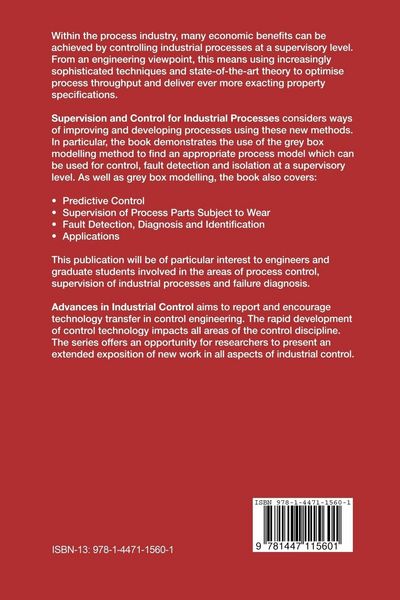
The series Advances in Industrial Control aims to report and encourage technology transfer in control engineering. The rapid development of control technology impacts all areas of the control discipline. New theory, new controllers, actuators, sensors, new industrial processes, computer methods, new applications, new philosophies ... , new challenges. Much of this development work resides in industrial reports, feasibility study papers and the reports of advanced collaborative projects. The series offers an opportunity for researchers to present an extended exposition of such new work in all aspects of industrial control for wider and rapid dissemination. The steel industry world-wide is highly competitive and there is significant research in progress to ensure competitive success prevails in the various companies. From an engineering viewpoint, this means the use of increasingly sophisticated techniques and state-of-the-art theory to optimise process throughput and deliver ever more exacting dimensional and material property specifications. Dr. Bjöm Sohlberg's monograph demonstrates this interplay between fundamental control engineering science and the demands of a particular applications project in the steel strip production business. It is an excellent piece of work which clearly shows how these industrial engineering challenges can be formulated and solved.
Noch keine Bewertungen vorhanden
Verfassen Sie die erste Bewertung zu diesem Artikel
Helfen Sie anderen Kundinnen und Kunden durch Ihre Meinung.