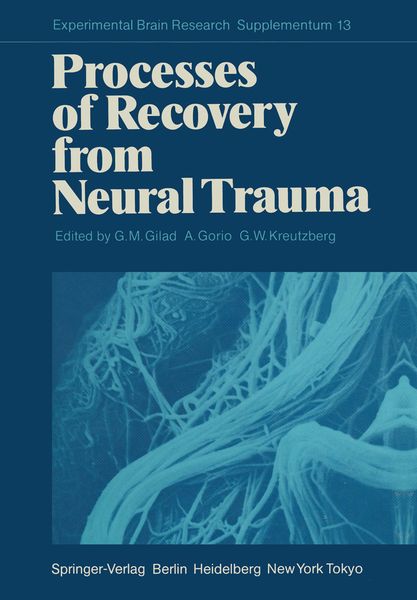
• Produktbild: Processes of Recovery from Neural Trauma
  • Produktbild: Processes of Recovery from Neural Trauma
Band 13

Processes of Recovery from Neural Trauma

Fr. 191.00

inkl. gesetzl. MwSt., Versandkostenfrei


Beschreibung

Produktdetails

Einband

Taschenbuch

Erscheinungsdatum

20.11.2011

Herausgeber

Gad M. Gilad + weitere

Verlag

Springer Berlin

Seitenzahl

369

Maße (L/B/H)

24.4/17/2.1 cm

Gewicht

667 g

Auflage

Softcover reprint of the original 1st ed. 1986

Sprache

Englisch

ISBN

978-3-642-70701-8

Beschreibung

Produktdetails

Einband

Taschenbuch

Erscheinungsdatum

20.11.2011

Herausgeber

Verlag

Springer Berlin

Seitenzahl

369

Maße (L/B/H)

24.4/17/2.1 cm

Gewicht

667 g

Auflage

Softcover reprint of the original 1st ed. 1986

Sprache

Englisch

ISBN

978-3-642-70701-8

Herstelleradresse

Springer-Verlag GmbH
Tiergartenstr. 17
69121 Heidelberg
DE

Email: GPSR Kontakt

Noch keine Bewertungen vorhanden

Verfassen Sie die erste Bewertung zu diesem Artikel

Helfen Sie anderen Kundinnen und Kunden durch Ihre Meinung.

Kundinnen und Kunden meinen

Bewertungen (0)

  • Produktbild: Processes of Recovery from Neural Trauma
  • Produktbild: Processes of Recovery from Neural Trauma
  • Neuronal Response to Nerve Trauma.- Reaction of Motoneurons and Their Microenvironment to Axotomy.- Coupling Among Neurons in Neocortical Slices: A Specific Response to Dendrotomy.- Regeneration of Axons in the Mammalian Visual System.- Axonal and Glial Proteins Associated with Development and Response to Injury in the Rat and Goldfish Optic Nerve.- Signals of External Origin Can Trigger Injured Adult Rabbit Optic Nerves to Express Regeneration-Like Responses.- Tissue Damage at the Site of Trauma.- Pathophysiology, Consequences and Pharmacological Prevention of Post-Traumatic CNS Ischemia.- Inflammation in Experimental Spinal Cord Injury.- Histopathology of Neural Transplants and Host Brain.- Plasticity of Intact Neurons After Trauma.- Correlative Morphological and Physiological Studies on Sprouting of Excitatory and Inhibitory Synapses of Red Nucleus Neurons.- Neurochemical Events Underlying Continued Function Despite Injury to Monoaminergic Systems.- Chemically Induced Homotypic Collateral Sprouting of Hippocampal Serotonergic Afferents.- Spinal Plasticity After Nerve Injury: Mediolateral Localization of Rewired Cells.- Physiological Changes in Cortical Cells Following Partial and Complete Visual Cortex Deafferentation in Cats.- Transneuronal and Peripheral Mechanisms for the Induction of Sprouting and Synapse Formation in Amphibian and Mammalian Motor Nervous System.- Changes in Target Tissue After Trauma.- Protein Synthesis Under Dendritic Spine Synapses During Lesion-Induced Synaptogenesis: Evidence for Regulation of Reinnervation by the Target Cell.- Acetylcholine Receptor Turnover Rates at Innervated and Denervated Vertebrate Neuromuscular Junctions.- Models for Axonal Growth.- Neuronal Interactions Between Peripheral Sensory and Central Monoamine Neurons Grafted to the Anterior Eye Chamber.- Factors Influencing Axonal Growth: Central vs. Peripheral Nerve Explants as Substrates in Vitro.- Neuronal Cell Cultures and Monosialoganglioside: A Model for Comprehension of Mechanisms Underlying Central Nervous System Repair.- Regeneration on Collagen Gels of Central and Peripheral Neurons Dissociated by a New Enzyme, RDB.- Environmental Factors that Influence the Differentiation and the Development of Voltage-Dependent Sodium Channel in Cultured Dorsal Root Ganglion Cells of Newborn Rats.- Behavioral Recovery After Trauma.- Recovery from Biochemical and Behavioral Deficits in Adult Ratswith Partial Lesions of the Fimbria.- The Effects of Surgical Manipulations of the Optic Tectum.- Pharmacological Approaches to Enhance Regeneration.- Histological Factors Influencing the Growth of Axons into Lesions of the Mammalian Spinal Cord.- Gangliosides Enhance Mechanisms of Recovery from Neural Damage by a Dual Mechanism.- GM1 Ganglioside Treatment Enhance Regrowth of Central and Peripheral Noradrenaline Neurons After Selective 6-Hydroxydopamine-lnduced Lesions.- Polyamines Enhance Survival and Regeneration of Sympathetic Neurons.- Reconstruction Models to Enhance Recovery.- Nerve Regeneration Chamber: Physical and Molecular Influences.- Experimental Problems in Spinal Cord Neural Reconstruction.- Transplantation of Fetal Central Nervous System into the Adult Spinal Cord: A Possible Aid to Regeneration.- Growth and Development of Neural Transplants: Some Quantitative Parameters.- Transplantation to the Damage Adult Hippocampal Formation.- Concluding Remarks.