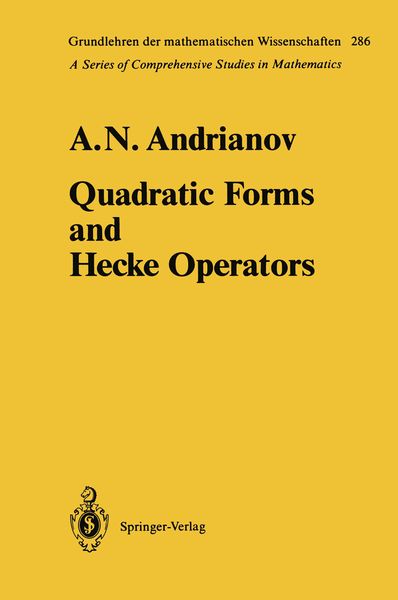
Produktbild: Quadratic Forms and Hecke Operators
Band 286

Quadratic Forms and Hecke Operators

Fr. 161.00

inkl. gesetzl. MwSt., Versandkostenfrei


Beschreibung

Produktdetails

Einband

Taschenbuch

Erscheinungsdatum

19.11.2011

Verlag

Springer Berlin

Seitenzahl

376

Maße (L/B/H)

22.9/15.2/2.2 cm

Gewicht

565 g

Auflage

Softcover reprint of the original 1st ed. 1987

Sprache

Englisch

ISBN

978-3-642-70343-0

Beschreibung

Produktdetails

Einband

Taschenbuch

Erscheinungsdatum

19.11.2011

Verlag

Springer Berlin

Seitenzahl

376

Maße (L/B/H)

22.9/15.2/2.2 cm

Gewicht

565 g

Auflage

Softcover reprint of the original 1st ed. 1987

Sprache

Englisch

ISBN

978-3-642-70343-0

Herstelleradresse

Springer-Verlag KG
Sachsenplatz 4-6
1201 Wien
AT

Email: GPSR Kontakt

Kundinnen und Kunden meinen

0 Bewertungen

Informationen zu Bewertungen

Zur Abgabe einer Bewertung ist eine Anmeldung im Konto notwendig. Die Authentizität der Bewertungen wird von uns nicht überprüft. Wir behalten uns vor, Bewertungstexte, die unseren Richtlinien widersprechen, entsprechend zu kürzen oder zu löschen.

Die Bewertungen sind nach Format, Anzahl Sterne und Datum sortiert.

Verfassen Sie die erste Bewertung zu diesem Artikel

Helfen Sie anderen Kund*innen durch Ihre Meinung

Kundinnen und Kunden meinen

0 Bewertungen filtern

  • Produktbild: Quadratic Forms and Hecke Operators
  • 1. Theta-Series.-
    1.1. Definition of Theta-Series.- 1.1.1. Representations of Quadratic Forms by Quadratic Forms.- 1.1.2. Definition of Theta-Series.-
    1.2. Symplectic Transformations.- 1.2.1. The Symplectic Group.- 1.2.2. The Siegel Upper Half-Plane.-
    1.3. Symplectic Transformations of Theta-Series.- 1.3.1. Transformations of Theta-Functions.- 1.3.2. The Siegel Modular Group and the Theta-Group.- 1.3.3. Symplectic Transformations of Theta-Series.-
    1.4. Computation of the Multiplier.- 1.4.1. Factors of Automorphy.- 1.4.2. Quadratic Forms of Level 1.- 1.4.3. The Multiplier as a Gaussian Sum.- 1.4.4. Quadratic Forms in an Even Number of Variables.- 1.4.5. Quadratic Forms in an Odd Number of Variables.- 2. Modular Forms.-
    2.1. Fundamental Domains for Subgroups of the Modular Group.- 2.1.1. The Modular Triangle.- 2.1.2. The Minkowski Domain.- 2.1.3. The Fundamental Domain for the Siegel Modular Group.- 2.1.4. Subgroups of Finite Index.-
    2.2. Definition of Modular Forms.- 2.2.1. Congruence Subgroups of the Modular Group.- 2.2.2. Modular Forms of Integral Weight.- 2.2.3. Modular Forms of Half-Integral Weight.- 2.2.4. Theta-Series as Modular Forms.-
    2.3. Fourier Expansions.- 2.3.1. Modular Forms for Triangular Subgroups.- 2.3.2. Koecher’s Effect.- 2.3.3. Fourier Expansions of Modular Forms.- 2.3.4. The Siegel Operator.- 2.3.5. Cusp Forms.- 2.3.6. Singular Forms.-
    2.4. Spaces of Modular Forms.- 2.4.1. Zeroes of Modular Forms for ?1.- 2.4.2. Modular Forms Whose Initial Fourier Coefficients Equal Zero.- 2.4.3. Dimension of Spaces of Modular Forms.-
    2.5. Scalar Product and Orthogonal Decomposition.- 2.5.1. Scalar Product.- 2.5.2. Orthogonal Decomposition.- 3. Hecke Rings.-
    3.1. Abstract Hecke Rings.- 3.1.1. Averaging over Double Cosets.- 3.1.2. Hecke Rings.- 3.1.3. The Imbedding i.- 3.1.4. The Anti-Isomorphism j.- 3.1.5. Representations on Automorphic Functions.- 3.1.6. Hecke Rings over a Commutative Ring.-
    3.2. Hecke Rings of the General Linear Group.- 3.2.1. Global Rings.- 3.2.2. Local Rings.- 3.2.3. The Spherical Mapping.-
    3.3. Hecke Rings of the Symplectic Group.- 3.3.1. Global Rings.- 3.3.2. Local Rings.- 3.3.3. The Spherical Mapping.-
    3.4. Hecke Rings of the Triangular Subgroup of the Symplectic Group.- 3.4.1. Global Rings.- 3.4.2. Local Rings.- 3.4.3. Decomposition of Elements Tn(a) for n = 1, 2.-
    3.5. Factorization of Symplectic Polynomials.- 3.5.1. “Negative Powers” of Frobenius Elements.- 3.5.2. Factorization of Symplectic Polynomials.- 3.5.3. A Symmetrie Factorization of Polynomials Qpn(v) for n = 1, 2.- 3.5.4. Coefficients of Factors of Polynomials Rpn(v).- 3.5.5. A Symmetrie Factorization of Polynomials Rpn(v).- 4. Hecke Operators.-
    4.1. Hecke Operators for Congruence Subgroups of the Modular Group.- 4.1.1. Hecke Operators.- 4.1.2. Invariant Subspaces and Eigenfunctions.-
    4.2. Action of Hecke Operators.- 4.2.1. Hecke Operators for ?0n(q).- 4.2.2. Hecke Operators for ?0n.- 4.2.3. Relations with Hecke Operators for GLn.- 4.2.4. Hecke Operators and the Siegel Operator.- 4.2.5. The Action of the Middle Factor of the Symmetrie Factorization of Polynomials Rpn(v).-
    4.3. Multiplicative Properties of Fourier Coefficients.- 4.3.1. Modular Forms of One Variable.- 4.3.2. Modular Forms of Genus 2, Gaussian Composition, and Zeta-Functions.- 4.3.3. Modular Forms of Arbitrary Genus and Even Zeta-Functions.- 5. The Action of Hecke Operators on Theta-Series.-
    5.1. The Action of Hecke Operators on Theta-Series.- 5.1.1. Theta-Series and ?-Series.- 5.1.2. The Basic Case.- 5.1.3. The General Case.-
    5.2. Theta-Matrices of Hecke Operators and Eichler Matrices.- 5.2.1. The Comparison of Fourier Coefficients.- 5.2.2. Theta-Matrices of Elements Tn(p).- 5.2.3. Theta-Matrices of Coefficients of Even Local Zeta-Functions.- 5.2.4. Theta-Matrices of Generators of Hecke Rings.- 5.2.5. Relations, Relations.- Appendix 1. Symmetrie Matrices over Fields.- A.1.1. Arbitrary Fields.- A.1.2. The Field ?.- Appendix 2. Quadratic Spaces.- A.2.1. The Geometrie Language.- A.2.2. Non-Degenerate Spaces.- A.2.3. Gaussian Sums.- A.2.5. Non-Singular Spaces over Residue Class Rings.- A.2.6. The Genus of Quadratic Spaces over ?.- Appendix 3. Modules in Quadratic Fields and Binary Quadratic Forms.- A.3.1 Modules of Algebraic Number Fields.- A.3.2 Modules in Quadratic Fields and Prime Numbers.- A.3.3 Modules in Imaginary Quadratic Fields and Quadratic Forms.- Notes.- On Chapter 1.- On Chapter 2.- On Chapter 3.- On Chapter 4.- On Chapter 5.- References.- Index of Terminology.- Index of Notation.