
Band 13
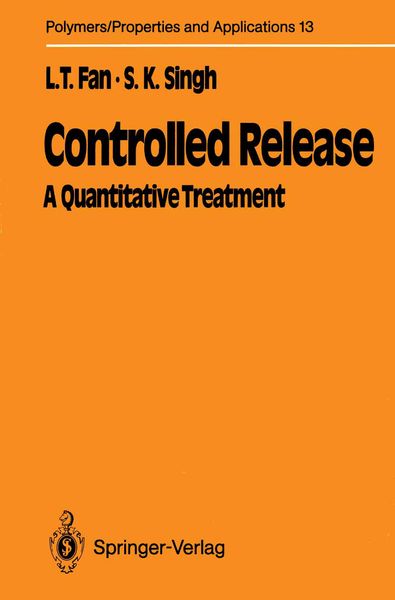
Controlled Release A Quantitative Treatment
Aus der Reihe
Polymers - Properties and Applications
-
- Taschenbuch ausgewählt
- eBook
-
Sprache:Englisch
Fr. 137.00
inkl. gesetzl. MwSt.,
Beschreibung
Produktdetails
Einband
Taschenbuch
Erscheinungsdatum
21.12.2011
Verlag
Springer BerlinSeitenzahl
233
Maße (L/B/H)
24.2/17/1.4 cm
Gewicht
430 g
Auflage
Softcover reprint of the original 1st ed. 1989
Sprache
Englisch
ISBN
978-3-642-74509-6
The concept of controlled release has attracted increasing attention over the last two decades, with the applications of this technology proliferating in diverse fields in cluding medicine, agriculture and biotechnology. Research and developmental efforts related to controlled release are multiplying in both industry and academia. The reason for this phenomenal growth is obvious. The use of a variety of biologically active agents, such as drugs, fertilizers and pesticides, has become an integral part of modern society. Along with the use of these reagents has evolved an awareness that their uncontrolled application almost inevitably induces harmful effects on the health of humans and their surrounding environments. To eliminate or minimize these harmful effects necessitates the controlled release of these chemicals. Moreover, the controlled release of substances, not usually considered toxic or hazardous, e.g., some catalysts and nutrients, can enhance their effectiveness. The numberand variety of controlled release systems, differing in their physical and chemical makeup, are increasing rapidly. Proliferation almost always demands correlation, generalization and unification; it requires both the development of underlying theories of their behavior and the mechanistic interpretation of their performance. This, in turn, requires a statistical and mathematical (quantitative) treatment of the scientific information and technical data pertaining to them. A quantitative treatment can also facilitate the formulation of procedures for computer-aided design of these systems through a priori prediction of their per formance for a variety of design parameters.
Noch keine Bewertungen vorhanden
Verfassen Sie die erste Bewertung zu diesem Artikel
Helfen Sie anderen Kundinnen und Kunden durch Ihre Meinung.