Gutscheinbedingungen

*Gültig bis 05.07.2026 auf (fast) alles. Ausgeschlossen sind Smartboxen, Zeitschriften, Tickets, Lebensmittel, Gaming-Elektroartikel, Tinte/Toner, Gutscheine, Geschenkkarten, Blumen und Abos | Einlösbar in allen Buchhandlungen von Orell Füssli, Barth Bücher, Buchladen Rapunzel, Papeterie Köhler, Schuler Orell Füssli, Stauffacher und ZAP unter Vorweisung des Gutscheins, auf www.orellfüssli.ch durch Eingabe des Gutscheincodes. Beim Service „eBooks verschenken“ und bei eBook-Käufen via eReader nicht einlösbar | Mindesteinkaufswert: Fr. 30.- | Nicht mit anderen Rabatten kumulierbar.

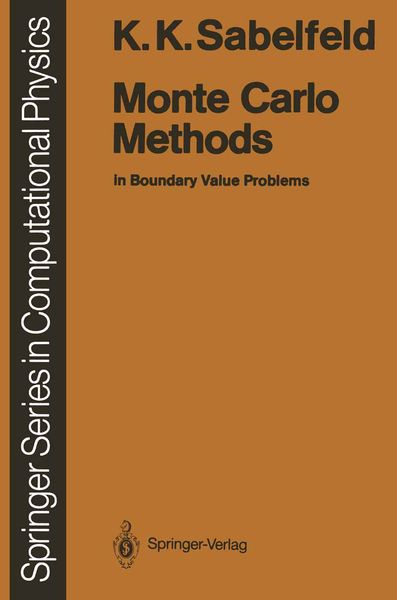
Produktbild: Monte Carlo Methods

Monte Carlo Methods in Boundary Value Problems

Aus der Reihe Scientific Computation

Fr. 72.90

inkl. gesetzl. MwSt., Versandkostenfrei


Beschreibung

Produktdetails

Einband

Taschenbuch

Erscheinungsdatum

13.12.2011

Verlag

Springer Berlin

Seitenzahl

283

Maße (L/B/H)

23.5/15.5/1.7 cm

Gewicht

464 g

Auflage

Softcover reprint of the original 1st ed. 1991

Sprache

Englisch

ISBN

978-3-642-75979-6

Beschreibung

Produktdetails

Einband

Taschenbuch

Erscheinungsdatum

13.12.2011

Verlag

Springer Berlin

Seitenzahl

283

Maße (L/B/H)

23.5/15.5/1.7 cm

Gewicht

464 g

Auflage

Softcover reprint of the original 1st ed. 1991

Sprache

Englisch

ISBN

978-3-642-75979-6

Herstelleradresse

Springer-Verlag KG
Sachsenplatz 4-6
1201 Wien
AT

Email: GPSR Kontakt

Noch keine Bewertungen vorhanden

Verfassen Sie die erste Bewertung zu diesem Artikel

Helfen Sie anderen Kundinnen und Kunden durch Ihre Meinung.

Kundinnen und Kunden meinen

Bewertungen (0)

  • Produktbild: Monte Carlo Methods
  • 1. General Schemes for Constructing Scalar and Vector Monte Carlo Alogorithms for Solving Boundary Value Problems.- 1.1 Random Walks on Boundary and Inside the Domain Algorithms.- 1.1.1 Monte Carlo Algorithms.- 1.1.2 Scalar and Vector Walk Inside the Domain Algorithms.- 1.1.3 Walk on Boundary Algorithms.- 1.1.4 Probabilistic Representations in the Form of Continual Integrals.- 1.2 Random Walks and Approximations of Random Processes.- 1.2.1 Walk Inside the Domain Processes.- 1.2.2 Walk on Boundary Processes.- 1.2.3 Approximation of Wiener Processes.- 1.2.4 Simulation of Random Fields.- 1.2.5 Stochastic Problems and Double Randomization.- 2. Monte Carlo Algorithms for Solving Integral Equations.- 2.1 Algorithms Based on Numerical Analytical Continuation.- 2.1.1 Statement of the Problem and the Main Definitions.- 2.1.2 Analytical Continuation of Neumann Series Based on the Spectral Parameter Transformation.- 2.1.3 Transformations of the Type ? = ?(?) = a0 + a1? + a2?2 +.- 2.2 Asymptotically Unbiased Estimates Based on Singular Approximation of the Kernel.- 2.2.1 Finite-Dimensional Case and One-Point Approximation.- 2.2.2 Systems of Integral Equations.- 2.2.3 General Case of the Kernel Approximation.- 2.3 The Eigen-value Problem for the Integral Operators.- 2.3.1 Calculation of Eigen-values on the Basis of the Transformation ? = ?(?).- 2.3.2 Calculation of Eigen-values by Asymptotically Unbiased Estimates.- 2.4 Alternative Constructions of the Resolvent: Modifications and Numerical Experiments.- 2.4.1 Continuation by the Mittag-Leffler Method Combined with the Transformation ? = i(i + p)/(i - p).- 2.4.2 Generalized Summation Methods.- 2.4.3 Transformation and Convergence Acceleration of Series. Euler Summation.- 2.4.4 Padé Approximation of the Resolvent and Approximation by Continued Fractions.- 2.4.5 Methods of Regularization of Analytical Continuation for Solving Integral Equations.- 3. Monte Carlo Algorithms for Solving Boundary Value Problems of the Potential Theory.- 3.1 The Walk on Boundary Algorithms for Solving Interior and Exterior Boundary Value Problems of the Potential Theory.- 3.1.1 Boundary Integral Equations.- 3.1.2 Interior Dirichlet and Exterior Neumann Problems.- 3.1.3 Interior Neumann, Exterior Dirichlet, and the Third Boundary Value Problems.- 3.1.4 Dirichlet and Neumann Problems for the Helmholtz Equation.- 3.1.5 The Variance, the Error and the Cost of the Walk on Boundary Algorithms.- 3.2 Walk Inside the Domain Algorithms.- 3.2.1 General Scheme for Constructing Monte Carlo Estimates on the Walk Inside the Domain Processes.- 3.2.2 Non-homogeneous Equations and Global Walk on Spheres Algorithm for Calculating the Solution and Derivative Fields.- 3.2.3 The Walk on Small Spheres and on Other Standard Domains.- 3.3 Numerical Solution of Some Test and Applied Problems of Potential Theory in Deterministic and Stochastic Formulation.- 3.3.1 Numerical Experiments: Solution of Test Problems of Potential Theory.- 3.3.2 Calculation of the Capture Coefficient of Highly Dispersed Aerosols (3D).- 4. Monte Carlo Algorithms for Solving High-Order Equations and the Elasticity Problems.- 4.1 Biharmonic Problem.- 4.1.1 Vector Walk on Circles Algorithm for Solving the Plate Bending Problem for Simply Supported Plates.- 4.1.2 Plates with Arbitrary Boundaries.- 4.1.3 Direct and Adjoint Algorithms for Calculating the Fields of Solution and Derivatives.- 4.2 Metaharmonic Equations.- 4.2.1 Mean Value Theorems for Metaharmonic Equations.- 4.2.2 Vector Walk on Spheres Algorithm.- 4.2.3 Scalar Algorithms.- 4.3 Spatial Problems of the Elasticity Theory.- 4.3.1 Walk on Boundary Algorithms for the Lamé Equation.- 4.3.2 Walk on Spheres Algorithm for the First Boundary Value Problem.- 4.4 Application to Stochastic Elasticity Problems.- 4.4.1 The Bending Problem for a Plate Lying on an Elastic Base.- 4.4.2 Random Loads.- 5. Monte Carlo Algorithms for Solving Diffusion Problems.- 5.1 Walk on Boundary Algorithms for the Heat Equation.- 5.1.1 Generalization of Isotropic Walk on Boundary Processes to the Nonstationary Case.- 5.1.2 The Variance and Cost of the Walk on Boundary Algorithms.- 5.1.3 Diffusion Equation in a Half-space. Direct Monte Carlo Scheme.- 5.1.4 Adjoint Scheme.- 5.1.5 Nonhomogeneous Case.- 5.1.6 Calculation of Derivatives.- 5.2 The Walk Inside the Domain Algorithms.- 5.2.1 Cauchy Problem.- 5.2.2 Use of the Laplace Transform.- 5.3 Particle Diffusion in Random Velocity Fields.- 5.3.1 Particle Diffusion in Local-Isotropic Velocity Fields.- 5.3.2 Calculation of Statistical Characteristics of a Cloud.- 5.3.3 Statistical Model of the Turbulent Velocity Field for a Horizontally Homogeneous Boundary Layer.- 5.4 Applications to Diffusion Problems.- 5.4.1 Distribution of the First Passage Time for Particles Moving in Classical Isotropic Random Velocity Fields.- 5.4.2 Spread of Clouds of Particles of Aerosol Insecticide in Arboreal Canopies.- 5.4.3 Diffuse Deposition of Polydispersed Aerosol Particles in Pipes.- 5.4.4 Simulation of the Growth of Nuclei Highly Dispersed Aerosol Particles.- References.