
• Produktbild: Physical Aspects of Soil Water and Salts in Ecosystems
  • Produktbild: Physical Aspects of Soil Water and Salts in Ecosystems
Band 4

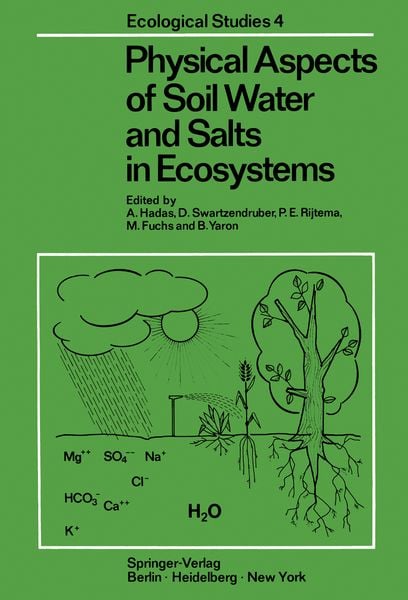
Physical Aspects of Soil Water and Salts in Ecosystems

Aus der Reihe Ecological Studies

Fr. 137.00

inkl. gesetzl. MwSt., Versandkostenfrei


Beschreibung

Produktdetails

Einband

Taschenbuch

Erscheinungsdatum

15.11.2011

Herausgeber

A. Hadas + weitere

Verlag

Springer Berlin

Seitenzahl

462

Maße (L/B/H)

24.4/17/2.7 cm

Gewicht

828 g

Auflage

Softcover reprint of the original 1st ed. 1973

Sprache

Englisch

ISBN

978-3-642-65525-8

Beschreibung

Produktdetails

Einband

Taschenbuch

Erscheinungsdatum

15.11.2011

Herausgeber

Verlag

Springer Berlin

Seitenzahl

462

Maße (L/B/H)

24.4/17/2.7 cm

Gewicht

828 g

Auflage

Softcover reprint of the original 1st ed. 1973

Sprache

Englisch

ISBN

978-3-642-65525-8

Herstelleradresse

Springer-Verlag KG
Sachsenplatz 4-6
1201 Wien
AT

Email: ProductSafety@springernature.com

Kundinnen und Kunden meinen

0 Bewertungen

Informationen zu Bewertungen

Zur Abgabe einer Bewertung ist eine Anmeldung im Konto notwendig. Die Authentizität der Bewertungen wird von uns nicht überprüft. Wir behalten uns vor, Bewertungstexte, die unseren Richtlinien widersprechen, entsprechend zu kürzen oder zu löschen.

Die Bewertungen sind nach Format, Anzahl Sterne und Datum sortiert.

Verfassen Sie die erste Bewertung zu diesem Artikel

Helfen Sie anderen Kund*innen durch Ihre Meinung

Kundinnen und Kunden meinen

0 Bewertungen filtern

  • Produktbild: Physical Aspects of Soil Water and Salts in Ecosystems
  • Produktbild: Physical Aspects of Soil Water and Salts in Ecosystems
  • I. Water Status and Flow in Soils.- A. Water Movement in Soils.- 1. The Physics of Infiltration.- 2. Drainage of a Vertical Column.- 3. Infiltration Predictions by a Moving Strained Coordinates Method.- 4. Theory of Transport in Soils.- 5. Calculation of Vertical Moisture Flow in a Soil Body during Evaporation, Infiltration and Redistribution.- 6. Linearized Solution of Infiltration at Constant Rate.- 7. Analysis and Interpretation of Experimentally Determined Absorption Curves. I. Interpretation via D-6 Function Derived from Numerical Analysis.- 8. Analysis and Interpretation of Experimentally Determined Absorption Curves. II. Interpretation via an Equivalent Depth of Penetration and a Shape Factor.- 9. Infiltration of Water into Layered Field Soils.- 10. Infiltration of Water into Nonuniform Soils.- 11. An Analysis of Soil Water Movement toward Seedlings Prior to Emergence.- B. Energy of Soil Water and Soil-Water Interactions.- 1. The Unfrozen Interfacial Phase in Frozen Soil Water Systems.- 2. On the Energy Concept of Soil Water.- 3. The Mechanical and Physical Behaviour of Ca-Clay Soil and K-Clay Soil.- 4. Streaming-Potential Effects in Saturated Water Flow through a Sand-Kaolinite Mixture.- 5. The Influence of Clay Minerals and Exchangeable Cations on Soil Moisture Potential.- 6. The Hysteresis of Pore Water in Presence of Non-Independent Water Elements.- 7. Comparison between the Drainage Efficiency of a Leached Pseudogley Soil and a Pelosol.- 8.Correlation of Field Capacity between Open Field and Laboratory Determinations.- 9. Soil Crust Formation as Affected by Raindrop Impact.- Remarks and Discussion.- II. Evapotranspiration and Crop-Water Requirements.- A. Evaporation from Soils and Plants.- 1. Evaporation, Transpiration and Evapotranspiration: A Case for Ockham’s Razor.- 2. Evaporation from Bare Soils.- 3. Evaporation from Bare Soil in a Coastal Environment.- 4. Potential Evaporation as Influenced by Barrier-Induced Microclimate.- 5. Evaluation of Several Methods for Estimating Evapotranspiration under Semi-Arid Conditions.- 6. Dynamics of Water in the Soil-Plant Atmosphere System: A Model Named Troika.- 7. Microclimate Factors Affecting Evaporation and Transpiration.- 8. Bioclimatic Method for Scheduling Irrigation: Experiment with Maize in Vojvodina, Yugoslavia.- 9. Prediction of the Thermal Regime of Bare Soils.- B. Crop-Water Requirements.- 1. A Method of Determining, on the Farm, the Amount of Water and the Frequency of Irrigation.- 2. Measurement of Soil Moisture Deficit by Neutron Moderation under Two Densities of Sugar Beet with and without Irrigation.- 3. A Runoff-Farming Trial with Almonds in the Negev of Israel.- 4. Results from a Three-Year Experiment on the Effect of the Irrigation Regime on the Yield of Corn in Southwest Spain.- 5. Moisture Use by Irrigated Tea in Southern Malawi.- 6. Citrus Water Requirement Experiments Conducted in Israel during the 1960’s.- 7. Relation between Apple Root Distribution and Soil Water Extraction in Different Irrigation Regimes.- Remarks and Discussion.- III. Salinity Control.- 1. Ionic Activity and Ion Uptake by Plants Grown in Saline Environments.- 2. The Relationship between the Composition of the Exchange Complex and the Composition of the Soil Solution.- 3. Patterns of Salt Distribution under Trickle Irrigation.- 4. A Model for the Water and Salt Economy in Irrigated Agriculture.- 5. Response of a Citrus Orchard to Soil Moisture and Soil Salinity.- 6. Pepper Plant Response to Irrigation Water Quality and Timing of Leaching.- 7. Reclamation of Alkali Soils with CaCl2 Solutions.- 8. Evaluation of Methods for Reclaiming Sodic Soils with CaCl2.- Remarks and Discussion.