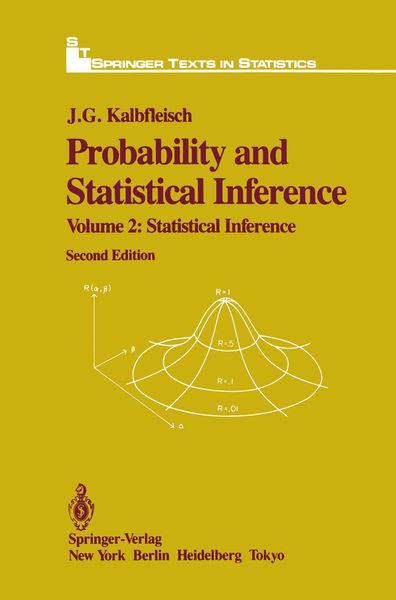
Probability and Statistical Inference Volume 2: Statistical Inference
Aus der Reihe
Springer Texts in Statistics
-
- Hardcover
- Taschenbuch ausgewählt
-
Sprache:Englisch
-
Auflage:2nd ed. 1985. Softcover reprint of the original 2nd ed. 1985
Fr. 119.00
inkl. gesetzl. MwSt.,
Beschreibung
Produktdetails
Einband
Taschenbuch
Erscheinungsdatum
01.10.2011
Verlag
Springer UsSeitenzahl
360
Maße (L/B/H)
23.5/15.5/2.1 cm
Gewicht
575 g
Auflage
2nd ed. 1985. Softcover reprint of the original 2nd ed. 1985
Sprache
Englisch
ISBN
978-1-4612-9579-2
This book is in two volumes, and is intended as a text for introductory courses in probability and statistics at the second or third year university level. It em phasizes applications and logical principles rather than mathematical theory. A good background in freshman calculus is sufficient for most of the material presented. Several starred sections have been included as supplementary material. Nearly 900 problems and exercises of varying difficulty are given, and Appendix A contains answers to about one-third of them. The first volume (Chapters 1-8) deals with probability models and with math ematical methods for describing and manipulating them. It is similar in content and organization to the 1979 edition. Some sections have been rewritten and expanded-for example, the discussions of independent random variables and conditional probability. Many new exercises have been added. In the second volume (Chapters 9-16), probability models are used as the basis for the analysis and interpretation of data. This material has been revised extensively. Chapters 9 and 10 describe the use of the likelihood function in estimation problems, as in the 1979 edition. Chapter 11 then discusses frequency properties of estimation procedures, and introduces coverage probability and confidence intervals. Chapter 12 describes tests of significance, with applications primarily to frequency data. The likelihood ratio statistic is used to unify the material on testing, and connect it with earlier material on estimation.
Noch keine Bewertungen vorhanden
Verfassen Sie die erste Bewertung zu diesem Artikel
Helfen Sie anderen Kundinnen und Kunden durch Ihre Meinung.