
• Produktbild: Pattern Formation in Liquid Crystals
  • Produktbild: Pattern Formation in Liquid Crystals

Pattern Formation in Liquid Crystals

Fr. 137.00

inkl. gesetzl. MwSt., Versandkostenfrei


Beschreibung

Produktdetails

Einband

Taschenbuch

Erscheinungsdatum

17.09.2011

Herausgeber

Agnes Buka + weitere

Verlag

Springer Us

Seitenzahl

340

Maße (L/B/H)

23.5/15.5/2 cm

Gewicht

540 g

Auflage

Softcover reprint of the original 1st ed. 1996

Sprache

Englisch

ISBN

978-1-4612-8464-2

Beschreibung

Produktdetails

Einband

Taschenbuch

Erscheinungsdatum

17.09.2011

Herausgeber

Verlag

Springer Us

Seitenzahl

340

Maße (L/B/H)

23.5/15.5/2 cm

Gewicht

540 g

Auflage

Softcover reprint of the original 1st ed. 1996

Sprache

Englisch

ISBN

978-1-4612-8464-2

Herstelleradresse

Springer-Verlag GmbH
Tiergartenstr. 17
69121 Heidelberg
DE

Email: ProductSafety@springernature.com

Kundinnen und Kunden meinen

0 Bewertungen

Informationen zu Bewertungen

Zur Abgabe einer Bewertung ist eine Anmeldung im Konto notwendig. Die Authentizität der Bewertungen wird von uns nicht überprüft. Wir behalten uns vor, Bewertungstexte, die unseren Richtlinien widersprechen, entsprechend zu kürzen oder zu löschen.

Die Bewertungen sind nach Format, Anzahl Sterne und Datum sortiert.

Verfassen Sie die erste Bewertung zu diesem Artikel

Helfen Sie anderen Kund*innen durch Ihre Meinung

Kundinnen und Kunden meinen

0 Bewertungen filtern

  • Produktbild: Pattern Formation in Liquid Crystals
  • Produktbild: Pattern Formation in Liquid Crystals
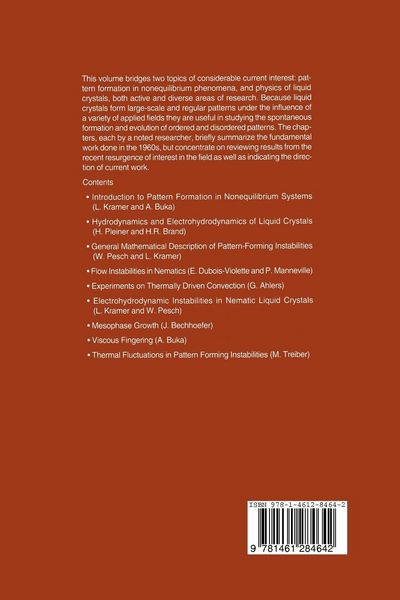
  • 1 Introduction to Pattern Formation in Nonequilibrium Systems.- 1.1 General Remarks.- 1.2 A Simple Model.- 1.3 Pattern Formation in Liquid Crystals.- 1.3.1 Transient Patterns in the Freédericksz Transition.- 1.3.2 Patterns in Rotating Magnetic and Electric Fields.- References.- 2 Hydrodynamics and Electrohydrodynamics of Liquid Crystals.- 2.1 Introduction.- 2.2 Symmetries and Broken Symmetries.- 2.2.1 Conservation Laws.- 2.2.2 Broken Symmetries.- 2.2.3 Slowly Relaxing Variables.- 2.3 Statics.- 2.3.1 Thermodynamics.- 2.3.2 Energy and Thermodynamic Forces.- 2.4 Dynamics.- 2.4.1 Reversible Currents.- 2.4.2 Irreversible Currents.- 2.5 Electrohydrodynamics.- 2.5.1 External Fields.- 2.5.2 Statics and Dynamics.- 2.6 Additions to Nematodynamics.- 2.6.1 Fluctuating Forces.- 2.6.2 Biaxial Nematics.- 2.6.3 Order Parameter Variable.- 2.6.4 Side-Chain Polymers.- 2.6.5 Nonlinearities and Higher-Order Gradient Terms.- 2.7 Director-Type Degrees of Freedom.- 2.7.1 Smectic A Liquid Crystals.- 2.7.2 Cholesteric Liquid Crystals.- 2.7.3 Smectic C, C*, CM, and CM*Liquid Crystals.- 2.7.4 Smectic F, I, and L Liquid Crystals.- References.- 3 General Mathematical Description of Pattern-Forming Instabilities.- 3.1 Introductory Remarks.- 3.2 Linear Analysis.- 3.3 The Landau Equation.- 3.4 The Ginzburg—Landau Equations.- 3.4.1 Derivation.- 3.4.2 Application of the Ginzburg—Landau Equations.- 3.5 Extended Weakly Nonlinear Analysis.- 3.5.1 Derivation of Order Parameter Equations.- 3.6 From Order Parameter to Amplitude Equations.- 3.6.1 Derivation of Coupled Amplitude Equations.- 3.7 Concluding Remarks.- 3.7.1 Swift—Hohenberg Equation.- 3.7.2 Phase Equations.- References.- 4 Flow Instabilities in Nematics.- 4.1 Introduction.- 4.2 Continuous Description of Nematics and Viscometry.- 4.2.1 Nematohydrodynamics.- 4.2.2 Viscometry.- 4.2.3 Apparent Non-Newtonian Behavior and Flow Alignment.- 4.2.4 Anisotropy of Viscous Forces.- 4.2.5 Viscous Relaxation of the Orientation, Flow, and the Ericksen Number.- 4.3 Stability Analysis and Basic Mechanisms.- 4.3.1 Stability Analysis.- 4.3.2 The Pieranski—Guyon Mechanism.- 4.4 Shear Flow Instabilities with the Director Perpendicular to the Shear Plane.- 4.4.1 Simple Shear Flow.- 4.4.2 Alternating Shear Flows.- 4.4.3 Poiseuille Flow.- 4.5 Flow Instabilities with the Director Initially Parallel to the Shear Plane.- 4.6 Elliptical Shear Instability in Homeotropic Configuration.- 4.6.1 Experimental Results.- 4.6.2 Theoretical Account.- 4.7 Further Developments.- Appendix A: Linear stability problem when the director is perpendicular to the shear plane.- Appendix B: Elliptical Shear Equations.- References.- 5 Experiments on Thermally Driven Convection.- 5.1 Introduction.- 5.1.1 Instability Mechanisms.- 5.1.2 Stability Analysis.- 5.1.3 Pattern Formation.- 5.1.4 Materials.- 5.2 Planar Alignment and a Horizontal Magnetic Field.- 5.2.1 Introductory Remarks.- 5.2.2 Theoretical Predictions.- 5.2.3 Experimental Results.- 5.3 Homeotropic Alignment and a Vertical Magnetic Field.- 5.3.1 General Remarks.- 5.3.2 Heating from Below.- 5.3.3 Heating from Above.- 5.4 Two-Phase Convection.- 5.4.1 Theoretical Predictions.- 5.4.2 Experimental results.- Appendix A: Experimental Methods.- Appendix B: Physical Properties of 5CB.- References.- 6 Electrohydrodynamic Instabilities in Nematic Liquid Crystals.- 6.1 Introduction.- 6.1.1 General Considerations.- 6.1.2 Theoretical preliminaries.- 6.2 Planar alignment: linear theory.- 6.2.1 Conduction regime.- 6.2.2 Dielectric regime.- 6.3 Planar alignment: nonlinear theory.- 6.3.1 Results of Ginzburg—Landau Equation (GLE).- 6.3.2 Beyond the GLE.- 6.4 Homeotropic alignment.- 6.4.1 Case C.- 6.4.2 Case F.- 6.5 Concluding remarks.- References.- 7 Mesophase Growth.- 7.1 Introduction.- 7.2 The Mullins—Sekerka Instability.- 7.2.1 Undercooled Pure Material.- 7.2.2 Thin Layer of a Binary Alloy in a Temperature Gradient.- 7.3 Directional Growth Experiments.- 7.3.1 The Initial Instability.- 7.3.2 Secondary Instabilities.- 7.3.3 Tertiary and Higher Instabilities.- 7.3.4 Other Experimental Systems.- 7.4 Free-Growth Experiments.- 7.4.1 Microscopic-Solvability Theory.- 7.4.2 Dendritic Growth at the Discotic-Isotropic Interface.- 7.4.3 Dendritic Growth in Other Mesophase Systems.- 7.5 Prospects.- References.- 8 Viscous Fingering.- 8.1 Introduction.- 8.2 Theoretical Background.- 8.3 Experiments.- 8.3.1 Isotropic Systems.- 8.3.2 Anisotropic Systems.- 8.4 Concluding Remarks.- References.- 9 Thermal Fluctuations in Pattern Forming Instabilities.- 9.1 Introduction.- 9.2 Macroscopic Stochastic Equations for Thermal Noise.- 9.3 Stochastic Amplitude Equations.- 9.4 Theoretical Results.- 9.4.1 Rayleigh—Bénard Convection.- 9.4.2 Taylor—Couette Flow.- 9.4.3 Planar Electrohydrodynamic Convection.- 9.5 Experimental Results.- 9.6 Discussion.- References.