Band 12
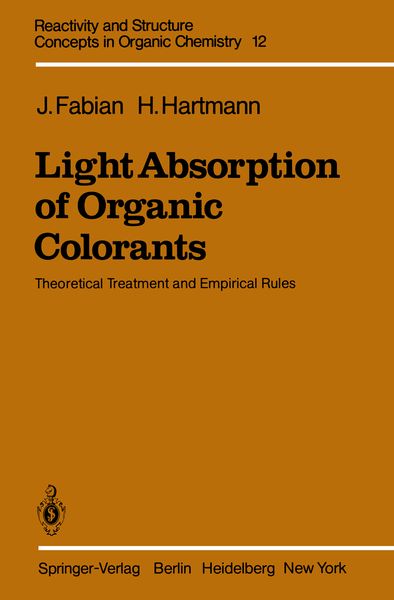
Light Absorption of Organic Colorants Theoretical Treatment and Empirical Rules
Aus der Reihe
Reactivity and Structure: Concepts in Organic Chemistry
-
- Englisch ausgewählt
Fr. 72.90
inkl. gesetzl. MwSt.,
Beschreibung
Produktdetails
Einband
Taschenbuch
Erscheinungsdatum
21.01.2012
Verlag
Springer BerlinSeitenzahl
248
Maße (L/B/H)
24.4/17/1.5 cm
Gewicht
455 g
Auflage
Softcover reprint of the original 1st ed. 1980
Sprache
Englisch
ISBN
978-3-642-67589-8
Although studies on synthetic dyes have been performed for more than 100 years, their detailed elucidation requires further extensive research. The discovery of novel high polymers, the necessity of supplying a whole range of shades and increasing require ments for dyestuffs of high fastness properties give rise to a permanent search for new dyes. Extensive investigations on dyes were also occasioned by various applications in the field of spectral sensitization and of staining of biological specimens. Another more recent development concerns the lasing properties of some organic dyes. Most of the progress, however, was only achieved by time-consuming, purely empirical approaches and theoretical understanding of the dye properties is only at its very beginnings. The color is the sine qua non of every dye. For this reason organic chemists and color chemists have looked for relations between the "color and constitution" of dye molecules for a long time. This knowlege as a whole is known as "theory of color". The classic theory of color was established abou t 100 years ago by Witt and was signi ficantly extended 50 years later by W. Konig.
Noch keine Bewertungen vorhanden
Verfassen Sie die erste Bewertung zu diesem Artikel
Helfen Sie anderen Kundinnen und Kunden durch Ihre Meinung.