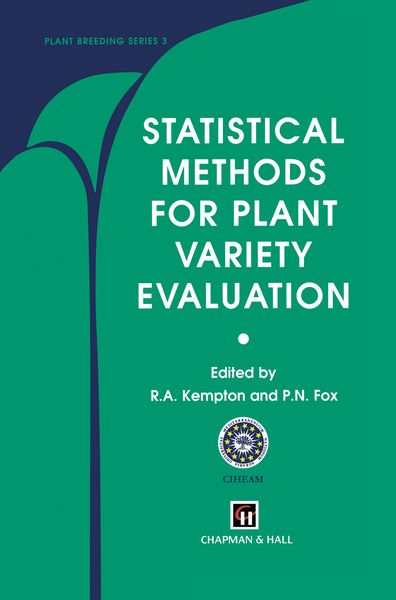
Statistical Methods for Plant Variety Evaluation
Aus der Reihe
Plant Breeding
-
- Hardcover
- Taschenbuch ausgewählt
- eBook
-
Sprache:Englisch
Fr. 241.00
inkl. gesetzl. MwSt.,
Beschreibung
Produktdetails
Einband
Taschenbuch
Erscheinungsdatum
28.09.2011
Abbildungen
XII, 192 p.
Herausgeber
R.A. Kempton + weitereVerlag
Springer NetherlandSeitenzahl
192
Maße (L/B/H)
23.5/15.5/1.2 cm
Gewicht
324 g
Auflage
1997
Sprache
Englisch
ISBN
978-94-010-7172-7
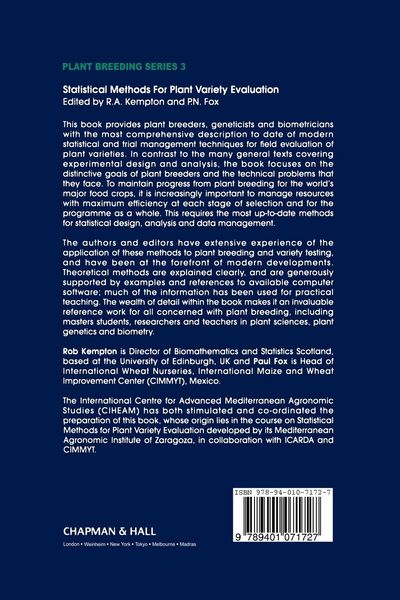
The International Centre for Advanced Mediterranean Agronomic Studies (CIHEAM), established in 1962, is an intergovernmental organization of four teen countries: Albania, Algeria, Egypt, France, Greece, Italy, Lebanon, Malta, Morocco, Portugal, Spain, Tunisia, Turkey and Yugoslavia. Four institutes (Bari, Italy; Chania, Greece; Montpellier, France and Zaragoza, Spain) provide post-graduate education at the Master of Science level. CIHEAM promotes research networks on Mediterranean agricultural priorities, supports the organization of specialized education in member countries, holds seminars and workshops bringing together technologists and scientists involved in Mediterranean agriculture and regularly produces diverse publications including the series 'Options Mediterraneennes'. Through these activities, CIHEAM promotes North/South dialogue and international co-operation for agricultural development in the Mediterranean region. Plant breeding is, since 1982, one of the fields in which CIHEAM is con ducting a programme of training and promotion of research, through its Mediterranean Agronomic Institute of Zaragoza. The programme includes a one-year advanced specialization course, a series of two-week courses for professionals, and support for collaborative research activities in Mediterranean-relevant species. Many of these activities are organized in col laboration with national and international institutions. The publication in 1993 of Plant Breeding. Principles and Prospects, which ini tiated the Chapman & Hall's Plant Breeding Series, has become an important feature of CIHEAM's plant breeding programme. We are now pleased to add a further volume to that series: the present book, Statistical Methods for Plant Variety Evaluation.
Noch keine Bewertungen vorhanden
Verfassen Sie die erste Bewertung zu diesem Artikel
Helfen Sie anderen Kundinnen und Kunden durch Ihre Meinung.