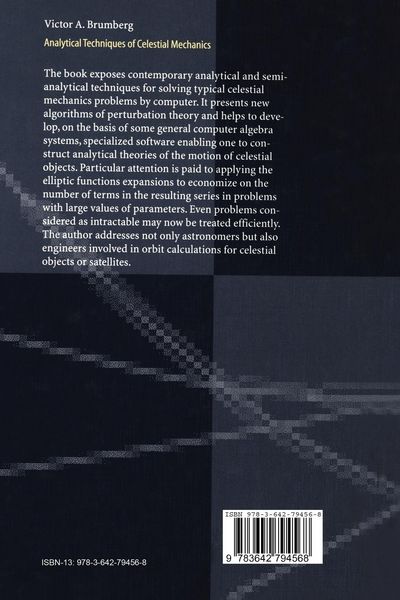
• Produktbild: Analytical Techniques of Celestial Mechanics
  • Produktbild: Analytical Techniques of Celestial Mechanics

Analytical Techniques of Celestial Mechanics

Fr. 72.90

inkl. gesetzl. MwSt., Versandkostenfrei


Beschreibung

Produktdetails

Einband

Taschenbuch

Erscheinungsdatum

13.12.2011

Verlag

Springer Berlin

Seitenzahl

236

Maße (L/B/H)

23.5/15.5/1.4 cm

Gewicht

382 g

Auflage

Softcover reprint of the original 1st ed. 1995

Sprache

Englisch

ISBN

978-3-642-79456-8

Beschreibung

Produktdetails

Einband

Taschenbuch

Erscheinungsdatum

13.12.2011

Verlag

Springer Berlin

Seitenzahl

236

Maße (L/B/H)

23.5/15.5/1.4 cm

Gewicht

382 g

Auflage

Softcover reprint of the original 1st ed. 1995

Sprache

Englisch

ISBN

978-3-642-79456-8

Herstelleradresse

Springer-Verlag GmbH
Tiergartenstr. 17
69121 Heidelberg
DE

Email: ProductSafety@springernature.com

Kundinnen und Kunden meinen

0 Bewertungen

Informationen zu Bewertungen

Zur Abgabe einer Bewertung ist eine Anmeldung im Konto notwendig. Die Authentizität der Bewertungen wird von uns nicht überprüft. Wir behalten uns vor, Bewertungstexte, die unseren Richtlinien widersprechen, entsprechend zu kürzen oder zu löschen.

Die Bewertungen sind nach Format, Anzahl Sterne und Datum sortiert.

Verfassen Sie die erste Bewertung zu diesem Artikel

Helfen Sie anderen Kund*innen durch Ihre Meinung

Kundinnen und Kunden meinen

0 Bewertungen filtern

  • Produktbild: Analytical Techniques of Celestial Mechanics
  • Produktbild: Analytical Techniques of Celestial Mechanics
  • 1 The Poisson-Series Processor.- 1.1 Universal CAS and Poisson-Series Processors.- 1.2 Operations with Poisson Series.- 1.3 Location of Poisson Series.- 2 The Keplerian Processor.- 2.1 The Keplerian Processor in Closed Form.- 2.2 The Keplerian Processor in Poisson-Series Form.- 2.3 General Terms of the Elliptic-Motion Expansions.- 2.4 The Keplerian Processor in Taylor-Series Form.- 2.5 The Keplerian Processor with the Aid of Elliptic Functions.- 2.6 Functions Involving the Coordinates of Two Bodies.- 3 Quasi-polynomial Systems.- 3.1 The N-Planet Problem in Polynomial Form.- 3.2 Kustaanheimo-Stiefel (KS) Variables.- 3.3 Hansen Coordinates and Euler Parameters.- 4 Algorithms to Solve Polynomial Systems.- 4.1 Taylor Expansions.- 4.2 Normalization and Trigonometric Expansions.- 5 The Satellite Disturbing Function.- 5.1 Expansions in Spherical Functions.- 5.2 The Recurrence Determination of Solid Spherical Harmonics.- 5.3 The Disturbing Function and Its Derivatives.- 5.4 Equations of Motion in Rotating Systems.- 6 The Planetary Disturbing Function.- 6.1 General Structure.- 6.2 Expansion Algorithms.- 6.3 Expansion with the Aid of Elliptic Functions.- 7 Iteration Techniques of Perturbation Theory.- 7.1 Iteration Versions of the Classical Methods.- 7.2 Intermediate Orbits in the N-Planet Problem.- 7.3 Iterations in the Two-Body Problem.- 8 Separation of Variables in Elements.- 8.1 The Krylov-Bogoljubov Method.- 8.2 The von Zeipel Method and Its Modifications.- 8.3 The von Zeipel Method as a “Coordinate” Method.- 8.4 The Kolmogorov-Arnold Method Using Howland’s Technique.- 9 Separation of Variables in Rectangular Coordinates.- 9.1 Reducibility of the Equations of Variations.- 9.2 The Perturbed Two-Body Problem.- 9.3 Solution Techniques.- 10 The General Planetary Theory.- 10.1 The Basic Theory.- 10.2 Right-Hand Members.- 10.3 The Intermediary.- 10.4 Linear Eccentricity and Inclination Terms.- 10.5 Non-linear Terms.- 10.6 The Secular System.- 11 GPT Techniques in Minor-Planet and Lunar Problems.- 11.1 Right-Hand Members.- 11.2 The Intermediary.- 11.3 Solution Techniques.- 11.4 The Secular System.- 11.5 The Lunar Problem.- References.