
• Produktbild: Analysis with Supercritical Fluids: Extraction and Chromatography
  • Produktbild: Analysis with Supercritical Fluids: Extraction and Chromatography

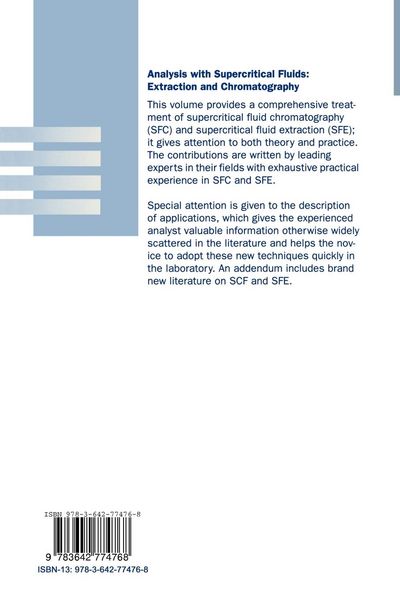
Analysis with Supercritical Fluids: Extraction and Chromatography

Fr. 72.90

inkl. gesetzl. MwSt., Versandkostenfrei


Beschreibung

Produktdetails

Einband

Taschenbuch

Erscheinungsdatum

21.12.2011

Herausgeber

Bernd Wenclawiak

Verlag

Springer Berlin

Seitenzahl

214

Maße (L/B/H)

23.5/15.5/1.3 cm

Gewicht

358 g

Auflage

Softcover reprint of the original 1st ed. 1992

Sprache

Englisch

ISBN

978-3-642-77476-8

Beschreibung

Produktdetails

Einband

Taschenbuch

Erscheinungsdatum

21.12.2011

Herausgeber

Bernd Wenclawiak

Verlag

Springer Berlin

Seitenzahl

214

Maße (L/B/H)

23.5/15.5/1.3 cm

Gewicht

358 g

Auflage

Softcover reprint of the original 1st ed. 1992

Sprache

Englisch

ISBN

978-3-642-77476-8

Herstelleradresse

Springer-Verlag KG
Sachsenplatz 4-6
1201 Wien
AT

Email: ProductSafety@springernature.com

Kundinnen und Kunden meinen

0 Bewertungen

Informationen zu Bewertungen

Zur Abgabe einer Bewertung ist eine Anmeldung im Konto notwendig. Die Authentizität der Bewertungen wird von uns nicht überprüft. Wir behalten uns vor, Bewertungstexte, die unseren Richtlinien widersprechen, entsprechend zu kürzen oder zu löschen.

Die Bewertungen sind nach Format, Anzahl Sterne und Datum sortiert.

Verfassen Sie die erste Bewertung zu diesem Artikel

Helfen Sie anderen Kund*innen durch Ihre Meinung

Kundinnen und Kunden meinen

0 Bewertungen filtern

  • Produktbild: Analysis with Supercritical Fluids: Extraction and Chromatography
  • Produktbild: Analysis with Supercritical Fluids: Extraction and Chromatography
  • 1 SFC and SFE: An Introduction for Novices.- 2 Physico-Chemical Principles of Supercritical Fluid Separation Processes.- 2.1 Introduction.- 2.2 Physico-Chemical Properties of Pure Supercritical Solvents.- 2.2.1 Thermodynamic Properties.- 2.2.2 Dielectric Properties.- 2.2.3 Transport Properties.- 2.3 Phase Equilibria of Fluid Mixtures.- 2.3.1 Phase-Theoretical Aspects.- 2.3.2 Classification of Binary Critical Phase Behavior By “Families”.- 2.3.3 Ternary Systems.- 2.3.4 Quaternary Systems.- 2.3.5 Solubility of Solids in Supercritical Solvents.- 2.3.6 Isothermal Pressure (Concentration) Phase Diagrams.- 2.3.7 Calculation and Correlation of Fluid Phase Equilibria.- 2.4 Physico-Chemical Applications of Sfc.- 2.4.1 Capacity Ratios.- 2.4.2 Diffusion Coefficients.- References.- 3 Basic Principles of Analytical Supercritical Fluid Extraction.- 3.1 The Development of Analytical SFE.- 3.1.1 Sample Preparation in Analytical Chemistry.- 3.1.2 Utilization of Supercritical Fluids in Analytical-Scale Extractions.- 3.1.3 Features of Analytical SFE.- 3.2 Fluid Properties in SFE.- 3.2.1 Selection of The Supercritical Fluid.- 3.2.2 Unique Properties of Supercritical Fluid Carbon Dioxide.- 3.2.3 The Use of Cosolvents in SFE.- 3.3 Optimizing Experimental Conditions For Analytical SFE.- 3.3.1 Objectives of The Extraction.- 3.3.2 Critical Parameters Pertinent To SFE.- 3.3.3 A Theoretical Approach For Optimizing SFE.- 3.4 The Relevance of Sfc-Derived Data To Analytical SFE.- 3.4.1 Relevant Measurements By SFC.- 3.4.2 Implications For SFE.- 3.5 The Practice of Analytical SFE.- 3.5.1 Equipment Requirements.- 3.5.2 Experimental Considerations in Analytical SFE.- 3.6 Sample Matrix Effects in SFE.- 3.6.1 Physical Matrix Effects.- 3.6.2 Chemical Changes in The Sample Matrix.- 3.6.3 Impact of Matrix On Extraction Kinetics.- 3.7 Problems and Future Research Needs in Analytical SFE.- References.- 4 Coupled Supercritical Fluid Extraction-Capillary Gas Chromatography (SFE-GC).- 4.1 introduction.- 4.2 Performing SFE-GC.- 4.2.1 instrumentation and Methods.- 4.2.2 Fluids and Extraction Conditions Used For SFE-GC.- 4.3 Abilities and Limitations of Split and On-Column SFE-GC.- 4.3.1 Chromatographic Peak Shapes Obtained Using SFE-GC.- 4.3.2 Quantitation Using SFE-GC.- 4.3.3 Speed of SFE-GC Analyses.- 4.3.4 Sensitivity and Sample Sizes.- 4.3.5 Sample Types and Matrix Considerations.- 4.4 Summary.- References.- 5 Gradients in SFC.- 5.1 Overview.- 5.2 Temperature Gradients.- 5.3 Pressure Gradients.- 5.4 Density Gradients.- 5.5 Velocity Gradients.- 5.6 References.- 6 injection Techniques in SFC.- 6.1 introduction.- 6.2 The Physical State of The Sample.- 6.3 introduction of Supercritical Fluid Extracts.- 6.4 introducing a Solution.- 6.5 Peak Focusing.- 6.6 Direct injection.- 6.7 Open Split (Dynamic Split) injection.- 6.8 Timed Split injection.- 6.9 Solvent Effects on Peak Shape.- 6.10 Solvent Venting with A Precolumn.- 6.11 Solvent Backflush.- 6.12 Solvent Venting with Gas Purging.- 6.13 Sample Losses in The injector.- References.- 7 Stationary Phases For Packed Column Supercritical Fluid Chromatography.- 7.1 introduction.- 7.2 Physical Properties of Column Packings.- 7.3 influence of Substrate Morphology on The Properties of Chemically Bonded Phases in SFC.- 7.4 influence of Surface Heterogeneity on The Properties of Chemically Bonded Phases.- 7.4.1 Chemical interactions with Silanol Groups.- 7.4.2 Deactivation of Silanol Groups with Mobile Phase Modifiers.- 7.4.3 Shielding of Silanol Groups By Polymer Encapsulation.- 7.5 Macroporous Polymeric Packings.- 7.6 Column Packings Used For Special Applications.- 7.7 Conclusions.- References.- 8 Enantiomer Separation By Capillary Supercritical Fluid Chromatography.- 8.1 introduction.- 8.2 General Aspects.- 8.2.1 Temperature.- 8.2.2 Speed of Analysis and Efficiency.- 8.2.3 Mobile Phase.- 8.2.4 Column Loadability.- 8.3 Packed Column SFC.- 8.4 Open Tubular Column SFC.- 8.5 Conclusion.- References.- 9 Supercritical Fluid Chromatography/Mass Spectrometry.- 9.1 introduction.- 9.2 Early investigations of SFC/MS.- 9.3 SFC/MS Using Direct introduction interfaces.- 9.3.1 Flow Restriction.- 9.3.2 Ionization Methods.- 9.3.2.1 Chemical Ionization.- 9.3.2.2 Electron Ionization and Charge Exchange.- 9.3.2.3 Secondary Ion Mass Spectrometry.- 9.3.3 Type of Mass Analyzer.- 9.3.3.1 DFI SFC/MS Using Quadrupole Mass Spectrometers.- 9.3.3.2 DFI SFC/MS Using Double-Focussing Sector Mass Spectrometers.- 9.3.3.3 DFI SFC/MS Using Fourier Transform Mass Spectrometers.- 9.4 SFC/MS Using High-Flow-Rate interfaces.- 9.4.1 SFC/MS Using The Moving Belt interface.- 9.4.2 SFC/MS Using The Particle Beam interface.- 9.4.3 off-Line SFC/MS.- 9.4.4 SFC/MS Using Direct introduction of Split Effluents.- 9.4.5 SFC/MS Using Post-Expansion Splitting.- 9.4.6 SFC/MS Using The Thermospray interface.- 9.5 Supercritical Fluid injection/Mass Spectrometry.- 9.6 Conclusion.- References.- 10 Supercritical Fluid Chromatography with FT-IR Detection.- 10.1 introduction.- 10.2 Flow Cell Approach.- 10.3 Solvent Elimination Approach.- 10.4 Summary.- References.- 11 Supersonic Jet Spectroscopy with Supercritical Fluids.- 11.1 introduction.- 11.2 Supersonic Jet Spectroscopy.- 11.2.1 Principles of Supersonic Expansions.- 11.2.2 Spectroscopic Methods For Detection.- 11.3 High Pressure Fluid injection For Nonvolatile Samples.- 11.3.1 Experimental.- 11.3.2 Supercritical Fluid injection.- 11.3.3 High Pressure Liquid injection.- 11.4 Supercritical Fluid Chromatography and Supersonic Jet Spectroscopy.- 11.4.1 Experimental.- 11.4.2 The interfaces.- 11.5 Conclusions.- References.- Basic References Analytical Scale SFC/SFE.- Recommended Literature.