
• Produktbild: Macromolecular Complexes in Chemistry and Biology
  • Produktbild: Macromolecular Complexes in Chemistry and Biology

Macromolecular Complexes in Chemistry and Biology

Fr. 137.00

inkl. gesetzl. MwSt., Versandkostenfrei


Portrait

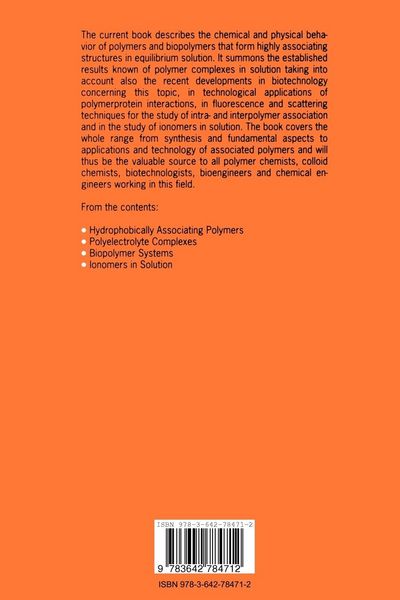
The current book describes the chemical and physical behavior of polymers and biopolymers that form highly associating structures in equilibrium solution. It summons the established results known of polymer complexes in solution taking into account also the recent developments. It covers the whole range from synthesis and fundamental aspects to applications and technology of associated polymers.

Produktdetails

Einband

Taschenbuch

Erscheinungsdatum

08.12.2011

Herausgeber

Paul Dubin + weitere

Verlag

Springer Berlin

Seitenzahl

361

Maße (L/B/H)

23.5/15.5/2.1 cm

Gewicht

580 g

Auflage

Softcover reprint of the original 1st ed. 1994

Sprache

Englisch

ISBN

978-3-642-78471-2

Portrait

Produktdetails

Einband

Taschenbuch

Erscheinungsdatum

08.12.2011

Herausgeber

Verlag

Springer Berlin

Seitenzahl

361

Maße (L/B/H)

23.5/15.5/2.1 cm

Gewicht

580 g

Auflage

Softcover reprint of the original 1st ed. 1994

Sprache

Englisch

ISBN

978-3-642-78471-2

Herstelleradresse

Springer-Verlag KG
Sachsenplatz 4-6
1201 Wien
AT

Email: GPSR Kontakt

Noch keine Bewertungen vorhanden

Verfassen Sie die erste Bewertung zu diesem Artikel

Helfen Sie anderen Kundinnen und Kunden durch Ihre Meinung.

Kundinnen und Kunden meinen

Bewertungen (0)

  • Produktbild: Macromolecular Complexes in Chemistry and Biology
  • Produktbild: Macromolecular Complexes in Chemistry and Biology
  • I. Hydrophobically Associating Polymers.- 1 Synthesis and Characterization of Hydrophobically Associating Water-Soluble Polymers.- 1.1 Introduction.- 1.2 Synthesis.- 1.3 Copolymerization.- 1.4 Postpolymerization Modification.- 1.5 Characterization-Hydrophobe Incorporation.- 1.6 Summary.- 1.7 References.- 2 Analysis of Hydrophobically Associating Copolymers Utilizing Spectroscopic Probes and Labels.- 2.1 Introduction.- 2.2 Emission Probes and Labels.- 2.3 Absorption Probes.- 2.4 Concluding Remarks.- 2.5 References.- 3 Solution Properties of Hydrophobically Associating Water-Soluble Polymers.- 3.1 Introduction.- 3.2 Polymer Systems.- 3.3 Solubility Characteristics.- 3.4 Solution Stability.- 3.5 Solution Rheological Properties.- 3.6 Summary.- 3.7 References.- 4 Aggregation of Hydrophobically Modified Polyelectrolytes in Dilute Solution: Tonic Strength Effects.- 4.1 Introduction.- 4.2 Experimental.- 4.3 The Polymers.- 4.4 Dilute Solution Viscosity.- 4.5 Fluorescence Spectroscopy.- 4.6 Intrinsic Viscosity.- 4.7 Concluding Remarks.- 4.8 References.- 5 Microdomain Composition in Two-Phase Hydrogels.- 5.1 Introduction.- 5.2 Background.- 5.2.1 Microphase Separation in Polymers.- 5.2.2 Importance of Graft Polymers.- 5.3 Results.- 5.3.1 Hydrogels from Surfactant Solutions.- 5.3.2 Hydrogels from Ethanol/Water Solutions.- 5.3.3 Solute Uptake by Gels.- 5.4 Conclusions.- 5.5 References.- 6 Molecular Association and Polymerization of 1-Alkyl-4-vinylpyridinium Ions.- 6.1 Complexation in 1-Alkyl-4-vinylpyridinium Ions and Related Polymers.- 6.2 Homopolymerization of 1-Alkyl-4-vinylpyridinium Ions.- 6.3 Copolymerization of 1-Alkyl-4-vinylpyridinium Ions.- 6.4 Conclusion.- 6.5 References.- 7 Fluorocarbon-Modified Water Soluble Polymers.- 7.1 Introduction.- 7.2 Experimental.- 7.3 Results and Discussion.- 7.4 Conclusions.- 7.5 References.- II. Polyelectrolyte Complexes.- 8 Static Light Scattering of Polyelectrolyte Complex Solutions.- 8.1 Introduction.- 8.2 Survey of Static Light Scattering Studies on PEC Solutions.- 8.3 Interpretation of Light Scattering Experiments.- 8.4 Experimental.- 8.4.1 Materials.- 8.4.2 Methods of Investigation.- 8.5 Results and Discussion.- 8.6 Conclusion.- 8.7 References.- 9 Interaction Between Oppositely Charged Low Ionic Density Polyelectrolytes: Complex Formation or Simple Mixture?.- 9.1 Introduction.- 9.2 Material and Techniques.- 9.2.1 Polymer Synthesis.- 9.2.2 Polymer Characterization.- 9.2.3 Other Techniques.- 9.3 Phase Diagram.- 9.3.1 Phase Diagram Representation.- 9.3.2 Influence of the Charge Density.- 9.3.3 Influence of the Ionic Strength.- 9.3.4 Influence of the Molecular Weight of the Samples.- 9.3.5 Phase Diagram and Complex Formation.- 9.4 Polymer-Polymer Affinity and Phase Diagram.- 9.5 Conclusion.- 9.6 References.- 10 Basic Properties of Soluble Interpolyelectrolyte Complexes Applied to Bioengineering and Cell Transformations.- 10.1 Introduction.- 10.2 Kinetic and Equilibrium Properties of Interpolyelectrolyte Complexes.- 10.3 Interpolyelectrolyte Complexes as Protein Carriers.- 10.4 Complexes of DNA with Synthetic Polycations for Cell Transformation.- 10.5 Conclusion.- 10.6 References.- 11 Conformation Presumption for Polysaccharide-Polylysine Complexation.- 11.1 Introduction.- 11.2 Complex Formation.- 11.3 Pectate-Polylysine Interaction.- 11.4 Polyguluronate Rich Alginate-Polylysine Interaction.- 11.5 Polymannuronate Rich Alginate-Polylysine Interaction.- 11.6 Conclusion.- 11.7 References.- 12 Interpolymer Complexes and their Ion-Conduction.- 12.1 Introduction.- 12.2 Classification of Interpolymer Complexes.- 12.3 Formation of Interpolymer Complexes from PAA with POE.- 12.4 Thermodynamics of Interpolymer Complexes from PAA (or PMMA) with POE.- 12.5 Selective and Substitution Interpolymer Complexation.- 12.6 Solid Properties of a Hydrogen-Bonding Complex.- 12.7 Ion Conduction and Solid Polymer Electrolytes.- 12.8 Ion Conduction of Hydrogen-Bonding Complexes.- 12.9 References.- 13 Fluorescence Probe Studies of Poly(acrylic acid) Interchain Complexation Induced by High Shear Flow and Influence of Cationic Surfactants on the Complexation.- 13.1 Introduction.- 13.2 Experimental.- 13.2.1 Materials.- 13.2.2 Flow Processing.- 13.2.3 Fluorescence Measurements.- 13.3 Results and Discussion.- 13.3.1 Drag Reduction (DR) and PAA Conformation.- 13.3.2 Local Chain Rigidity.- 13.3.3 Hydrophobic Association.- 13.3.4 Hydrophobe-Assisted Rigidity.- 13.4 References.- III. Biopolymer Systems.- 14 Water-Soluble Biospecific Polymers for New Affinity Purification Techniques.- 14.1 Introduction.- 14.2 Discrimination on the Basis of High Molecular Weight.- 14.2.1 Biospecific Ultrafiltration.- 14.2.2 Biospecific Gel Filtration.- 14.3 Discrimination on the Basis of High Density of Charges: Affinophoresis.- 14.4 Discrimination on the Basis of Surface Tension Properties: Affinity Partition.- 14.5 Discrimination on the Basis of Reversible Solubility: Affinity Precipitation.- 14.6 Advantages and Drawbacks of Techniques Involving Water-Soluble Biospecific Polymers.- 14.7 References.- 15 Protein-Polyelectrolyte Complexes.- 15.1 Introduction.- 15.2 Investigation Methods.- 15.3 Factors Influencing Protein-Polyelectrolyte Complexation and Structures of the Protein-Polyelectrolyte Complexes.- 15.4 Protein Separation by Polyelectrolytes.- 15.5 Enzymes in Polyelectrolyte Complexes.- 15.6 Conclusion.- 15.7 References.- 16 Precipitation of Proteins with Polyelectrolytes: Role of Polymer Molecular Weight.- 16.1 Introduction.- 16.2 Materials and Methods.- 16.3 Results and Discussion.- 16.4 Conclusions.- 16.5 References.- 17 Complex Coacervation: Micro-Capsule Formation.- 17.1 Introduction and Terminology.- 17.2 Simple Coacervation.- 17.3 Complex Coacervation.- 17.4 Theory of Complex Coacervation.- 17.5 Coacervation as a Method of Microencapsulation.- 17.6 Materials and Methods.- 17.7 Results.- 17.8 Conclusions.- 17.9 References.- 18 Complexation of Proteins with Polyelectrolytes in a Salt-Free System and Biochemical Characteristics of the Resulting Complexes.- 18.1 Introduction.- 18.2 Experimental Section.- 18.3 Results and Discussion.- 18.4 Conclusions and Topics for Future Research.- 18.5 References.- IV. Ionomers in Solution.- 19 Ionomer Solutions: Polyelectrolyte or Ionomer behavior.- 19.1 Introduction.- 19.2 Sulfonated Polystyrene Ionomer Solutions in Nonpolar Solvents.- 19.3 Sulfonated Polystyrene Ionomer Solutions in Polar Solvents.- 19.4 Perfluorinated Ionomer Solutions.- 19.5 Conclusion.- 19.6 References.- 20 Scattering Studies of Ionomer Aggregates in Nonpolar Solvents.- 20.1 Introduction.- 20.2 Experimental.- 20.3 Light Scattering Analysis.- 20.4 Results and Discussion.- 20.5 References.