• Produktbild: The Statistical Analysis of Categorical Data
  • Produktbild: The Statistical Analysis of Categorical Data

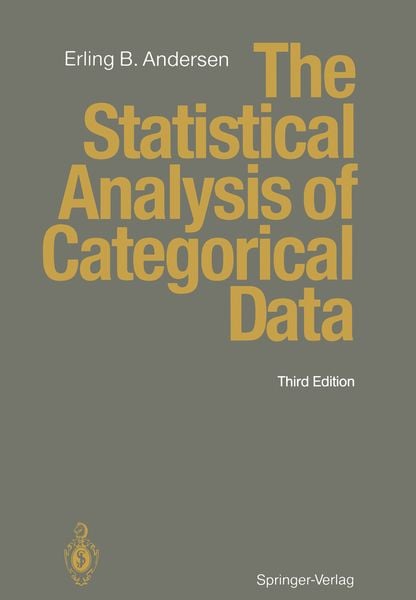
The Statistical Analysis of Categorical Data

Fr. 72.90

inkl. gesetzl. MwSt., Versandkostenfrei


Beschreibung

Produktdetails

Einband

Taschenbuch

Erscheinungsdatum

13.12.2011

Verlag

Springer Berlin

Seitenzahl

532

Maße (L/B/H)

24.4/17/3 cm

Gewicht

933 g

Auflage

Third Edition 1994

Sprache

Englisch

ISBN

978-3-642-78819-2

Beschreibung

Produktdetails

Einband

Taschenbuch

Erscheinungsdatum

13.12.2011

Verlag

Springer Berlin

Seitenzahl

532

Maße (L/B/H)

24.4/17/3 cm

Gewicht

933 g

Auflage

Third Edition 1994

Sprache

Englisch

ISBN

978-3-642-78819-2

Herstelleradresse

Springer-Verlag KG
Sachsenplatz 4-6
1201 Wien
AT

Email: GPSR Kontakt

Noch keine Bewertungen vorhanden

Verfassen Sie die erste Bewertung zu diesem Artikel

Helfen Sie anderen Kundinnen und Kunden durch Ihre Meinung.

Kundinnen und Kunden meinen

Bewertungen (0)

  • Produktbild: The Statistical Analysis of Categorical Data
  • Produktbild: The Statistical Analysis of Categorical Data
  • 1. Categorical Data.- 2. Preliminaries.- 2.1 Statistical models.- 2.2 Estimation.- 2.3 Testing statistical hypotheses.- 2.4 Checking the model.- 3. Statistical Inference.- 3.1 Log-linear models.- 3.2 The one-dimensional case.- 3.3 The multi-dimensional case.- 3.4 Testing composite hypotheses.- 3.5 The parametric multinomial distribution.- 3.6 Generalized linear models.- 3.7 Solution of likelihood equations.- 3.8 Exercises.- 4. Two-way Contingency Tables.- 4.1 Three models.- 4.2 The 2×2 table.- 4.3 The log-linear parameterization.- 4.4 The hypothesis of no interaction.- 4.5 Residual analysis.- 4.6 Exercises.- 5. Three-way Contingency Tables.- 5.1 The log-linear parameterization.- 5.2 Hypothesis in a three-way table.- 5.3 Hypothesis testing.- 5.4 Decomposition of the test statistic.- 5.5 Detection of model departures.- 5.6 Exercises.- 6. Multi-dimension Contingency Tables.- 6.1 The log-linear model.- 6.2 Interpretation of log-linear models.- 6.3 Search for a model.- 6.4 Diagnostics for model departures.- 6.5 Exercises.- 7. Incomplete Tables, Separability and Collapsibility.- 7.1 Incomplete tables.- 7.2 Two-way tables and quasi-independence.- 7.3 Higher order tables. Separability.- 7.4 Collapsibility.- 7.5 Exercises.- 8. The Logit Model.- 8.1 The logit-model with binary explanatory variables.- 8.2 The logit model with polytomous explanatory variables.- 8.3 Exercises.- 9. Logistic Regression Analysis.- 9.1 The logistic regression model.- 9.2 Regression diagnostics.- 9.3 Predictions.- 9.4 Polytomous response variables.- 9.5 Exercises.- 10. Models for the Interactions.- 10.1 Introduction.- 10.2 Symmetry models.- 10.3 Marginal homogeneity.- 10.4 Models for mobility tables.- 10.5 Association models.- 10.6 RC-association models.- 10.7 Log-linear association models.- 10.8 Exercises.- 11. Correspondence Analysis.- 11.1 Correspondence analysis for two-way tables.- 11.2 Correspondence analysis for multi-way tables.- 11.3 Comparison of models.- 11.4 Exercises.- 12. Latent Structure Analysis.- 12.1 Latent structure models.- 12.2 Latent class models.- 12.3 Continuous latent structure models.- 12.4 The EM-algorithm.- 12.5 Estimation in the latent class model.- 12.6 Estimation in the continuous latent structure model.- 12.7 Testing the goodness of fit.- 12.8 Diagnostics.- 12.9 Score models with varying discriminating powers.- 12.10 Comparison of latent structure models.- 12.11 Estimation of the latent variable.- 12.12 Exercises.- 13. Computer Programs.- References.- Author Index.- Examples with Data.