• Produktbild: Neuroprosthetics: from Basic Research to Clinical Applications
  • Produktbild: Neuroprosthetics: from Basic Research to Clinical Applications

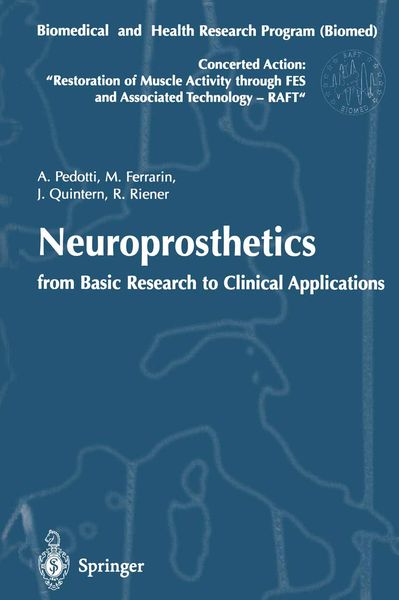
Neuroprosthetics: from Basic Research to Clinical Applications Biomedical and Health Research Program (Biomed) of the European Union. Concerted Action: Restoration of Muscle Activity through FES and Associated Technology (RAFT)

Fr. 137.00

inkl. gesetzl. MwSt., Versandkostenfrei


Portrait

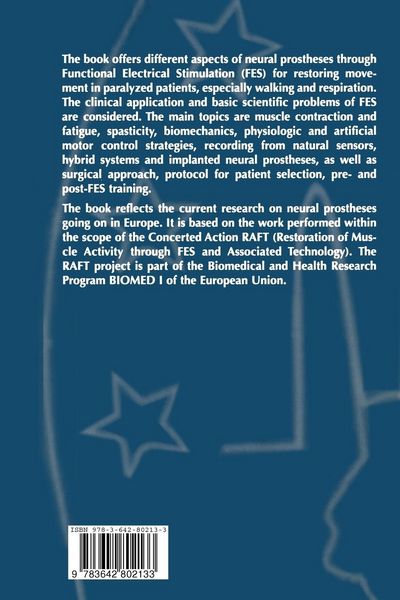
The book covers various aspects of motor neural prostheses and reflects the current research activities on this field in Europe. It enables the reader to acquire a deeper understanding of the complex interactions between biological and technical systems. This book addresses scientists involved in neurophysiology, orthopaedics, rehabilitation, biomedical and control engineering.

Produktdetails

Einband

Taschenbuch

Erscheinungsdatum

27.12.2011

Herausgeber

Antonio Pedotti + weitere

Verlag

Springer Berlin

Seitenzahl

654

Maße (L/B/H)

23.5/15.5/3.6 cm

Gewicht

1001 g

Auflage

Softcover reprint of the original 1st ed. 1996

Sprache

Englisch

ISBN

978-3-642-80213-3

Portrait

Produktdetails

Einband

Taschenbuch

Erscheinungsdatum

27.12.2011

Herausgeber

Verlag

Springer Berlin

Seitenzahl

654

Maße (L/B/H)

23.5/15.5/3.6 cm

Gewicht

1001 g

Auflage

Softcover reprint of the original 1st ed. 1996

Sprache

Englisch

ISBN

978-3-642-80213-3

Herstelleradresse

Springer-Verlag GmbH
Tiergartenstr. 17
69121 Heidelberg
DE

Email: ProductSafety@springernature.com

Kundinnen und Kunden meinen

0 Bewertungen

Informationen zu Bewertungen

Zur Abgabe einer Bewertung ist eine Anmeldung im Konto notwendig. Die Authentizität der Bewertungen wird von uns nicht überprüft. Wir behalten uns vor, Bewertungstexte, die unseren Richtlinien widersprechen, entsprechend zu kürzen oder zu löschen.

Die Bewertungen sind nach Format, Anzahl Sterne und Datum sortiert.

Verfassen Sie die erste Bewertung zu diesem Artikel

Helfen Sie anderen Kund*innen durch Ihre Meinung

Kundinnen und Kunden meinen

0 Bewertungen filtern

  • Produktbild: Neuroprosthetics: from Basic Research to Clinical Applications
  • Produktbild: Neuroprosthetics: from Basic Research to Clinical Applications
  • 1: Natural control of movement and posture.- Feedforword postural control during movement.- Is the center of gravity controlled during movement?.- Basic neurophysiology and FES.- Correlation analysis as a tool for defining strategies of movement.- Plasticity of primary motor areas of the brain after stroke — a motor cortex stimulation study.- Locomotor capacity of spinal cord in paraplegic patients.- Stretch reflex variations during gait.- Modulation of the Hoffmann reflex of soleus during the walking cycle in stroke patients and associated control of ankle joint movement.- 2: Contraction and fatigue of stimulated muscles.- Muscle recruitment with surface and implanted electrodes.- The effect of contractile activity on the damaged skeletal muscle and the application on paraplegic locomotion.- A dynamic model of electrically stimulated knee muscles in healthy and paraplegics.- A model for an artificially activated musculoskeletal system.- Physiologically based multi-input model of muscle activation.- Novel stimulation strategies for the recruitment of paralysed muscle.- Towards an optimized muscle controller.- The function of neuromuscular junction in upper motor neuron weakness.- Fatigue indices in electrically stimulated quadriceps muscle with surface electrodes.- Muscle fatigue facing continuous and intermittent simulation and recovery from fatigue.- Fatigue of intermittently stimulated human quadriceps: influence of knee angular velocity.- 3: Control strategies in FES.- A comprehensive FES control system for mobility restoration in paraplegics.- Control of the first generation CALIES implants.- Description of the CALTES external controller.- Design of a multisensor closed-loop neurostimulator. Part A: Communication unit with wireless data link and digital signal processor.- Design of a multisensor closed-loop neurostimulator. Part B: Input and output stage.- A modular system for controlled FES and therapy of paralyses.- Optimized experimental control of FES-induced swing phase of paraplegic gait.- Development of control strategies for FES- supported closed-loop standing-up.- Unsupported standing of paraplegics by stimulation of the plantarflexors: some results from the wobbler apparatus.- Biomechanical simulation of the lower extremity for the development of control strategies for FES.- Biomechanical modelling in artificial control of FES assisted mobility.- Inverse models for control of movements.- Neural networks for the control of posture and locomotion.- Self tuning control in FES with compensation of nonlinear recruitment characteristics by artificial neural networks.- 4: Biomechanics applied to neuroprosthetics.- Biomechanical simulation and animation of the lower extremity for the design of neural prostheses.- Optimal trajectory generation for a paralegic patient raising from a chair by means of FES.- Crutch assisted FES gait and upright stability assessment.- Sensor staircase for the measurement of ground reaction loads: preliminary results.- Modeling of joint-rotations during line tracking arm movements.- 5: Artificial and natural sensors.- 3D movement analysis using accelerometry — theoretical concepts.- Restoration of lateral hand grasp using natural sensors.- Extraction of slip information from digital nerve signals in man.- Characterization of the ENG activity from a digital nerve for feedback control in grasp neuroprostheses.- Selective intraneural sensing for neuroprosthetics.- Myoelectric signals from paretic wrist extensor controlling electrical stimulation of the same muscle.- Study of methods for decomposition of superimposed signals with application to electromyograms.- 6: Spasticity: pathophysiology, evaluation, and treatment.- Which spinal cord neurophysiologic mechanisms are responsible for spasticity?.- Biomechanical and neurophysiological implications on spasticity assessment.- A new biomechanical approach to pendulum test for spasticity evaluation.- A comparison of clinical and biomechanical assessments of spinal spasticity.- Parameters controlling antispastic electical stimulation: clinical application and theoretical considerations.- Clinical considerations on spasticity and FES.- Pharmacologic management of spasticity.- Management of spasticity — Southport experience.- 7: Orthotics and hybrid systems.- Powered hip orthosis.- On the improvement provided by hip transversal rotation on paralegic gait walking with reciprocating orthosis.- Mechanical orthoses and FES for patients with complete thoracic lesions.- Hybrid FES/reciprocating gait orthosis design.- Hybrid system for upright mobility with unlockable orthotic knee for knee bending during swing phase.- 8: Clinical application of surface FES for motor functions.- Multichannel electrical stimulation in hemiparatic patients.- Multi-channel FES therapy in rehabilitation of gait in stroke patients.- Restoration of gait by FES in stroke and spinal cord injury patients.- Long term electrically induced cycling in SCI. A pilot study.- Preliminary results of muscle strength, indurance and metabolism in the wrist extensors of tetraplegics following 12 weeks of electrically induced training.- 9: Implanted systems and neuroprosthetics for autonomic functions.- Biomechanical basis of the choice of the stimulated muscles for CALIES program.- Dual channel implantable stimulator system for selective stimulation of ankle dorsal flexors and evertors.- Lumbar anterior root stimulator for lower limb control in paraplegia.- Initial results with a lumbar/sacral anterior root stimulator implant.- Augmentation of pulmonary ventilation by electrical stimulation of abdominal muscles..- Functional recovery of respiration: phrenic nerve stimulation.- Modelling and evaluation of a nerve cuff electrode.