• Produktbild: Nonlinear Model-based Process Control
  • Produktbild: Nonlinear Model-based Process Control

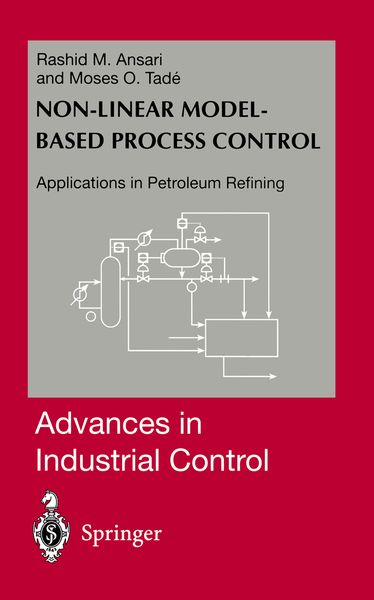
Nonlinear Model-based Process Control Applications in Petroleum Refining

Fr. 137.00

inkl. gesetzl. MwSt., Versandkostenfrei


Beschreibung

Produktdetails

Einband

Taschenbuch

Erscheinungsdatum

12.12.2011

Verlag

Springer London

Seitenzahl

232

Maße (L/B/H)

23.5/15.5/1.5 cm

Gewicht

400 g

Auflage

Softcover reprint of the original 1st ed. 2000

Sprache

Englisch

ISBN

978-1-4471-1192-4

Beschreibung

Rezension

“The book covers many topics. … The book is largely self-contained. It may be useful for the academic control community; also it can serve as a concise reference for technicians interested in the application of nonlinear process control theory related to the petroleum refining industry.” (I.Randvee, zbMATH 0953.93006, 2022) 

Produktdetails

Einband

Taschenbuch

Erscheinungsdatum

12.12.2011

Verlag

Springer London

Seitenzahl

232

Maße (L/B/H)

23.5/15.5/1.5 cm

Gewicht

400 g

Auflage

Softcover reprint of the original 1st ed. 2000

Sprache

Englisch

ISBN

978-1-4471-1192-4

Herstelleradresse

Springer-Verlag KG
Sachsenplatz 4-6
1201 Wien
AT

Email: GPSR Kontakt

Noch keine Bewertungen vorhanden

Verfassen Sie die erste Bewertung zu diesem Artikel

Helfen Sie anderen Kundinnen und Kunden durch Ihre Meinung.

Kundinnen und Kunden meinen

Bewertungen (0)

  • Produktbild: Nonlinear Model-based Process Control
  • Produktbild: Nonlinear Model-based Process Control
  • 1 Introduction.- 1.1 Non-linear Model-based Control.- 1.2 Motivation for this Book.- 1.3 Objectives and Contributions.- 1.3.1 Objectives.- 1.3.2 Contributions.- 1.3.2.1 Non-linear Control Theory and Development.- 1.3.2.1 Practical Applications in Industries.- 1.4 Scope of the Book.- 1.5 Book Overview.- 2 Literature Review.- 2.1 Introduction.- 2.1.1 Industrial Background.- 2.1.2 Academic Background.- 2.2 Model-predictive Control.- 2.2.1 Dynamic Matrix Control (DMC).- 2.2.2 Limitations of DMC.- 2.2.3 Model Algorithm Control (MAC).- 2.2.4 Difference Between DMC and MAC.- 2.2.5 Principal Component Analysis (PCA).- 2.3 Internal Model Control (IMC).- 2.3.1 IMC Theoretical Background.- 2.3.2 Comparison of IMC with DMC and MAC.- 2.3.3 Extensions and Variants of IMC.- 2.4 Stability and Robustness of Linear MPC.- 2.5 Non-linear Model-based Control (NMBC).- 2.5.1 Introduction.- 2.5.2 Non-linear Model-based Control Architecture.- 2.5.2.1 NMBC-Model.- 2.5.2.2 NMBC-Model Parameter Update.- 2.5.2.3 NMBC- Controller Configuration/Simulation.- 2.5.3 Non-linear Control System Technique.- 2.5.4 Non-linear Programming Methods.- 2.6 Generic Model Control (GMC).- 2.6.1 Introduction.- 2.6.2 GMC and Internal Model Control (IMC).- 2.6.3 GMC and Model-predictive Control (MPC).- 2.6.3.1 Discrete form of GMC.- 2.6.3.2 Relationship between Discrete GMC and MPC.- 2.7 Stability and Robustness of Non-linear System.- 2.8 Conclusions and Discussion.- 3 Inferential Models In Non-linear Multivariable Control Applications.- 3.1 Introduction.- 3.2 Development of Inferential Models.- 3.2.1 Overview of Models.- 3.2.2 Non-linear Inferential Control Model.- 3.2.3 Correlation-Based Model.- 3.2.4 Verification of Correlation-Based Model.- 3.3 On-line Applications of Inferential Models.- 3.3.1 Naphtha Final Boiling Point (FBP) of Crude Distillation.- 3.3.2 Kerosene Flash Point of Crude Distillation.- 3.3.3 Reid Vapour Pressure (RVP) of Debutanizer Bottom.- 3.3.4 Iso-Pentane of Debutanizer Overhead.- 3.3.5 Octane Inferential Model for Catalytic Reforming.- 3.4 Tuning of Inferential Models.- 3.5 Inferential Models in Non-linear Multivariable Control Applications.- 3.6 Benefits of Inferential Models.- 3.7 Conclusions.- 4 Non-linear Model-based Multivariable Control of a Debutanizer.- 4.1 Introduction.- 4.2 The Debutanizer Control Strategy.- 4.2.1 Objective.- 4.2.2 Process Description.- 4.2.3 Control Proposal.- 4.2.4 Hardware Consideration.- 4.3 The Non-linear GMC Control Law.- 4.4 GMC Application to Debutanizer.- 4.5 Model Development.- 4.5.1 Steady-State Model Considerations.- 4.5.2 Development of Inferential Models.- 4.5.2.1 RVP of Platformer Feed.- 4.5.2.2 Iso-pentane of the Debutanizer Overhead.- 4.6 Controller Implementation.- 4.6.1 Controller-Process Interface.- 4.6.2 Non-linear Controller Tuning.- 4.7 Results and Discussions.- 4.8 Cost/Benefit Analysis.- 4.8.1 Benefits Calculations.- 4.9 Conclusions.- 5 Non-linear Model-based Multivariable Control of a Crude Distillation Process.- 5.1 Introduction.- 5.2 Crude Distillation Process Control Overview.- 5.2.1 Process Description.- 5.2.2 Control Objectives and Constraints.- 5.2.2.1 Control Objectives.- 5.2.2.2 Control Constraints.- 5.2.3 Dynamic Model with Uncertainty.- 5.3 Non-linear Control Algorithm for Fractionator.- 5.4 Model Parameter Update.- 5.5 Model-predictive Control.- 5.5.1 Problem Formulation for Linear Control.- 5.5.2 MATLAB®/SIMULINK® Programme.- 5.6 Results and Discussions.- 5.6.1 Simulation Results.- 5.6.2 Integrating Top End Point Inferential Model.- 5.6.3 Real —time Implementation Results.- 5.7 Conclusions.- 6 Constrained Non-linear Multivariable Control of a Catalytic Reforming Process.- 6.1 Introduction.- 6.2 Process Constraints Classifications.- 6.3 Constraint Non-linear Multivariable Control.- 6.3.1 Control Theory and Design.- 6.3.2 Selection of Design Parameters.- 6.3.2.1 Selection of K1C and K2C.- 6.3.2.2 Selection of W.- 6.4 Application to Catalytic Reforming Process.- 6.4.1 Dynamic Model of the Process.- 6.4.1.1 Introduction.- 6.4.1.2 Model Development.- 6.4.1.3 Numerical Integration.- 6.4.1.4 Results and Discussion.- 6.4.1.5 Conclusions.- 6.4.2 Non-linear Control Algorithm for Reforming Reactors.- 6.4.2.1 Problem Formulation.- 6.4.2.2 Constrained Non-linear Optimization Problem.- 6.4.3 Non-linear Control Objectives and Strategies.- 6.4.3.1 Control Objectives.- 6.4.3.2 WAIT/Octane Control Strategies.- 6.5 Real-time Implementation.- 6.5.1 Non-linear Controller Tuning.- 6.5.2 Results and Discussions.- 6.6 Conclusions.- 7 Non-linear Multivariable Control of a Fluid Catalytic Cracking Process.- 7.1 Introduction.- 7.2 FCC Process Control Overview.- 7.2.1 Process Description.- 7.2.2 Economic Objectives and Non-linear Control Strategies.- 7.3 Dynamic Model of FCC Process.- 7.3.1 Model Development.- 7.3.1.1 Riser and Reactor Section.- 7.3.1.2 Regenerator Section.- 7.3.2 Results and Discussions.- 7.4 Non-linear Control Algorithm for FCC Reactor-Regenerator System.- 7.5 Dynamic Model Parameter Update.- 7.5.1 Introduction.- 7.5.2 Development of Model Parameter Update System.- 7.5.2.1 Parameter Update Algorithm.- 7.5.2.2 Application to FCC Process.- 7.6 Model-predictive Control.- 7.6.1 Problem Formulation for Linear Control.- 7.6.1.1 Signal Conditioning.- 7.6.1.2 Prediction Trend Correction.- 7.6.1.3 Control Move Calculation.- 7.6.2 Process Identification Tests.- 7.6.2.1 Combustion-air-flow Models.- 7.6.2.2 Feed-flow-rate Models.- 7.6.2.3 Feed-preheat-temperature Models.- 7.6.2.4 Riser-outlet-temperature Models.- 7.7 Real-time Implementation.- 7.7.1 Non-linear Controller Tuning.- 7.7.2 Controller Interface to DCS System.- 7.7.3 Results and Discussions.- 7.7.4 Comparison of Non-linear Control with DMC.- 7.8 Plant Results.- 7.9 Conclusions.- 8 Conclusions and Recommendations.- 8.1 Conclusions.- 8.1.1 Summary of Results Achieved.- 8.1.2 Outline of the Major Contributions of this Research.- 8.2 Recommendations.- 8.2.1 Embedded Optimization for Non-linear Control.- 8.2.2 Non-linear Nonminimum Phase Systems.- 8.2.3 Robust Stability and Performance of Non-linear Systems.- 8.2.4 On-line Parameter Estimation (Model Adaptation).- Appendix A.- A.1 Programme for Pressure-compensated Temperature.- A.2 Programme for Naphtha-final-boiling-point Inferential Model.- A.3 Theory Underlying the Pressure-compensated Temperature.- Appendix B.- B.1 S-B GMC Controller Implementation.- Appendix C.- Constrained Multivariable Control System Programme for Shell Heavy Oil Fractionator.- Appendix D.- D.1 Description and Application of Real-time Optimization (RT-Opt.) Software to Catalytic Reforming Reactor Section.- D.1.1 Description.- D.1.2 Mathematical Algorithm.- D.1.3 Application to Catalytic Reforming Reactor Section.- D.2 Implementation Procedure of Real-time Optimization (RT-Opt.).- Appendix E.- Constrained Multivariable Predictive Control for Fluid Catalytic Cracking (FCC) Process.- References.