Gutscheinbedingungen

*Gültig bis 05.07.2026 auf (fast) alles. Ausgeschlossen sind Smartboxen, Zeitschriften, Tickets, Lebensmittel, Gaming-Elektroartikel, Tinte/Toner, Gutscheine, Geschenkkarten, Blumen und Abos | Einlösbar in allen Buchhandlungen von Orell Füssli, Barth Bücher, Buchladen Rapunzel, Papeterie Köhler, Schuler Orell Füssli, Stauffacher und ZAP unter Vorweisung des Gutscheins, auf www.orellfüssli.ch durch Eingabe des Gutscheincodes. Beim Service „eBooks verschenken“ und bei eBook-Käufen via eReader nicht einlösbar | Mindesteinkaufswert: Fr. 30.- | Nicht mit anderen Rabatten kumulierbar.

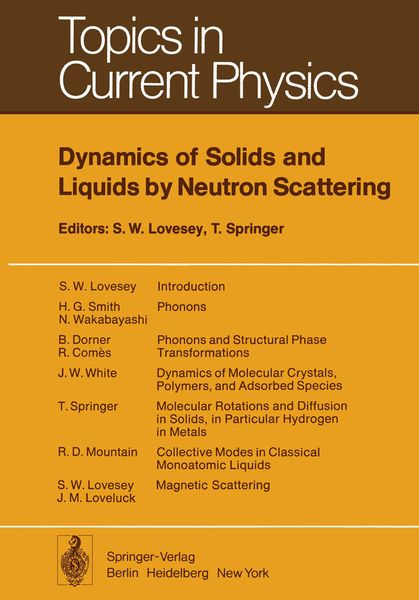
  • Produktbild: Dynamics of Solids and Liquids by Neutron Scattering
  • Produktbild: Dynamics of Solids and Liquids by Neutron Scattering
Band 3

Dynamics of Solids and Liquids by Neutron Scattering

Fr. 72.90

inkl. gesetzl. MwSt., Versandkostenfrei


Beschreibung

Produktdetails

Einband

Taschenbuch

Erscheinungsdatum

07.01.2012

Herausgeber

S. W. Lovesey + weitere

Verlag

Springer Berlin

Seitenzahl

382

Maße (L/B/H)

24.4/17/2.2 cm

Gewicht

688 g

Auflage

Softcover reprint of the original 1st ed. 1977

Sprache

Englisch

ISBN

978-3-642-81115-9

Beschreibung

Produktdetails

Einband

Taschenbuch

Erscheinungsdatum

07.01.2012

Herausgeber

Verlag

Springer Berlin

Seitenzahl

382

Maße (L/B/H)

24.4/17/2.2 cm

Gewicht

688 g

Auflage

Softcover reprint of the original 1st ed. 1977

Sprache

Englisch

ISBN

978-3-642-81115-9

Herstelleradresse

Springer-Verlag KG
Sachsenplatz 4-6
1201 Wien
AT

Email: GPSR Kontakt

Noch keine Bewertungen vorhanden

Verfassen Sie die erste Bewertung zu diesem Artikel

Helfen Sie anderen Kundinnen und Kunden durch Ihre Meinung.

Kundinnen und Kunden meinen

Bewertungen (0)

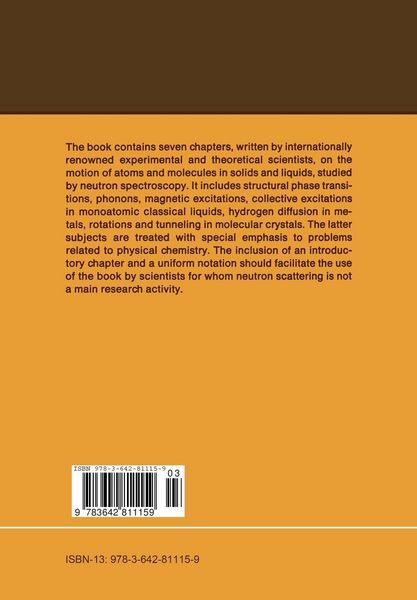
  • Produktbild: Dynamics of Solids and Liquids by Neutron Scattering
  • Produktbild: Dynamics of Solids and Liquids by Neutron Scattering
  • 1. Introduction.- 1.1 Prologue.- 1.2 Correlation Functions.- 1.3 Nuclear Scattering.- 1.3.1 Scattering by Phonons.- 1.3.2 Phonon Interactions.- 1.3.3 Electron-Phonon Interactions.- 1.3.4 Monoatomic Liquids.- 1.3.5 Molecular Gases.- 1.4 Polarization Effects.- 1.5 Magnetic Scattering.- 1.5.1 Ferromagnetic Spin Waves.- 1.5.2 Antiferromagnetic Spin Waves.- 1.5.3 Paramagnetic Scattering.- Appendix A: Crystal Lattices and Reciprocal Lattices.- References.- 2. Phonons.- 2.1 Lattice Dynamics and Neutron Scattering.- 2.1.1 General Model.- 2.1.2 Rigid-Ion and Shell Models.- 2.1.3 Experimental.- 2.2 Lattice Dynamics of Crystals of the Rutile Type — TiO2, MgF2, and MnF2.- 2.2.1 TiO2.- 2.2.2 MgF2.- 2.2.3 MnF2.- 2.2.4 Conclusions.- 2.3 Phonon Anomalies in Superconducting Materials.- 2.3.1 Transition Metal Carbides.- 2.3.2 A-15 Compounds.- 2.3.3 Niobium-Alloys, Other Compounds, and Impurities.- 2.3.4 Other Superconductors — Tc, Mo-Re, Hg.- 2.3.5 Conclusions.- 2.4 Layered Compounds.- 2.4.1 MoS2.- 2.4.2 NbSe2.- 2.4.3 Graphite.- 2.4.4 PbI2.- 2.4.5 Concluding Remarks.- 2.5 Effects of Pressure on Phonon Spectra.- 2.5.1 Experimental Aspects.- 2.5.2 Phonon Shifts and Widths in Neon.- 2.5.3 Selected Phonons in Rubidium as a Function of Temperature and Volume.- 2.5.4 Conclusions.- References.- 3. Phonons and Structural Phase Transformations.- 3.1 Relation Between Neutron and X-Ray Scattering Techniques.- 3.1.1 Elastic and Inelastic Scattering.- 3.1.2 Experimental Technique.- Inelastic Neutron Scattering.- X-Ray Scattering.- 3.1.3 Correlations and Dimensionality in Real and Reciprocal Space.- 3.2 Fluctuations and Order.- 3.2.1 Soft Modes.- 3.2.2 Critical Slowing Down.- 3.2.3 Eigenvector and Order Parameter.- 3.3 Experimental Results.- 3.3.1 Ferrodistortive Transformations.- 3.3.2 Antiferrodistortive Transformations.- 3.3.3 Modulated Lattices and Low Dimensional Systems.- References.- 4. Dynamics of Molecular Crystals, Polymers, and Adsorbed Species.- 4.1 Molecular Crystals.- 4.1.1 Models for the Lattice Dynamics in Molecular Crystals.- 4.1.2 The Lattice Dynamics of ?-Paradichlorobenzene.- 4.1.3 The Dynamics of Hexamethylenetetramine.- 4.1.4 Incoherent Neutron Scattering, Phonon Density of States, and Intramolecular Vibrations.- 4.1.5 Molecular Torsional Motions and Tunneling Spectroscopy.- 4.1.6 Phonon Density of States Measurements by Optical Spectroscopy.- 4.2 Polymers.- 4.2.1 Polyethylene — the Isolated Chain and Incoherent Scattering Studies.- 4.2.2 Polyoxymethylene.- 4.2.3 Biopolymers.- 4.3 Structure and Dynamics of Adsorbed Species.- 4.3.1 Substrates.- 4.3.2 Physisorption.- 4.3.3 Incoherent Scattering.- 4.4 Chemisorption.- 4.4.1 Hydrocarbons Adsorbed on Zeolites.- 4.4.2 Hydrogen Adsorbed on Metals.- 4.5 Intercalation Compounds.- 4.5.1 Tantalum Disulphide-Ammonia.- 4.5.2 Translational Diffusion in Alumino-Silicate Minerals.- 4.6 Conclusions.- References.- 5. Molecular Rotations, and Diffusion in Solids, in Particular Hydrogen in Metals.- 5.1 Diffusion in Solids, in Particular Hydrogen in Metals.- 5.1.1 General Aspects.- 5.1.2 Experiments on Hydrogen in Pd, a fcc-Lattice.- 5.1.3 Hydrogen in the bcc Metals Ta, Nb, and V.- 5.1.4 The Temperature- and Q-Dependence of the Quasielastic Intensity.- 5.1.5 Conclusions on H-Metal Systems; Other Problems of Diffusion in Solids.- 5.2 Rotations in Molecular Solids.- 5.2.1 Rotations and Hindrance Potential; Scattering Law.- 5.2.2 High Temperatures: Rotational Jumps and Rotational Diffusion.- 5.2.3 Fixed-Window-Method.- 5.2.4 Low Temperature Experiments; Quantum Rotations.- 5.3 Liquids, Liquid Crystals, and Related Problems.- 5.3.1 The Scattering Law for Molecular Liquids.- 5.3.2 Liquid Crystals, Polymers.- References.- 6. Collective Modes in Classical Monoatomic Liquids.- 6.1 Collective Modes.- 6.1.1 Collective Variables.- 6.1.2 Generalized Hydrodynamics.- 6.2 Coherent Scattering.- 6.2.1 Insulating Liquids.- 6.2.2 Liquid Metals.- 6.2.3 Comparison of Systems Studied.- 6.3 Transverse Current Correlations.- 6.4 Relations Between S(Q,?) and Ss(Q,?).- 6.5 Current Issues.- References.- 7. Magnetic Scattering.- 7.1 Magnons in Ionic Compounds.- 7.2 Quasi One- and Two-Dimensional Systems.- 7.2.1 Magnetic Linear-Chain Systems.- 7.2.2 Layered Magnetic Systems.- 7.3 Magnons in Metals.- 7.4 Crystal Field Levels in Rare Earth Compounds.- 7.5 Magnons and Excitons in Rare Earth Metals.- 7.6 Critical Magnetic Scattering.- 7.7 Hyperfine Field Measurements.- References.