
Gutscheinbedingungen

*Gültig bis 05.07.2026 auf (fast) alles. Ausgeschlossen sind Smartboxen, Zeitschriften, Tickets, Lebensmittel, Gaming-Elektroartikel, Tinte/Toner, Gutscheine, Geschenkkarten, Blumen und Abos | Einlösbar in allen Buchhandlungen von Orell Füssli, Barth Bücher, Buchladen Rapunzel, Papeterie Köhler, Schuler Orell Füssli, Stauffacher und ZAP unter Vorweisung des Gutscheins, auf www.orellfüssli.ch durch Eingabe des Gutscheincodes. Beim Service „eBooks verschenken“ und bei eBook-Käufen via eReader nicht einlösbar | Mindesteinkaufswert: Fr. 30.- | Nicht mit anderen Rabatten kumulierbar.

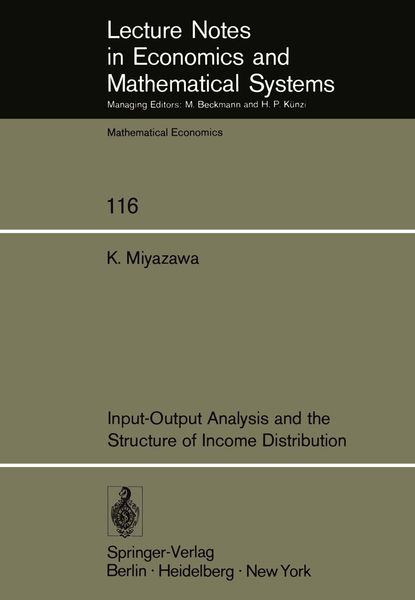
  • Produktbild: Input-Output Analysis and the Structure of Income Distribution
  • Produktbild: Input-Output Analysis and the Structure of Income Distribution
Band 116

Input-Output Analysis and the Structure of Income Distribution

Fr. 171.00

inkl. gesetzl. MwSt., Versandkostenfrei


Beschreibung

Produktdetails

Einband

Taschenbuch

Erscheinungsdatum

01.03.1976

Verlag

Springer Berlin

Seitenzahl

138

Maße (L/B/H)

24.4/17/0.9 cm

Gewicht

282 g

Auflage

Softcover reprint of the original 1st ed. 1976

Sprache

Englisch

ISBN

978-3-540-07613-1

Beschreibung

Produktdetails

Einband

Taschenbuch

Erscheinungsdatum

01.03.1976

Verlag

Springer Berlin

Seitenzahl

138

Maße (L/B/H)

24.4/17/0.9 cm

Gewicht

282 g

Auflage

Softcover reprint of the original 1st ed. 1976

Sprache

Englisch

ISBN

978-3-540-07613-1

Herstelleradresse

Springer-Verlag KG
Sachsenplatz 4-6
1201 Wien
AT

Email: GPSR Kontakt

Noch keine Bewertungen vorhanden

Verfassen Sie die erste Bewertung zu diesem Artikel

Helfen Sie anderen Kundinnen und Kunden durch Ihre Meinung.

Kundinnen und Kunden meinen

Bewertungen (0)

  • Produktbild: Input-Output Analysis and the Structure of Income Distribution
  • Produktbild: Input-Output Analysis and the Structure of Income Distribution
  • One: Input-Output and Income Formation.- 1 Interindustry Analysis and the Structure of Income Distribution.- I. Introduction.- II. Interindustry Analysis and the Process of Distribution and Expenditure of National Income.- 1) The Leontief Multiplier, Keynesian Multiplier and Kalecki Multiplier.- 2) Generalization of the Input-Output Model.- 3) The Coefficients of Inter-Income-Groups.- III. The Relationship of Inter-Income-Groups and the Multi-Sector Income Multiplier.- 1) The Income Multiplier as a Matrix.- 2) Accepted Multipliers as Special Cases.- 3) Structure of the Propagation Process.- IV. The Convergence Conditions of the Model.- 1) The Properties of Leontief-type Matrices.- 2) Convergence Conditions in the Model.- 2 Input-Output Analysis and Interrelational Income Multiplier as a Matrix.- I. Introduction.- II. Formulation of a Regional Income Multiplier in the form of a Matrix.- III. The International Income Multiplier among Regions.- IV. Composition of Final Demand and the Regional Income-Distribution.- V. Output Determination and Interregional Income Generation.- 3 Foreign Trade Multiplier, Input-Output Analysis and the Consumption Function.- I. Introduction.- II. The Foreign Trade Multiplier and the Circular Flow of Intermediate Products.- III. The Modified Multiplier and the Fundamental Equation for an Open Economy.- IV. Interindustry Analysis and the Consumption Function.- V. Empirical Estimates.- VI. Formula for the Computation of the Subjoined Inverse showing the Effect of Endogenous Changes in Consumption.- 1) Derivation of the Computation Formula.- 2) Propagation Process Combining Leontief’s Multiplier and the Keynesian Multiplier.- Two: Internal and External Multipliers.- 4 Internal and External Matrix Multipliers in the Input-Output Model.- I. Introduction.- II. Partitioned Matrix Multipliers.- III. Interregional Repercussion Model.- IV. Some Extensions of the Model.- 1) Extension in the Number of Partitioned Groups.- 2) Inclusion of the Income Formation Process.- 5 An Analysis of the Interdependence between Service and Goods-Producing Sectors.- I. Introduction.- II. Income and Employment Analysis of Interdependency of Two Sectors.- III. Input-Output Analysis of the Interdependency of Two Sectors.- 1) Intersectoral Propagation Pattern.- 2) Cost-Push Effects of Service-Prices.- IV. International Comparison.- Three: Dual Economic Structure.- 6 The Dual Structure of the Japanese Economy and its Growth Pattern.- I. Introduction.- II. Economic Growth and Differentials in Capital Intensity by Size of Firm.- 1) Schema of Capital Concentration and Growth of Enterprises.- 2) Differentials in Wages and Capital Intensity.- 3) Permanence of the Dual Structure.- III. Differentials in Composition of Funds and Interest Rates.- 1) Funds of Enterprises and Capital Accessibility.- 2) Differentials in Interest Rates on Borrowed Funds and Cost of Funds.- 3) Differentials in Interest Rates and Unequal Distribution of Loans.- IV. Structural Peculiarities of Capital Concentration.- 1) Factor Proportion and Differentials in Wages and Interest Rates.- 2) Structural Peculiarities of Capital Concentration in Japan.- V. Conclusion.- References.