
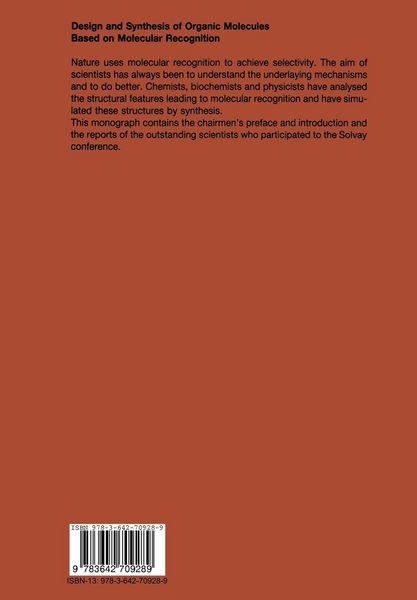
Design and Synthesis of Organic Molecules Based on Molecular Recognition Proceedings of the XVIIIth Solvay Conference on Chemistry Brussels, November 28 - December 01, 1983
-
- Taschenbuch ausgewählt
- eBook
-
Sprache:Englisch
Fr. 137.00
inkl. gesetzl. MwSt.,
Beschreibung
Produktdetails
Einband
Taschenbuch
Erscheinungsdatum
19.11.2011
Herausgeber
Georges van BinstVerlag
Springer BerlinSeitenzahl
316
Maße (L/B/H)
24.4/17/1.9 cm
Gewicht
581 g
Auflage
Softcover reprint of the original 1st ed. 1986
Sprache
Englisch
ISBN
978-3-642-70928-9
A topic for a Solvay Conference should be general enough to conform with the great tradition of previous conferences. On the other hand it should not be so broad that it can not be covered during the limited time of the conference. After discussion of several such topics, "Design and Synthesis of Organic Molecules Based on Molecular Recognition" was chosen. According to Albert Einstein we live in an era of perfect methods and confused aims. For example in organic chemistry the known synthetic methods allow us to prepare an astronomical number of compounds; the gap between the possible and the relevant becomes larger every day. After discovery and classification of the main types of reactions, the study of the selectivity of reactions becomes of paramount importance. One can learn quite a lot from Nature, which uses molecular recognition to achieve selec tivity in a degree so far unattainable by mere mortals. To analyze the structural features applied by Nature, to accomplish high molecular recog nition, and to simulate these features by synthesis have recently become therefore favorite occupations of chemists. The purpose of this conference was to bring together two groups, the analysts and the syntheticists, to discuss the present status of the knowledge. This monograph contains the chairman's introduction in which he has summarized the main points at issue and the contributions of the renowned scientists who participated. The organizers hope that it will stimulate further research in this fascinating field.
Noch keine Bewertungen vorhanden
Verfassen Sie die erste Bewertung zu diesem Artikel
Helfen Sie anderen Kundinnen und Kunden durch Ihre Meinung.