• Produktbild: Project Engineering
  • Produktbild: Project Engineering

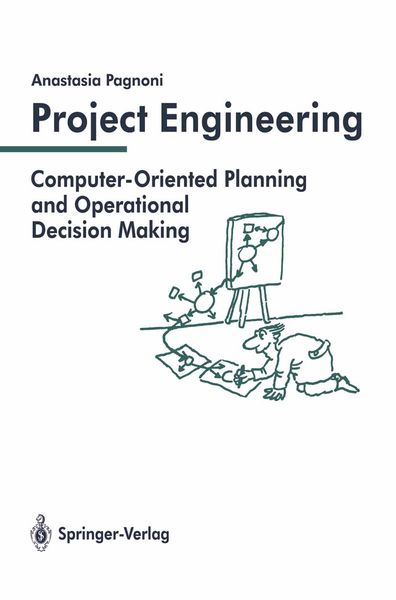
Project Engineering Computer-Oriented Planning and Operational Decision Making

Fr. 72.90

inkl. gesetzl. MwSt., Versandkostenfrei


Beschreibung

Produktdetails

Einband

Taschenbuch

Erscheinungsdatum

28.01.2012

Verlag

Springer Berlin

Seitenzahl

239

Maße (L/B/H)

23.5/15.5/1.5 cm

Gewicht

399 g

Auflage

Softcover reprint of the original 1st ed. 1990

Sprache

Englisch

ISBN

978-3-642-75632-0

Beschreibung

Produktdetails

Einband

Taschenbuch

Erscheinungsdatum

28.01.2012

Verlag

Springer Berlin

Seitenzahl

239

Maße (L/B/H)

23.5/15.5/1.5 cm

Gewicht

399 g

Auflage

Softcover reprint of the original 1st ed. 1990

Sprache

Englisch

ISBN

978-3-642-75632-0

Herstelleradresse

Springer-Verlag KG
Sachsenplatz 4-6
1201 Wien
AT

Email: ProductSafety@springernature.com

Kundinnen und Kunden meinen

0 Bewertungen

Informationen zu Bewertungen

Zur Abgabe einer Bewertung ist eine Anmeldung im Konto notwendig. Die Authentizität der Bewertungen wird von uns nicht überprüft. Wir behalten uns vor, Bewertungstexte, die unseren Richtlinien widersprechen, entsprechend zu kürzen oder zu löschen.

Die Bewertungen sind nach Format, Anzahl Sterne und Datum sortiert.

Verfassen Sie die erste Bewertung zu diesem Artikel

Helfen Sie anderen Kund*innen durch Ihre Meinung

Kundinnen und Kunden meinen

0 Bewertungen filtern

  • Produktbild: Project Engineering
  • Produktbild: Project Engineering
  • 1. Survey of Methodologies.- 2. Planning with Temporal Constraints.- 2.1 Graphs, Weighted Graphs, Bipartite Graphs.- Subgraphs.- Digraphs.- Walks in Graphs and Digraphs.- Connected Graphs, Weakly and Strongly Connected Digraphs.- Trees.- Graph Matrices.- Digraph Representation of Plans.- 2.2 Activity Networks.- Planning with Activity Networks.- Activity Network Unfoldings.- 3. Disciplined Planning.- 3.1 Top-Down Development of Plans.- 3.2 Disciplined Planning Syntax.- 4. Planning under Precedence/Duration Constraints: Networking Techniques.- 4.1 No Choices, No Cycles, Known Durations: CPM.- Execution Control: Event Time Bounds.- Critical Paths.- Event Realization Slacks.- Activity Time Bounds.- 4.2 No Choices, No Cycles, Known Direct Costs: Cost-CPM.- Updating of Time Schedule and Cost Plan.- Cost Optimization.- Analytical Cost Optimization Algorithm.- A Heuristic Speeding Up Algorithm.- Operational Considerations.- 4.3 No Choices, No Cycles, Beta-Distributed Durations: PERT.- Probability Distribution of Activity Durations.- The Beta Distribution.- The Critical Path Question.- Investigation of Project Completion Time.- Warnings about Improper Use of PERT.- PERT Cost Planning and Optimization.- Operational Considerations.- 4.4 Choices, Cycles, Random Durations: GERT.- Event Realization “Logics”.- Network Structure.- Probability Distribution of Activity Durations.- STEOR Networks and Markov Renewal Processes.- The MRP Method.- Simulation of GERT Networks.- 5. Clock-Independent Planning: Petri Nets.- 5.1 Causal Interconnection of State and Transition Elements: Nets.- Enabling, Steps, Reachability.- Pure Nets, Simple Nets.- S-Graph, T-Graph, Free Choice Net.- Subnets, S-Vectors, T-Vectors.- 5.2 Causal Interconnection of Conditions and Events: CE Nets.- About Petri Net Plans.- 5.3 Causal Interconnection of Resources and Operations: FT Nets.- Incidence Matrix.- Reachability Graph.- Liveness, Stop States and Home States.- 5.4 Conservation of Resource Counts and Reproduction of States: S- and T-Invariants.- Calculation of Invariants.- Project Analysis by Means of Invariants.- 5.5 Representing Operations with Variable Resources Compactly: an Outline of PrT Nets.- 6. Net Plan Executions.- 6.1 Representing Net Plan Executions.- Execution Nets.- 6.2 Figuring Out Execution Alternatives: Control Nets.- 7. Choosing a Course of Action: Operational Decision Making.- 7.1 Execution Alternatives.- 7.2 The Formal Representation of Vagueness: Fuzzy Sets.- 7.3 Fuzzy Attributes.- Attributes over Operations.- Attributes over Alternatives.- Attributes over Executions.- 7.4 Preference Degree of Executions. Optimal Executions.- Weighted Attributes.- 7.5 Clustering Executions into Preference Classes: Fuzzy Outranking.- Fuzzy Outranking Relation.- Classification of Executions.- Singling out Best Executions: Dichotomy.- Partitioning Executions into Preference Classes: Polychotomy.- References.- Further Reading.