
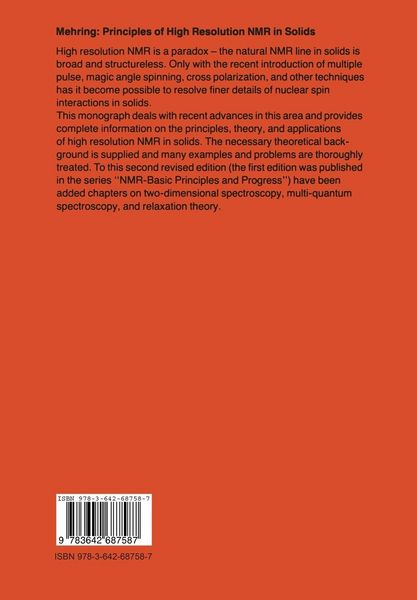
• Produktbild: Principles of High Resolution NMR in Solids
  • Produktbild: Principles of High Resolution NMR in Solids

Principles of High Resolution NMR in Solids

Fr. 112.00

inkl. gesetzl. MwSt., Versandkostenfrei


Beschreibung

Produktdetails

Einband

Taschenbuch

Erscheinungsdatum

19.01.2012

Verlag

Springer Berlin

Seitenzahl

344

Maße (L/B/H)

24.4/17/2 cm

Gewicht

614 g

Auflage

Second Edition 1983

Sprache

Englisch

ISBN

978-3-642-68758-7

Beschreibung

Produktdetails

Einband

Taschenbuch

Erscheinungsdatum

19.01.2012

Verlag

Springer Berlin

Seitenzahl

344

Maße (L/B/H)

24.4/17/2 cm

Gewicht

614 g

Auflage

Second Edition 1983

Sprache

Englisch

ISBN

978-3-642-68758-7

Herstelleradresse

Springer-Verlag KG
Sachsenplatz 4-6
1201 Wien
AT

Email: ProductSafety@springernature.com

Kundinnen und Kunden meinen

0 Bewertungen

Informationen zu Bewertungen

Zur Abgabe einer Bewertung ist eine Anmeldung im Konto notwendig. Die Authentizität der Bewertungen wird von uns nicht überprüft. Wir behalten uns vor, Bewertungstexte, die unseren Richtlinien widersprechen, entsprechend zu kürzen oder zu löschen.

Die Bewertungen sind nach Format, Anzahl Sterne und Datum sortiert.

Verfassen Sie die erste Bewertung zu diesem Artikel

Helfen Sie anderen Kund*innen durch Ihre Meinung

Kundinnen und Kunden meinen

0 Bewertungen filtern

  • Produktbild: Principles of High Resolution NMR in Solids
  • Produktbild: Principles of High Resolution NMR in Solids
  • 1 Introduction.- 2 Nuclear Spin Interactions in Solids.- 2.1 Basic Nuclear Spin Interactions in Solids.- 2.2 Spin Interactions in High Magnetic Fields.- 2.3 Transformation Properties of Spin Interactions in Real Space.- 2.4 Powder Spectrum Line Shape.- 2.5 The NMR Spectrum. Lineshapes and Moments.- 2.6 Magic Angle Spinning (MAS).- 2.7 Rapid Anisotropic Molecular Rotation.- 2.8 Line Shapes in the Presence of Molecular Reorientation.- 3 Multiple-Pulse NMR Experiments.- 3.1 Idealized Multiple-Pulse Sequences.- 3.2 The Four-Pulse Sequence (WHH-4).- 3.3 Coherent Averaging Theory.- 3.4 Application of Coherent Averaging Theory to Multiple-Pulse Sequences.- 3.5 Arbitrary Rotations and Finite Pulse Width in Multiple-Pulse Experiments.- 3.6 Second Averaging.- 3.7 The Influence of Pulse Imperfections on Multiple-Pulse Experiments.- 3.8 Resolution of Multiple-Pulse Experiments.- 3.9 Magic Angle Rotating Frame Line Narrowing Experiments.- 3.10 Modulation Induced Line Narrowing.- 3.11 Applications of Multiple-Pulse Experiments.- 4 Double Resonance Experiments.- 4.1 Basic Principles of Double Resonance Experiments.- 4.2 Cross-Polarization of Dilute Spins.- 4.3 Cross-Polarization Dynamics.- 4.4 Spin-Decoupling Dynamics.- 4.5 Application of Cross-Polarization Experiments.- 5 Two-Dimensional NMR Spectroscopy.- 5.1 Basic Principles of 2 D-Spectroscopy.- 5.2 2D-Spectroscopy of 13C-1H Interactions in Solids.- 5.3 Applications of 2D-Spectroscopy.- 6 Multiple-Quantum NMR Spectroscopy.- 6.1 Double-Quantum Decoupling.- 6.2 The Three-Level System; Double Quantum Coherence.- 6.3 Multiple-Quantum Coherence.- 6.4 Selective Multiple-Quantum Coherence.- 6.5 Double-Quantum Cross-Polarization.- 7 Magnetic Shielding Tensor.- 7.1 Ramsey’s Formula.- 7.2 Approximate Calculations of the Shielding Tensor.- 7.3 Proton Shielding Tensors.- 7.4 19F Shielding Tensors.- 7.5 13C Shielding Tensors.- 7.6 Other Shielding Tensors.- 8 Spin-Lattice Relaxation.- 8.1 Spin-Lattice Relaxation in the Weak Collision Limit.- 8.2 Spin-Lattice Relaxation in Multiple-Pulse Experiments.- 8.3 Application of Multiple-Pulse Experiments to the Investigation of Spin-Lattice Relaxation.- 8.4 Spin-Lattice Relaxation in Dilute Spin Systems.- 8.5 Selective Excitation and Spectral Diffusion.- 9 Appendix.- A Irreducible Tensor Representation of Spin Interactions.- B Rotations.- C General Line Shape Theory.- D Homogeneous, Inhomogeneous and Heterogeneous Lineshapes.- E Lineshape and Relaxation due to Fluctuating Chemical Shift Tensors.- F Time Evolution and Magnus Expansion.- G Coherent Versus Secular Averaging Theory.- H Applications of Average Hamiltonian Theory.- I Relaxation Theory.- 10 References.- 11 Subject Index.