
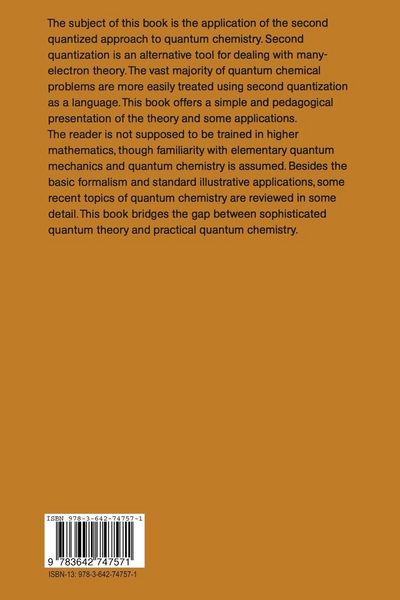
• Produktbild: Second Quantized Approach to Quantum Chemistry
  • Produktbild: Second Quantized Approach to Quantum Chemistry

Second Quantized Approach to Quantum Chemistry An Elementary Introduction

Fr. 112.00

inkl. gesetzl. MwSt., Versandkostenfrei


Beschreibung

Produktdetails

Einband

Taschenbuch

Erscheinungsdatum

13.12.2011

Verlag

Springer Berlin

Seitenzahl

184

Maße (L/B/H)

23.5/15.5/1.2 cm

Gewicht

318 g

Auflage

Softcover reprint of the original 1st ed. 1989

Sprache

Englisch

ISBN

978-3-642-74757-1

Beschreibung

Produktdetails

Einband

Taschenbuch

Erscheinungsdatum

13.12.2011

Verlag

Springer Berlin

Seitenzahl

184

Maße (L/B/H)

23.5/15.5/1.2 cm

Gewicht

318 g

Auflage

Softcover reprint of the original 1st ed. 1989

Sprache

Englisch

ISBN

978-3-642-74757-1

Herstelleradresse

Springer-Verlag KG
Sachsenplatz 4-6
1201 Wien
AT

Email: ProductSafety@springernature.com

Kundinnen und Kunden meinen

0 Bewertungen

Informationen zu Bewertungen

Zur Abgabe einer Bewertung ist eine Anmeldung im Konto notwendig. Die Authentizität der Bewertungen wird von uns nicht überprüft. Wir behalten uns vor, Bewertungstexte, die unseren Richtlinien widersprechen, entsprechend zu kürzen oder zu löschen.

Die Bewertungen sind nach Format, Anzahl Sterne und Datum sortiert.

Verfassen Sie die erste Bewertung zu diesem Artikel

Helfen Sie anderen Kund*innen durch Ihre Meinung

Kundinnen und Kunden meinen

0 Bewertungen filtern

  • Produktbild: Second Quantized Approach to Quantum Chemistry
  • Produktbild: Second Quantized Approach to Quantum Chemistry
  • 1 Introduction.- 1.1 Importance of Second Quantization.- 1.2 The One-Electron Model.- 2 Concept of Creation and Annihilation Operators.- 2.1 The Vacuum State.- 2.2 Creating Electrons.- 2.3 Particle Number Representation.- 2.4 Annihilating Electrons.- 2.5 Commutator Relation between Creation and Annihilation Operators.- 2.6 The Adjoint Relation — Role of Orthogonality of One-Particle States.- 2.7 Summary of the Properties of Creation/Annihilation Operators.- 3 Particle Number Operators.- 4 Second Quantized Representation of Quantum Mechanical Operators.- 4.1 General.- 4.2 One-Electron Operators.- 4.3 Two-Electron Operators.- 4.4 Second Quantized Form of the Born-Oppenheimer Hamiltonian.- 4.5 Hermiticity of Second Quantized Operators.- 5 Evaluation of Matrix Elements.- 5.1 Basic Matrix Elements.- 5.2 Concept of the Fermi Vacuum.- 6 Advantages of Second Quantization — Illustrative Examples.- 6.1 General.- 6.2 Overlap of two Determinants.- 6.3 Hückel Energy Expression.- 6.4 Interaction of Two Electrons.- 7 Density Matrices.- 7.1 First-Order Density Matrix.- 7.2 Second-Order Density Matrix.- 7.3 Hartree-Fock Energy Expression.- 8 Connection to “Bra and Ket” Formalism.- 9 Using Spatial Orbitals.- 10 Some Model Hamiltonians in Second Quantized Form.- 10.1 ?-Electron Hamiltonians.- 10.1.1 Hückel Level.- 10.1.2 Hubbard Model.- 10.1.3 Pariser-Parr-Pople (PPP) Model.- 10.2 Particle-Hole Symmetry.- 10.3 All-Valence Electron Hamiltonians.- 10.4 The Hartree-Fock Hamiltonian.- 11 The Brillouin Theorem.- 12 Many-Body Perturbation Theory.- 13 Second Quantization for Nonorthogonal Orbitals.- 13.1 Anticommutation Rules.- 13.2 The Hamiltonian in Nonorthogonal Representations.- 13.3 Extended Hückel Theory.- 14 Second Quantization and Hellmann-Feynman Theorem.- 14.1 General.- 14.2 Variation of Energy-Orthogonal Basis Set.- 14.3 Variation of Energy-Nonorthogonal Basis Set.- 14.4 Special Case: The SCF Gradient Formula.- 15 Intermolecular Interactions.- 15.1 The Operator for Interaction.- 15.2 Symmetry-Adapted Perturbation Theory.- 16 Quasiparticle Transformations.- 16.1 One-Particle Transformations.- 16.2 Two-Particle Transformations.- 16.3 A Theory of the Local Chemical Bond.- 17 Miscellaneous Topics Related to Second Quantization.- 17.1 Spin Operators and Spin Hamiltonians.- 17.2 Unitary Group Approach.- 18 Problem Solutions.- 19 References.