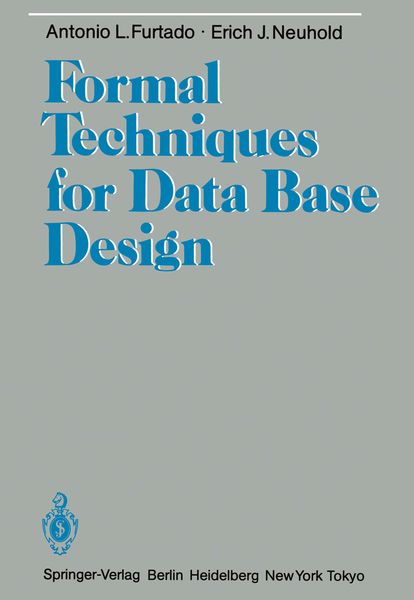
• Produktbild: Formal Techniques for Data Base Design
  • Produktbild: Formal Techniques for Data Base Design

Formal Techniques for Data Base Design

Fr. 72.90

inkl. gesetzl. MwSt., Versandkostenfrei


Beschreibung

Produktdetails

Einband

Taschenbuch

Erscheinungsdatum

10.12.2011

Verlag

Springer Berlin

Seitenzahl

114

Maße (L/B/H)

24.4/17/0.8 cm

Gewicht

232 g

Auflage

Softcover reprint of the original 1st edition 1986

Sprache

Englisch

ISBN

978-3-642-70594-6

Beschreibung

Produktdetails

Einband

Taschenbuch

Erscheinungsdatum

10.12.2011

Verlag

Springer Berlin

Seitenzahl

114

Maße (L/B/H)

24.4/17/0.8 cm

Gewicht

232 g

Auflage

Softcover reprint of the original 1st edition 1986

Sprache

Englisch

ISBN

978-3-642-70594-6

Herstelleradresse

Springer-Verlag KG
Sachsenplatz 4-6
1201 Wien
AT

Email: GPSR Kontakt

Noch keine Bewertungen vorhanden

Verfassen Sie die erste Bewertung zu diesem Artikel

Helfen Sie anderen Kundinnen und Kunden durch Ihre Meinung.

Kundinnen und Kunden meinen

Bewertungen (0)

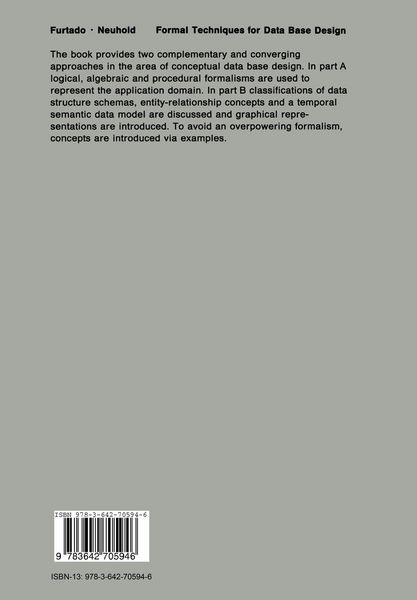
  • Produktbild: Formal Techniques for Data Base Design
  • Produktbild: Formal Techniques for Data Base Design
  • 1 General Introduction — Two Approaches to Formal Data Base Design.- A — Application-Oriented Approach.- 2 Introduction to Part A.- 3 An Informal Outline.- 3.1 Information Level.- 3.2 Functions Level.- 3.3 Representation Level.- 3.4 Placing the Formalisms.- 4 The Information Level — The Use of Logical Formalisms.- 4.1 Logical Formalisms.- 4.2 An Example.- 5 The Functions Level — The Use of Algebraic Formalisms.- 5.1 Algebraic Formalisms.- 5.2 Obtaining a Functions Level Specification — An Example.- 5.3 First to Second Level Refinements.- 5.4 Proof of Correctness of the Refinement — An Example.- 6 The Representation Level —The Use of a Programming Language Formalism.- 6.1 Programming Language Formalism.- 6.1.1 Syntax — The Use of a Grammatical Formalism.- 6.1.2 Semantics — The Use of a Denotational Formalism.- 6.2 Obtaining a Representation Level Specification — An Example.- 6.3 Second to Third Level Refinements.- 6.4 Proof of Correctness of the Refinement — An Example.- B — Semantic Data Models.- 7 Introduction to Part B.- 8 The Logical Database Model.- 8.1 The Semantic Framework.- 8.1.1 Reality and the Real World States.- 8.1.2 The Natural Language State Description.- 8.1.3 The Abstract Model and the Standard Interpretation.- 8.1.4 The Logical State Description and the Interpretation IDB.- 8.1.5 Conventional Data Bases — The Syntactical View.- 8.2 The Logical Data Definition Language.- 8.2.1 Type Declarations.- 8.2.2 The Clause of a Type Declaration.- 8.2.3 The Clause of a Type Declaration.- 8.2.4 The Clause of a Type Declaration.- 8.2.5 Relation Declarations.- 8.2.6 The Clause of Relation Declarations.- 8.2.7 The Clause of Relation Declarations.- 8.3 The Logical Data Language LDL.- 9 The Entity-Relationship Model.- 9.1 The Entity-Relationship-Value Concept.- 9.1.1 Level 1: Entities, Relationships, Values.- 9.1.2 Level 2: Entity-Relationship Diagram.- 9.1.3 Level 3: Entity Relations, Relationship Relations and Relation Tables.- 9.2 Data Types and the Entity-Relationship Model.- 9.2.1 Generalization/Specialization.- 9.2.2 Aggregation.- 9.2.3 Grouping.- 9.3 Existence and Identification Constraints in the Extended ER-Model.- 9.3.1 Constraints Related to Generalization/Specialization.- 9.3.2 Constraints Related to Aggregation.- 9.3.3 Constraints Related to Grouping.- 9.4 An Example Using the Extended ER-Model.- 10 The Temporal Hierarchic Model.- 10.1 The Basic Concepts of THM.- 10.2 The Notions of Time in THM.- 10.3 The Operational Facilities of the Temporal Hierarchic Model.- 10.3.1 The Basic State Manipulation Actions.- 10.3.2 Complex State Manipulation Actions.- 11 Conclusion.- 12 References.- 13 Subject Index.