• Produktbild: Remote Sensing of the Earth from Space: Atmospheric Correction
  • Produktbild: Remote Sensing of the Earth from Space: Atmospheric Correction

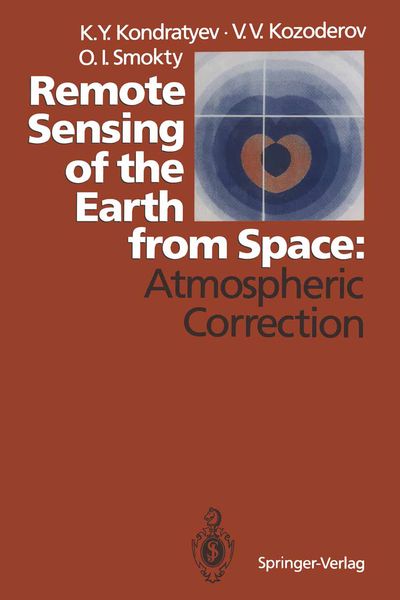
Remote Sensing of the Earth from Space: Atmospheric Correction

Fr. 137.00

inkl. gesetzl. MwSt., Versandkostenfrei


Beschreibung

Produktdetails

Einband

Taschenbuch

Erscheinungsdatum

11.01.2012

Verlag

Springer Berlin

Seitenzahl

478

Maße (L/B/H)

23.5/15.5/2.7 cm

Gewicht

743 g

Auflage

Softcover reprint of the original 1st ed. 1992

Sprache

Englisch

ISBN

978-3-642-76749-4

Beschreibung

Produktdetails

Einband

Taschenbuch

Erscheinungsdatum

11.01.2012

Verlag

Springer Berlin

Seitenzahl

478

Maße (L/B/H)

23.5/15.5/2.7 cm

Gewicht

743 g

Auflage

Softcover reprint of the original 1st ed. 1992

Sprache

Englisch

ISBN

978-3-642-76749-4

Herstelleradresse

Springer-Verlag KG
Sachsenplatz 4-6
1201 Wien
AT

Email: GPSR Kontakt

Noch keine Bewertungen vorhanden

Verfassen Sie die erste Bewertung zu diesem Artikel

Helfen Sie anderen Kundinnen und Kunden durch Ihre Meinung.

Kundinnen und Kunden meinen

Bewertungen (0)

  • Produktbild: Remote Sensing of the Earth from Space: Atmospheric Correction
  • Produktbild: Remote Sensing of the Earth from Space: Atmospheric Correction
  • 1 Optical-Physical Models of Atmospheric Aerosol.- 1.1 Complex Optical Models of Atmospheric Aerosol.- 1.2 Application of Mie Theory in Determining the Optical Parameters of Atmospheric Aerosol.- 1.3 Closed Modeling of the Optical Characteristics of Atmospheric Aerosol.- 2 The Radiation-Environment Interaction.- 2.1 Basic Definitions in Photometry.- 2.2 Equations of Interaction Between Radiation and Randomly Inhomogeneous Media.- 2.3 The Filtering Role of the Optical Radiation Sensors.- 2.4 Coherence Functions.- 2.5 The Structure of the Brightness Field and the Structuring of Computation Programs.- 2.6 Partially Coherent Waves Coherence Matrices.- 3 Theoretical Models of the Non-Polarized Optical Radiation in the Atmosphere-Surface System.- 3.1 Justification of the Necessity to Consider the Distorting Effect of the Atmosphere when Surveying the Earth from Space.- 3.2 Calculating Facilities of the Analytical and Numerical Methods of the Radiation Transfer Theory.- 3.3 Setting the Problem of Theoretical Determination of Scalar Asymptotic Transfer Functions of the Atmosphere.- 3.4 An Accurate Solution for the Problem of Diffused Reflection and Transmission of Light by the Terrestrial Atmosphere for Model Phase Functions.- 3.5 Algorithm to Determine the Azimuthal Harmonics of ?m and ?m Brightness Coefficients.- 3.6 Linear Integral Equations for Basic Functions.- 3.7 Application of the Specular Reflection Principle in the Theory of Radiation Transfer.- 3.8 The Meaning in Probability Terms of Basic $$\Omega _{\text{i}}^{\text{m}} $$ and $$\theta_{\text{i}}^{\text{m}} $$ Functions.- 3.9 Accurate Expressions for the Azimuthal Harmonics of Brightness Coefficients ?m and ?m for an Approximating Three-Term Phase Function (m = 0,1,2).- 3.10 Atmospheric Albedo, Spherical Albedo and Irradiance of the Planetary Surface.- 3.11 Approximate Expressions for the Coefficients of Diffused Reflection and Transmission with an Arbitrary Phase Function.- 3.12 Determination of the Parameters of the Radiation Field with the Use of an Advanced Method of Spherical Harmonics.- 4 A One-Dimensional Scalar Transfer Function of the Atmosphere.- 4.1 Theoretical Assessment of the Spectral Transfer Function for the Brightnesses of a Horizontally Homogeneous Surface.- 4.2 On the Solution of Inverse Problems of Space-Based Atmospheric Optics for Model Phase Functions.- 4.3 Tabulating Basic Constituents of the Scalar Transfer Function of an Aerosol Atmosphere.- 4.4 The Effect of the Non-Orthotropic Surface on the Radiation Field.- 4.5 Results of Numerical Modeling of the Background Spectral Transfer Functions.- 4.6 Diagrams of an Optimization of the Transforming Effect of the Atmosphere when Surveying the Earth from Space.- 4.7 The Geographical and Seasonal Distribution of the Transfer Function Monochromatic Values.- 4.8 The Effect of Atmospheric Haze on the Colour of Natural Formations.- 4.9 An Assessment of the Polarization Transfer Function of the Atmosphere.- 4.10 The Effect of the Atmosphere on the Spectral Albedo of Natural Formations.- 4.11 The Geographical and Seasonal Change of the Transfer Function for Albedo.- 5 The Effect of Horizontal Inhomogeneities of the Underlying Surface on the Scalar Transfer Function of the Atmospheric.- 5.1 Setting the Problem of Theoretical Estimation of a 2-Dimensional (2-D) Atmospheric Transfer Function.- 5.2 The Effect of the Atmospheric Optical Parameters and of the Conditions of Survey on a 2-D Transfer Function.- 5.3 The Effect of the Horizontally Inhomogeneous Constituent of the Scattered Radiation.- 5.4 An Assessment of the Effect of Horizontal Diffusion of Photons on the Spectral Transfer Function.- 5.5 An Approximate Assessment of the Transfer Function for a Surface Formed by Two Horizontally Homogeneous Half-Planes.- 5.6 A Comparison of Experimental and Theoretical Estimates of the Spectral Transfer Functions.- 5.7 The Effect of the Atmospheric Radiative Factors on the Detection of the Small-Sized Optical Inhomogeneities of the Terrestrial Surface.- 5.8 The Formation of Reflection Spectra Near the Interface Between Two Horizontally Homogeneous Media.- 6 Radiative Correction of the Space-Derived Images of the Earth Surface.- 6.1 Setting the Problem of Atmospheric Radiative Correction.- 6.2 The Status of the Problem of Radiative Correction of Multispectral Space-Derived Images.- 6.3 An Approximation of the Dependences of Outgoing Radiation Intensities by Orthogonal Polynomials.- 6.4 Sensitivity of the Calculation Scheme Considering the Atmospheric Haze Brightness to Variations in the Initial Data.- 6.5 Atmospheric Filter for Spatial Frequencies.- 6.6 Retrieving the Spatial Structure of an Ideal Image.- 6.7 A Regularized Solution for Inverse Problem.- 6.8 Results of Radiative Correction of the Digitized Photographic and Scanner Information.- 6.9 Comparison of Results of Surface Albedo Estimation from Satellites and Aircraft.- 6.10 Thematic Interpretation of Air- and Space-Derived Digitized Video Information.- 6.10.1 Improving the Properties of Images.- 6.10.2 Principles of Recognition of Images.- 6.10.3 Features of the Applied Method for Classification.- 6.10.4 Classification of Images Before and After Their Radiative Correction.- 6.11 Atmospheric Correction as One of the Stages of Thematic Interpretation of Video Information.- 6.11.1 A Comparative Analysis of Space Images and Spectra.- 6.11.2 The Stages of Atmospheric Correction of Video Information.- 6.11.3 The Morphological and Structural Analysis of Images.- 6.11.4 The Technology of Atmospheric Correction of Video Information.- 6.12 An Assessment of the State of Natural Objects from Remote Sensing Data.- 6.12.1 Models of Multifactor Regression.- 6.12.2 Interactive Classification of Soils and Vegetation from Mid-Resolution Images.- 6.13 The Structure and Principal Elements of the Automated System of Processing Digital Aerospace Video Information.- 7 Models of Interaction of the Shortwave and Longwave Components of the Radiation Budget with the Atmosphere and the Earth Surface.- 7.1 The Boundary Problems of Shortwave Radiation Transfer.- 7.2 Cross-Sections of Interaction and Phase Functions.- 7.3 The Solution of the Boundary Problem for Shortwave Radiation.- 7.4 Possibilities of Reducing Computer Time.- 7.5 Consideration of Non-Orthotropicity and Horizontal Inhomogeneity of the Earth-Surface.- 7.6 The Longwave Radiation Transfer.- 7.7 Radiation Fluxes and Heat Flux Divergences in Radiation-Balance Models.- 8 Observations of the Earth Radiation Budget from Space.- 8.1 The Status of the Problem of Retrieving the Heat and Radiation Budgets of the Earth’s Surface.- 8.2 Empirical Analysis of the Earth’s Radiation Budget Components.- 8.3 The Variability of the ERB Components from Satellite Measurements.- 8.4 The Retrieval of the Radiation and Heat Budgets of the Earth’s Surface.- 8.5 The Interannual Variability of Radiation Budget at the Upper and Lower Boundaries of the Atmosphere.- 8.6 Cloudiness as a Factor of Interannual Variability of the Radiation Budget.- 8.7 Statistical Characteristics of Anomalies of the 2-D Fields of the Radiation Budget of the North Atlantic.- 8.8 Anomalies of the Radiation Budget and the EAZO Problem.- 8.9 Teleconnections Between the ERB Anomalies in Tropical and Mid-Latitudes.- 8.10 Prospects for Using Satellite Measurements in Climate Studies.- Conclusion.- References.