• Produktbild: The Book of Prime Number Records
  • Produktbild: The Book of Prime Number Records

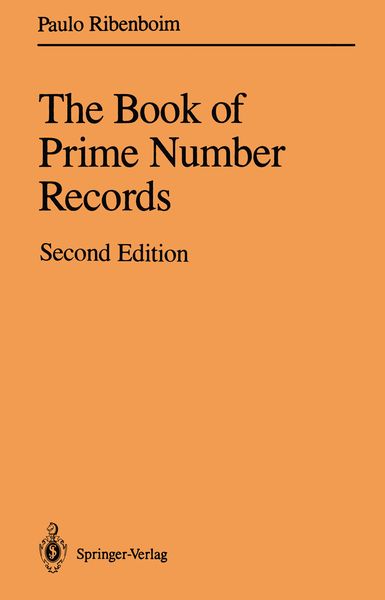
The Book of Prime Number Records

Fr. 147.00

inkl. gesetzl. MwSt., Versandkostenfrei


Beschreibung

Produktdetails

Einband

Taschenbuch

Erscheinungsdatum

05.02.2012

Verlag

Springer Us

Seitenzahl

479

Maße (L/B/H)

23.5/15.5/2.8 cm

Gewicht

756 g

Auflage

Second Edition 1989

Sprache

Englisch

ISBN

978-1-4684-0509-5

Beschreibung

Rezension

Third Edition


P. Ribenboim


The New Book of Prime Number Records


"A number-theoretical version of the Guinness Book of Records . . . There is much mathematics to be found in these pages. These are records given here as well. This book is written with much wit. Experts may not find much that is new, but it is always worthwhile to view the history of a subject as a whole rather than a collection of isolated results."—
MATHEMATICAL REVIEWS

Produktdetails

Einband

Taschenbuch

Erscheinungsdatum

05.02.2012

Verlag

Springer Us

Seitenzahl

479

Maße (L/B/H)

23.5/15.5/2.8 cm

Gewicht

756 g

Auflage

Second Edition 1989

Sprache

Englisch

ISBN

978-1-4684-0509-5

Herstelleradresse

Libri GmbH
Europaallee 1
36244 Bad Hersfeld
DE

Email: GPSR Kontakt

Noch keine Bewertungen vorhanden

Verfassen Sie die erste Bewertung zu diesem Artikel

Helfen Sie anderen Kundinnen und Kunden durch Ihre Meinung.

Kundinnen und Kunden meinen

Bewertungen (0)

  • Produktbild: The Book of Prime Number Records
  • Produktbild: The Book of Prime Number Records
  • 1. How Many Prime Numbers Are There?.- I. Euclid’s Proof.- II. Kummer’s Proof.- III. Polya’s Proof.- IV. Euler’s Proof.- V. Thue’s Proof.- VI. Two-and-a-Half Forgotten Proofs.- A. Perott’s Proof.- B. Auric’s Proof.- C. Metrod’s Proof.- VII. Washington’s Proof.- VIII. Fiirstenberg’s Proof.- 2. How to Recognize Whether a Natural Number Is a Prime?.- I. The Sieve of Eratosthenes.- II. Some Fundamental Theorems on Congruences.- A. Fermat’s Little Theorem and Primitive Roots Modulo a Prime.- B. The Theorem of Wilson.- C. The Properties of Giuga, Wolstenholme and Mann & Shanks.- D. The Power of a Prime Dividing a Factorial.- E. The Chinese Remainder Theorem.- F. Euler’s Function.- G. Sequences of Binomials.- H. Quadratic Residues.- III. Classical Primality Tests Based on Congruences.- IV. Lucas Sequences.- Addendum on Lehmer Numbers.- V. Classical Primality Tests Based on Lucas Sequences.- VI. Fermat Numbers.- VII. Mersenne Numbers.- Addendum on Perfect Numbers.- VIII. Pseudoprimes.- A. Pseudoprimes in Base 2 (psp).- B. Pseudoprimes in Base a (psp(a)).- B. Euler Pseudoprimes in Base a (epsp(a)).- D. Strong Pseudoprimes in Base a (spsp(a)).- Addendum on the Congruence an?k ? bn?k (mod n).- IX. Carmichael Numbers.- Addendum on Knödel Numbers.- X. Lucas Pseudoprimes.- A. Fibonacci Pseudoprimes.- B. Lucas Pseudoprimes (?psp(P, Q)).- C. Euler-Lucas Pseudoprimes (e?psp(P, Q)) and Strong Lucas Pseudoprimes (s?psp(P, Q)).- D. Carmichael-Lucas Numbers.- XI. Last Section on Primality Testing and Factorization!.- A. The Cost of Testing.- B. Recent Primality Tests.- C. Monte Carlo Methods.- D. Titanic Primes.- E. Factorization.- F. Public Key Cryptography.- 3. Are There Functions Defining Prime Numbers?.- I. Functions Satisfying Condition (a).- II. Functions Satisfying Condition (b).- III. Functions Satisfying Condition (c).- 4. How Are the Prime Numbers Distributed?.- I. The Growth of ?(x).- A. History Unfolding.- Euler.- Legendre.- Gauss.- Tschebycheff.- Riemann.- de la Valleé Poussin and Hadamard.- Erdös and Selberg.- B. Sums Involving the Möbius Function.- C. The Distribution of Values of Euler’s Function.- D. Tables of Primes.- E. The Exact Value of ?(x) and Comparison with x/(log x), Li(x), and R(x).- F. The Nontrivial Zeroes of ?(s).- G. Zero-Free Regions for ?(s) and the Error Term in the Prime Number Theorem.- H. The Growth of ?(s).- II. The nth Prime and Gaps.- A. Some Properties of ?(x).- B. The nth Prime.- C. Gaps between Primes.- D. The Possible Gaps between Primes.- E. Interlude.- III. Twin Primes.- Addendum on Polignac’s Conjecture.- IV. Primes in Arithmetic Progression.- A. There Are Infinitely Many!.- B. The Smallest Prime in an Arithmetic Progression.- C. Strings of Primes in Arithmetic Progression.- V. Primes in Special Sequences.- VI. Goldbach’s Famous Conjecture.- VII. The Waring-Goldbach Problem.- A. Waring’s Problem.- B. The Waring-Goldbach Problem.- VIII. The Distribution of Pseudoprimes and of Carmichael Numbers.- A. Distribution of Pseudoprimes.- B. Distribution of Carmichael Numbers.- C. Distribution of Lucas Pseudoprimes.- 5. Which Special Kinds of Primes Have Been Considered?.- I. Regular Primes.- II. Sophie Germain Primes.- III. Wieferich Primes.- IV. Wilson Primes.- V. Repunits and Similar Numbers.- VI. Primes with Given Initial and Final Digits.- VII. Numbers k × 2n ± 1.- Addendum on Cullen Numbers.- VIII. Primes and Second-Order Linear Recurrence Sequences.- IX. The NSW-Primes.- 6. Heuristic and Probabilistic Results About Prime Numbers.- I. Prime Values of Linear Polynomials.- II. Prime Values of Polynomials of Arbitrary Degree.- III. Some Probabilistic Estimates.- A. Partitio Numerorum.- B. Polynomials with Many Successive Composite Values.- C. Distribution of Mersenne Primes.- D. The log log Philosophy.- IV. The Density of the Set of Regular Primes.- Conclusion.- Dear Reader.- Citations for Some Possible Prizes for Work on the Prime Number Theorem.- A. General References.- B. Specific References.- 1.- 2.- 3.- 4.- 5.- 6.- Conclusion.- Primes up to 10,000.- Index of Names.- Gallimaufries.- Addenda to the Second Edition.