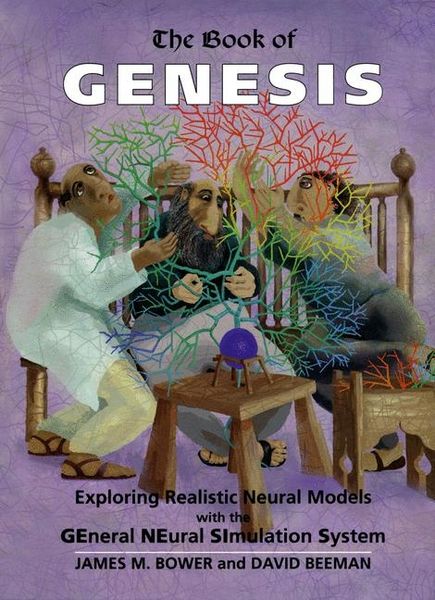
Produktbild: Bk Of Genesis Softcover Reprin

Bk Of Genesis Softcover Reprin Exploring Realistic Neural Models with the GEneral NEural SImulations System

Fr. 198.00

inkl. gesetzl. MwSt., Versandkostenfrei


Beschreibung

Produktdetails

Einband

Taschenbuch

Erscheinungsdatum

01.07.2012

Verlag

Springer

Seitenzahl

409

Maße (L/B/H)

25.4/17.8/2.2 cm

Gewicht

744 g

Auflage

Softcover reprint of the original 1st ed. 1995

Sprache

Englisch

ISBN

978-1-4684-0191-2

Beschreibung

Produktdetails

Einband

Taschenbuch

Erscheinungsdatum

01.07.2012

Verlag

Springer

Seitenzahl

409

Maße (L/B/H)

25.4/17.8/2.2 cm

Gewicht

744 g

Auflage

Softcover reprint of the original 1st ed. 1995

Sprache

Englisch

ISBN

978-1-4684-0191-2

Herstelleradresse

Springer Heidelberg
Tiergartenstr. 17
69121 Heidelberg
DE
buchhandel-buch@springer.com

Noch keine Bewertungen vorhanden

Verfassen Sie die erste Bewertung zu diesem Artikel

Helfen Sie anderen Kundinnen und Kunden durch Ihre Meinung.

Kundinnen und Kunden meinen

Bewertungen (0)

  • Produktbild: Bk Of Genesis Softcover Reprin
  • I Neurobiological Tutorials with GENESIS.- 1 Introduction.- 1.1 Computational Neuroscience.- 1.2 Using This Book.- 2 Compartmental Modeling.- 2.1 Modeling Neurons.- 2.1.1 Detailed Compartmental Models.- 2.1.2 Equivalent Cylinder Models.- 2.1.3 Single and Few Compartment Models.- 2.2 Equivalent Circuit of a Single Compartment.- 2.3 Axonal Connections, Synapses and Networks.- 2.4 Simulation Accuracy.- 2.4.1 Choice of Numerical Integration Technique.- 2.4.2 Integration Time Step.- 2.4.3 Accuracy of GENESIS.- 3 Neural Modeling with GENESIS.- 3.1 What is GENESIS?.- 3.1.1 Why Use a General Simulator?.- 3.1.2 GENESIS Design Features.- 3.1.3 GENESIS Development.- 3.2 Introduction to the Tutorials.- 3.3 Introduction to the GENESIS Graphical Interface.- 3.3.1 Starting the Simulation.- 3.3.2 The Control Panel.- 3.3.3 Using Help Menus.- 3.3.4 Displaying the Simulation Results.- 4 The Hodgkin-Huxley Model.- 4.1 Introduction.- 4.2 Historical Background.- 4.3 The Mathematical Model.- 4.3.1 Electrical Equivalent Circuit.- 4.3.2 HH Conventions.- 4.3.3 The Ionic Current.- 4.4 Voltage Clamp Experiments.- 4.4.1 Characterizing the K Conductance.- 4.5 GENESIS: Voltage Clamp Experiments.- 4.6 Parameterizing the Rate Constants.- 4.7 Inactivation of the Na Conductance.- 4.8 Current Injection Experiments.- 4.9 Exercises.- 5 Cable and Compartmental Models of Dendritic Trees.- 5.1 Introduction.- 5.2 Background.- 5.2.1 Dendritic Trees: Anatomy, Physiology and Synaptology.- 5.2.2 Summary.- 5.3 The One-Dimensional Cable Equation.- 5.3.1 Basic Concepts and Assumptions.- 5.3.2 The Cable Equation.- 5.4 Solution of the Cable Equation.- 5.4.1 Steady-state Voltage Attenuation with Distance.- 5.4.2 Voltage Decay with Time.- 5.4.3 Functional Significance of ? and ?m.- 5.4.4 The Input Resistance Rin and "trees equivalent to a cylinder".- 5.4.5 Summary of Main Results from the Cable Equation.- 5.5 Compartmental Modeling Approach.- 5.6 Compartmental Modeling Experiments.- 5.7 Main Insights for Passive Dendrites with Synapses.- 5.8 Biophysics of Excitable Dendrites.- 5.9 Computational Function of Dendrites.- 5.10 Exercises.- 6 Temporal Interactions Between PSP's.- 6.1 Introduction.- 6.2 Electrical Model of a Patch of Membrane.- 6.2.1 Voltage Response of Passive Membrane to a Current Pulse.- 6.3 Response to Activation of Synaptic Channels.- 6.3.1 The Post-synaptic Current.- 6.3.2 The Post-synaptic Potential.- 6.3.3 Smooth Synaptic Conductance Change: the "alpha function".- 6.4 A Remark on Synaptic Excitation and Inhibition.- 6.5 GENESIS Experiments with PSP's.- 6.5.1 Temporal Summation of Post-synaptic Potentials.- 6.5.2 Nonlinear Summation of Post-synaptic Potentials.- 6.6 Concluding Remarks.- 6.7 Exercises and Projects.- 7 Ion Channels in Bursting Neurons.- 7.1 Introduction.- 7.2 General Properties of Molluscan Neurons.- 7.3 Ionic Conductances - The Dance of the Ions.- 7.3.1 Action Potential Related Conductances.- 7.3.2 Control of Bursting Properties.- 7.4 A Model Molluscan Neuron.- 7.4.1 Adrift in Parameter Space.- 7.4.2 Implementation of the Model.- 7.4.3 Modeling the Channels.- 7.5 The Molluscan Neuron Simulation.- 7.5.1 Using Neurokit.- 7.5.2 Understanding the Results.- 7.6 The Traub Model CA3 Pyramidal Cell.- 7.6.1 Experiments with the Traub Model.- 7.6.2 Firing Patterns.- 7.7 Exercises.- 8 Central Pattern Generators.- 8.1 Introduction.- 8.2 Two-neuron Oscillators.- 8.2.1 Phase Equation Model of Coupled Oscillators.- 8.2.2 Simulation Parameters.- 8.2.3 Initial Conditions.- 8.2.4 Synaptic Coupling.- 8.2.5 Non-phase Equation Models.- 8.3 Four-neuron Oscillators.- 8.3.1 Chains of Coupled Oscillators.- 8.3.2 Simulation Parameters.- 8.3.3 Modeling Gaits.- 8.4 Summary.- 8.5 Exercises.- 9 Dynamics of Cerebral Cortical Networks.- 9.1 Introduction.- 9.2 Piriform Cortex.- 9.3 Structure of the Model.- 9.3.1 Cellular Complexity.- 9.3.2 Network Circuitry.- 9.4 Electroencephalography.- 9.5 Using the Tutorial.- 9.5.1 Getting Started.- 9.5.2 Generating Simulated Data.- 9.5.3 Initial Look at Simulated Activity.- 9.5.4 Observing Network Behavior.- 9.5.5 Varying Network Parameters.- 9.6 Detailed Examination of Network Behavior.- 9.7 Summary.- 9.8 Exercises.- II Creating Simulations with GENESIS.- 10 Constructing New Models.- 10.1 Structurally Realistic Modeling.- 10.2 The Modeling Process.- 10.2.1 Single Neurons or Networks.- 10.2.2 Modeling Steps.- 11 Introduction to GENESIS Programming.- 11.1 Simulating a Simple Compartment.- 11.2 Getting started with GENESIS.- 11.3 GENESIS Objects and Elements.- 11.3.1 Creating and Deleting Elements.- 11.3.2 Examining and Modifying Elements.- 11.4 Running a GENESIS Simulation.- 11.4.1 Adding Graphics.- 11.4.2 Linking Elements with Messages.- 11.4.3 Adding Buttons to a Form.- 11.5 How GENESIS Performs a Simulation.- 11.6 Exercises.- 12 Simulating a Neuron Soma.- 12.1 Some GENESIS Script Language Conventions.- 12.1.1 Defining Functions in GENESIS.- 12.2 Making a More Realistic Soma Compartment.- 12.2.1 Some Remarks on Units.- 12.2.2 Building a "squid-like" Soma.- 12.2.3 GIGO (Garbage In, Garbage Out).- 12.3 Debugging GENESIS Scripts.- 12.4 Exercises.- 13 Adding Voltage Activated Channels.- 13.1 Review.- 13.2 More Fun With XODUS.- 13.3 Voltage Activated Channel Objects.- 13.3.1 The hh_channel Object.- 13.3.2 Adding Hodgkin-Huxley Na and K Channels to the Soma...- 13.4 Final Additions and Improvements.- 13.4.1 Use of the Compartment init Vm Field.- 13.4.2 Overlaying GENESIS Plots.- 13.5 Extended Objects.- 13.6 Exercises.- 14 Building a Multi-compartmental Neuron.- 14.1 Making the Dendrite Compartment.- 14.2 Providing Synaptic Input.- 14.3 Connections Between Neurons.- 14.4 Where Do We Go from Here?.- 14.5 Exercises.- 15 Automating Cell Construction with the Cell Reader.- 15.1 Introduction.- 15.2 Creating a Library of Prototype Elements.- 15.2.1 Future Changes in the Cell Reader.- 15.2.2 The protodefs.g Script.- 15.3 The Format of the Cell Descriptor File.- 15.4 Modifying the Main Script to Use the Cell Reader.- 15.5 The Neurokit Simulation.- 15.6 Exercises.- 16 Building a Cell With Neurokit.- 16.1 Introduction and Review.- 16.2 Customizing the userprefs File.- 16.2.1 Step 1.- 16.2.2 Step 2.- 16.2.3 Step 3.- 16.3 The Cell Descriptor File.- 16.4 Some Experiments Using Neurokit.- 16.5 Exercises and Projects.- 17 Constructing Neural Circuits and Networks.- 17.1 Introduction.- 17.2 The Orient-tut simulation.- 17.3 Running the Simulation.- 17.4 Creating a Network Simulation.- 17.5 Defining Prototypes.- 17.6 Creating Arrays of Cells.- 17.7 Making Synaptic Connections.- 17.7.1 Specifying Individual Synaptic Connections.- 17.7.2 Commands Involving Groups of Synapses.- 17.7.3 Utility Functions for Synapses.- 17.8 Setting Up the Inputs.- 17.9 Summary.- 17.10 Exercises.- 18 Implementing Other Types of Channels.- 18.1 Introduction.- 18.2 Using Experimental Data to Make a tabchannel.- 18.2.1 Setting the tabchannel Internal Fields.- 18.2.2 Testing and Editing the Channel.- 18.3 Using Equations for the Rate Constants.- 18.4 Implementing Calcium Dependent Conductances.- 18.4.1 Calculating the Calcium Concentration.- 18.4.2 The AHP Current.- 18.4.3 The C-Current.- 18.4.4 Other Uses of the table Object.- 18.4.5 The vdep-gate Object.- 18.5 NMDA Channels.- 18.6 Gap Junctions.- 18.7 Dendrodendritic Synapses.- 18.8 Exercises.- 19 Speeding Up GENESIS Simulations.- 19.1 Introduction.- 19.2 Some General Hints.- 19.3 Numerical Methods Used in GENESIS.- 19.3.1 The Differential Equations Used in GENESIS.- 19.3.2 Explicit Methods.- 19.3.3 Implicit Methods.- 19.3.4 Instability and Stiffness.- 19.3.5 Implementation of the Implicit Methods.- 19.4 The setmethod Command.- 19.5 Using the hsolve Object.- 19.5.1 Modes of Operation.- 19.6 Setting up hsolve.- 19.7 Experiments with the hsolve Object.- 19.8 Exercises.- 20 Advanced XODUS Techniques.- 20.1 Introduction.- 20.2 What can your user interface do for you?.- 20.3 Draw/Pix Philosophy.- 20.4 Meet the Cast.- 20.4.1 The Draw Widget Family.- 20.4.2 The Pix Family.- 20.5 XODUS Events.- 20.5.1 Returning Arguments to Script Functions.- 20.6 Using Advanced Widgets: a Network Builder.- 20.6.1 The Library Window.- 20.6.2 Making Prototype Cells.- 20.6.3 The Work Window.- 20.6.4 Editing Cells.- 20.6.5 Connecting Cells.- 20.6.6 Plotting Cell Activity.- 20.6.7 Running Netkit.- 20.6.8 Extending Netkit.- 20.7 Interface vs. Simulation.- 20.8 Summary.- A Acquiring and Installing GENESIS.- A.1 System Requirements.- A.2 Obtaining GENESIS.- A.3 Installation and Documentation.- A.4 Copyright Notice.- B GENESIS Script Listings.- B.1 tutorial2.g.- B.2 tutorial3.g.- B.3 tutorial4.g.- B.4 tutorial5.g.- B.5 hhchan.g.- B.6 hhchan_K.g.- B.7 userprefs.g.- B.8 cellproto.g.- Index of GENESIS Commands.- Index of GENESIS Objects.