• Produktbild: Judicial Decision Making, Sentencing Policy, and Numerical Guidance
  • Produktbild: Judicial Decision Making, Sentencing Policy, and Numerical Guidance

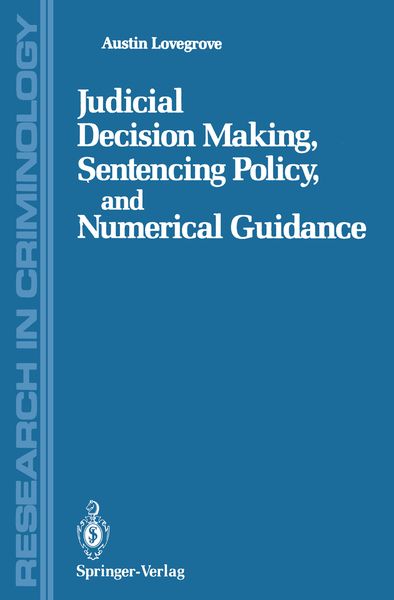
Judicial Decision Making, Sentencing Policy, and Numerical Guidance

Aus der Reihe Research in Criminology

Fr. 72.90

inkl. gesetzl. MwSt., Versandkostenfrei


Beschreibung

Produktdetails

Einband

Taschenbuch

Erscheinungsdatum

06.04.2012

Verlag

Springer Us

Seitenzahl

320

Maße (L/B/H)

23.5/15.5/1.9 cm

Gewicht

511 g

Auflage

Softcover reprint of the original 1st ed. 1989

Sprache

Englisch

ISBN

978-1-4684-7082-6

Beschreibung

Produktdetails

Einband

Taschenbuch

Erscheinungsdatum

06.04.2012

Verlag

Springer Us

Seitenzahl

320

Maße (L/B/H)

23.5/15.5/1.9 cm

Gewicht

511 g

Auflage

Softcover reprint of the original 1st ed. 1989

Sprache

Englisch

ISBN

978-1-4684-7082-6

Herstelleradresse

Springer-Verlag KG
Sachsenplatz 4-6
1201 Wien
AT

Email: GPSR Kontakt

Noch keine Bewertungen vorhanden

Verfassen Sie die erste Bewertung zu diesem Artikel

Helfen Sie anderen Kundinnen und Kunden durch Ihre Meinung.

Kundinnen und Kunden meinen

Bewertungen (0)

  • Produktbild: Judicial Decision Making, Sentencing Policy, and Numerical Guidance
  • Produktbild: Judicial Decision Making, Sentencing Policy, and Numerical Guidance
  • One A Perspective for a Quantitative Approach to Sentencing Policy and Guidance.- 1 The Task of Describing Sentencing Policy Quantitatively.- The Structure and Nature of the Sentencing Judgment.- Imprecision in the Sentencing Judgment.- Legal Perspectives on the Problem of Imprecision in the Sentencing Judgment.- The Study: Challenge and Constraints.- 2 Approaches to the Development of Detailed Sentencing Statistics and Numerical Guidelines.- Guideline Judgments of the Court of Appeal (Criminal Division) in England.- Wilkins’s Empirically Based Descriptive Guidelines.- Hogarth’s Sentencing Data Base.- Doob’s Sentencing Data Base.- Minnesota Sentencing Guidelines Commission’s Policy-Based Prescriptive Guidelines.- United States Sentencing Commission’s Presumptive Guidelines.- 3 Toward a Model of Judicial Decision Making: An Unproductive Review of Psychological Research.- Atheoretical Approaches to the Study of Sentencing.- Theoretical Approaches to the Study of Sentencing.- The Role of Theory in Sentencing.- Psychological Contributions to the Study of Sentencing: An Overview.- Two An Archival Study of a Legal Model of Judicial Decision Making in Sentencing.- 4 A Legal Model of Judicial Decision Making.- Scaling Culpability.- Primary and Secondary Decisions in the Sentencing Judgment.- The Construction of the Sentencing Statistics.- David Thomas: An Overdue Tribute.- 5 The Data Base and Data Collection.- The Principal Offense.- The Sample of Cases.- Sentences and Orders of the Court.- Data Sources.- Procedure.- The Cross Validation Study.- 6 Offense Characteristics of Burglary.- Violence to the Victims (Nonoffenders).- Organization.- Total Value of the Theft.- Counts of Burglary.- Comparison of the Frequency of the Use of the Categories Across Dimensions.- Supplementary Categories.- Cross-Validation Study.- 7 The Relationship Between Offense Characteristics of Burglary and Sentence.- Validity of the Assumptions Underlying the Use of Groups for Differentiating Offenses Across Premises Types and the Use of Dimensions to Differentiate Offenses Within Premises Types.- Cross Validation Study.- 8 Offender Characteristics and Prior Convictions in Cases of Burglary.- Use of Offender Categories.- Prior Convictions.- Comparison of the Frequency of the Use of the Categories Across the Dimensions of Prior Convictions.- Cross-Validation Study.- 9 The Relationship Between Offender Characteristics of Burglary and Sentence.- The Scoring and Weighting of Prior Convictions.- Offender Characteristics (Excluding Prior Convictions).- Total Mitigation Scores.- Relationship Between Total Mitigation Scores and Type of Premises.- Cross-Validation Study.- 10 The Relationship Between Case (Offense and Offender) Characteristics of Burglary and Sentence.- The Combination of Offense Seriousness and Total Mitigation.- Adjustment of the Case Scores.- Relationship Between Adjusted Case Scores for Burglary and Sentence.- The Sentencing Decision.- The Relationship Between the Type of Premises and the Length of the Effective Sentence.- Cross-Validation Study.- 11 Toward Detailed Sentencing Statistics.- Detailed Sentencing Statistics as an Operational System.- Detailed Sentencing Statistics: Problems and Prospects.- Three Sentencing Policy and Numerical Guidance as a Deliberative Process.- 12 Judicial Input Into the Model of Sentencing.- Decomposed Scaling Procedures.- Holistic Scaling Procedures.- Relative Merits of the Decomposed and Holistic Scaling Procedures.- Overview of the Analysis.- 13 The Validity of the Technique of Fictitious Cases.- The Validity Study.- 14 Multiattribute Utility Measurement and the Model of Judicial Decision Making.- Identification and Operational Definition of the Offense Characteristics Material to Seriousness.- Development of Scales of Relative Seriousness in Relation to Each Offense Factor.- Determination of the Relative Importance of Each Offense Factor in the Assessment of Seriousness.- Calculation of the Overall Seriousness of the Offense Characteristics.- Assessment of the Sensitivity of the Estimates of the Offense Factor Weights.- 15 Scaling of Seriousness and Assessment of Weights for Offense Factors of Burglary.- MAUM Method.- Text of Sentencing Research Exercise—Part 2.- Results and Discussion.- 16 Coherence and the Tariff.- Method.- Results and Discussion.- 17 Toward Deliberative Sentencing and Numerical Guidelines.- Fictitious Cases as a Basis for the Description of Current Sentencing Policy: Detailed Sentencing Statistics.- Fictitious Cases as a Basis for the Development and Reform of Sentencing Policy: Numerical Guidelines.- Overview and Conclusion.- Appendix 1 A Sample Case in Exercise 1.- New Case.- Appendix 2 A Sample Fictitious Case in Exercise 3 and Exercise 4.- New Case.- References.- Author Index.