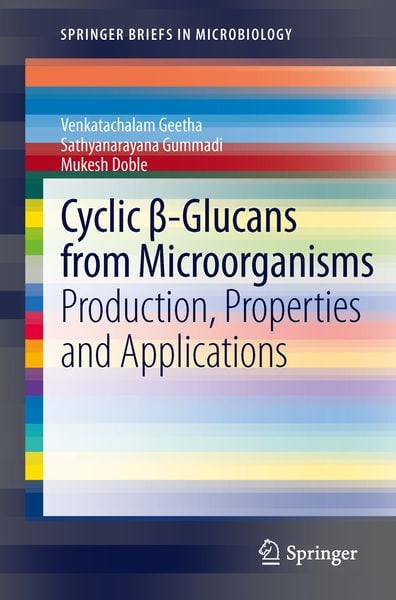

• Produktbild: Cyclic β-Glucans from Microorganisms
  • Produktbild: Cyclic β-Glucans from Microorganisms

Cyclic β-Glucans from Microorganisms Production, Properties and Applications

Fr. 73.90

inkl. gesetzl. MwSt., Versandkostenfrei


Beschreibung

Produktdetails

Einband

Taschenbuch

Erscheinungsdatum

06.10.2012

Abbildungen

XI, 23 illus., schwarz-weiss Illustrationen

Verlag

Springer Berlin

Seitenzahl

90

Maße (L/B/H)

23.5/15.5/0.7 cm

Gewicht

172 g

Auflage

2013

Sprache

Englisch

ISBN

978-3-642-32994-4

Beschreibung

Produktdetails

Einband

Taschenbuch

Erscheinungsdatum

06.10.2012

Abbildungen

XI, 23 illus., schwarz-weiss Illustrationen

Verlag

Springer Berlin

Seitenzahl

90

Maße (L/B/H)

23.5/15.5/0.7 cm

Gewicht

172 g

Auflage

2013

Sprache

Englisch

ISBN

978-3-642-32994-4

Herstelleradresse

Springer-Verlag KG
Sachsenplatz 4-6
1201 Wien
AT

Email: GPSR Kontakt

Noch keine Bewertungen vorhanden

Verfassen Sie die erste Bewertung zu diesem Artikel

Helfen Sie anderen Kundinnen und Kunden durch Ihre Meinung.

Kundinnen und Kunden meinen

Bewertungen (0)

  • Produktbild: Cyclic β-Glucans from Microorganisms
  • Produktbild: Cyclic β-Glucans from Microorganisms
  • 1. Introduction
    1.1. History of polysaccharides from bacteria
    1.2. Cyclic β-glucans
    1.3. α-cyclic glucan
    1.4. Linear glucans
    1.5. Cyclodextrins
     
    2. Applications of cyclic β-glucans
    2.1. In food
    2.2. Medical technology
    2.3. As wound dressing material
    2.4. Microparticulate form of β-glucan for pharmaceutical application
    2.5. Synthesis of selenium nanowires
    2.6. Drug delivery
    2.7. Enantiomeric seperator
    2.8. In chiral technology
    2.9. Chiral Stationary Phase 
    2.10. Carboxymethylated cyclic- β-glucans as enantiomeric separators
    2.11. Inclusion complexes
    2.12. β-D-Glucans complexation with Zearalenone
    2.13. Inclusion complex with Paclitaxel
    2.14. Inclusion complexation with a plant flavonoid luteolin
    2.15. Inclusion complexation with naproxen
    2.16. Functionalized β-1, 3-Glucan in carbon nanotube
    2.17. Application of cyclic β-(1, 3),(1, 6)-glucans in chiral technology
     
    3. Properties of cyclic glucans
    3.1. Structure
    3.2. Molecular biological function of β-Glucans in immunity
    3.2.1 The β-Glucan receptor - Dectin-1
    3.3. Complex forming ability
    3.4. Cytotoxicity of cyclic β-glucan
     
    4. Analytical tools for the characterization cyclic β-glucan
    4.1. Silica gel thin-layer chromatography (TLC)
    4.2. Degree of polymerization
    4.3. Compositional analysis of periplasmic glucan
    4.4. Glycosidic - linkage analysis
    4.5. Arrangement of linkages
    4.6. Protons and carbons in glucan
    4.7. Molecular weight
    4.8. Functional groups in cyclic β-glucans
    4.9. Supramolecular structure
    4.10. Separation of mixture of cyclic-β- glucan in HPLC
    4.11. CHN analysis
     
    5. Production of Cyclic β-glucans
    5.1. Osmolarity condition
    5.2. Media details
    5.3. Optimization of medium with mannitol
    5.4. Effect of media components and operating conditions
    5.4.1. Carbon
    5.4.2. Nitrogen
    5.4.3. Temperature
    5.4.4. Salt and pH
     
    6. Extraction and purification of cyclic β- glucan
    6.1. Extraction of cyclic β- glucan from culture filtrate
    6.2. Isolation and purification of osmoregulated periplasmic glucans
    6.3. Isolation and purification of algal cyclic glucans
    6.4. Purification of cyclic glucan from yeast
    6.5. Purification using column chromatography
     
    7. Mechanism of cyclic β-glucans production
    7.1. Genes responsible for synthesis of cyclic β-(1, 2)-glucan in Rhizobiaceae and Agrobacteriaceae
    7. 1.2. Genes for cyclic β-(1,3)
    7. 1.3. Genes for cyclic β-(1,3)-(1,6)-glucan
    7. 1. 4. Genes for cyclic β-(1,6)-(1,3)-glucan
    7. 2. Genes of periplasmic glucans (PGs) of the Proteobacteria
    7.3. Metabolic pathway of carbohydrate metabolism        
    7.4. Enzymes involved in Cyclic β- (1,2)-glucan synthesis
    7.4.1. Cyclic β-glucan synthase (Cβgs)
    7.4.2. β- (1, 3), β-(1,6)-(1,3) and β-(1,3)-(1,6) glucosyltransferase
    7.4.3. Enzymes involved in β-glucan degradation
     
    8. Conclusions