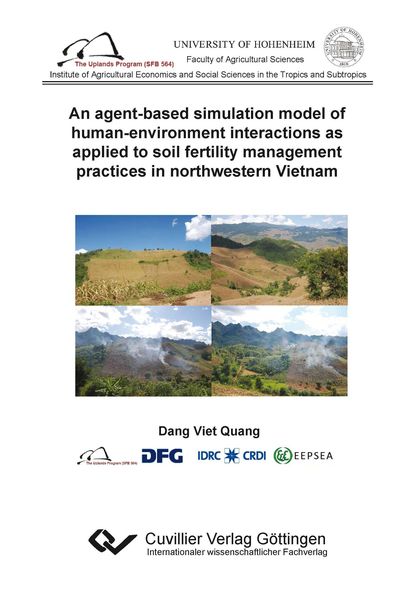
An agent-based simulation model of human-environment interactions as applied to soil fertility management practices in northwestern Vietnam
-
- Taschenbuch ausgewählt
- eBook
-
Sprache:Englisch
Fr. 37.90
inkl. gesetzl. MwSt.,
Beschreibung
Produktdetails
Einband
Paperback
Erscheinungsdatum
24.07.2012
Verlag
Cuvillier VerlagSeitenzahl
150
Maße (L/B/H)
21/14.8/0.8 cm
Gewicht
204 g
Auflage
1. Auflage
Sprache
Englisch
ISBN
978-3-95404-160-2
Intensification agriculture on sloping land in northwestern Vietnam has increased soil erosion and declined the soil fertility. In response to this decline in soil fertility, as well high output prices, highland farmers have increasingly turned to mineral fertilizers and high yielding varieties, and the rapid adoption of these has partly compensated for the underlying resource degradation process. However, these practices are not environmentally sustainable, and so long-term farm income levels could decline as a result.
The objective of this studies is to explore the relationship between the decisions made within farm households and biophysical dynamics - such as soil erosion and soil fertility change, in order to assess how the introduction of soil conservation practices affects soil fertility and farm household incomes, to identify possible constraints on the adoption of soil conservation practices, quantify trade-offs between sustainability and the income of farm households, and to appraise the possible policy options available in order to promote the adoption of soil conservation practices.
The studies applied an integrated model using a software package called ‘Mathematical Programming-based Multi-Agent Systems’ (MP-MAS) in combination processes manipulated using the Tropical Soil Productivity Calculator (TSPC). The model was calibrated to cover a 22.58 km2 catchment area in northwestern Vietnam that included 471 farm households, with each farm represented as an individual agent in the model.
The results of the simulation showed that an increased use of mineral fertilizers improved crop yields and reduced soil nutrient losses. When soil conservation practices were included into the decision-making model, the area of land under these techniques remained low. The main constraints to the use of soil conservation practices identified included low crop yields and high labor requirements when compared to conventional practices, that is, those not using soil conservation techniques.
It was also found that increasing levels of sustainability reduced soil erosion and soil nutrient losses, but also caused a decline in farm incomes. As a result, it was found that a soil-loss reduction of 80% was likely to reduce farm incomes by about 20±30%, revealing the trade-off between environmental sustainability and farm incomes.
The model was then used to explore the potential effect of various policy interventions, such as payments being provided for environmental services and a subsidy being given to incentivize soil conservation adoption. Compensating farmers to reduce soil erosion required an environmental payment of about 4.5 to 6 million VND/ha, while a 3 million VND/ha (equal to 187.5 USD/ha) subsidy for applying soil conservation practices was found to decrease soil losses by 39% on average.
In general, the studies showed that the current problem of soil degradation in Vietnam relies considerably on the decision-making of farmers in terms of their cropping activities as well as the application of fertilizers. The propagation of soil conservation techniques, the provision of payments for environmental services and the introduction of subsidy policies could all be used to address this problem. Applying a sustainability index in the model may be helpful in order to help scientists and policy makers estimate the payments needed to eliminate ecological problems.
The objective of this studies is to explore the relationship between the decisions made within farm households and biophysical dynamics - such as soil erosion and soil fertility change, in order to assess how the introduction of soil conservation practices affects soil fertility and farm household incomes, to identify possible constraints on the adoption of soil conservation practices, quantify trade-offs between sustainability and the income of farm households, and to appraise the possible policy options available in order to promote the adoption of soil conservation practices.
The studies applied an integrated model using a software package called ‘Mathematical Programming-based Multi-Agent Systems’ (MP-MAS) in combination processes manipulated using the Tropical Soil Productivity Calculator (TSPC). The model was calibrated to cover a 22.58 km2 catchment area in northwestern Vietnam that included 471 farm households, with each farm represented as an individual agent in the model.
The results of the simulation showed that an increased use of mineral fertilizers improved crop yields and reduced soil nutrient losses. When soil conservation practices were included into the decision-making model, the area of land under these techniques remained low. The main constraints to the use of soil conservation practices identified included low crop yields and high labor requirements when compared to conventional practices, that is, those not using soil conservation techniques.
It was also found that increasing levels of sustainability reduced soil erosion and soil nutrient losses, but also caused a decline in farm incomes. As a result, it was found that a soil-loss reduction of 80% was likely to reduce farm incomes by about 20±30%, revealing the trade-off between environmental sustainability and farm incomes.
The model was then used to explore the potential effect of various policy interventions, such as payments being provided for environmental services and a subsidy being given to incentivize soil conservation adoption. Compensating farmers to reduce soil erosion required an environmental payment of about 4.5 to 6 million VND/ha, while a 3 million VND/ha (equal to 187.5 USD/ha) subsidy for applying soil conservation practices was found to decrease soil losses by 39% on average.
In general, the studies showed that the current problem of soil degradation in Vietnam relies considerably on the decision-making of farmers in terms of their cropping activities as well as the application of fertilizers. The propagation of soil conservation techniques, the provision of payments for environmental services and the introduction of subsidy policies could all be used to address this problem. Applying a sustainability index in the model may be helpful in order to help scientists and policy makers estimate the payments needed to eliminate ecological problems.
Noch keine Bewertungen vorhanden
Verfassen Sie die erste Bewertung zu diesem Artikel
Helfen Sie anderen Kundinnen und Kunden durch Ihre Meinung.