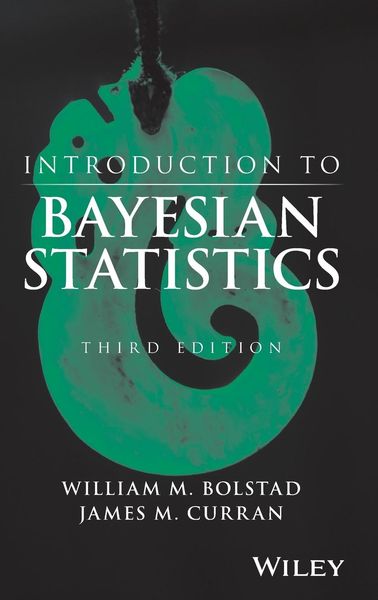
Introduction to Bayesian Statistics 3rd Edition
0-
Sprache:Englisch
-
Verlag:John Wiley & Sons
Fr. 189.00
inkl. gesetzl. MwSt.,
Beschreibung
Produktdetails
Einband
Gebundene Ausgabe
Erscheinungsdatum
03.10.2016
Verlag
John Wiley & SonsSeitenzahl
624
Maße (L/B/H)
24/16.1/3.7 cm
Gewicht
1085 g
Auflage
3rd edition
Sprache
Englisch
ISBN
978-1-118-09156-2
"...this edition is useful and effective in teaching Bayesian inference at both elementary and intermediate levels. It is a well-written book on elementary Bayesian inference, and the material is easily accessible. It is both concise and timely, and provides a good collection of overviews and reviews of important tools used in Bayesian statistical methods."
There is a strong upsurge in the use of Bayesian methods in applied statistical analysis, yet most introductory statistics texts only present frequentist methods. Bayesian statistics has many important advantages that students should learn about if they are going into fields where statistics will be used. In this third Edition, four newly-added chapters address topics that reflect the rapid advances in the field of Bayesian statistics. The authors continue to provide a Bayesian treatment of introductory statistical topics, such as scientific data gathering, discrete random variables, robust Bayesian methods, and Bayesian approaches to inference for discrete random variables, binomial proportions, Poisson, and normal means, and simple linear regression. In addition, more advanced topics in the field are presented in four new chapters: Bayesian inference for a normal with unknown mean and variance; Bayesian inference for a Multivariate Normal mean vector; Bayesian inference for the Multiple Linear Regression Model; and Computational Bayesian Statistics including Markov Chain Monte Carlo. The inclusion of these topics will facilitate readers' ability to advance from a minimal understanding of Statistics to the ability to tackle topics in more applied, advanced level books. Minitab macros and R functions are available on the book's related website to assist with chapter exercises. Introduction to Bayesian Statistics, Third Edition also features:
* Topics including the Joint Likelihood function and inference using independent Jeffreys priors and join conjugate prior
* The cutting-edge topic of computational Bayesian Statistics in a new chapter, with a unique focus on Markov Chain Monte Carlo methods
* Exercises throughout the book that have been updated to reflect new applications and the latest software applications
* Detailed appendices that guide readers through the use of R and Minitab software for Bayesian analysis and Monte Carlo simulations, with all related macros available on the book's website
Introduction to Bayesian Statistics, Third Edition is a textbook for upper-undergraduate or first-year graduate level courses on introductory statistics course with a Bayesian emphasis. It can also be used as a reference work for statisticians who require a working knowledge of Bayesian statistics.
There is a strong upsurge in the use of Bayesian methods in applied statistical analysis, yet most introductory statistics texts only present frequentist methods. Bayesian statistics has many important advantages that students should learn about if they are going into fields where statistics will be used. In this third Edition, four newly-added chapters address topics that reflect the rapid advances in the field of Bayesian statistics. The authors continue to provide a Bayesian treatment of introductory statistical topics, such as scientific data gathering, discrete random variables, robust Bayesian methods, and Bayesian approaches to inference for discrete random variables, binomial proportions, Poisson, and normal means, and simple linear regression. In addition, more advanced topics in the field are presented in four new chapters: Bayesian inference for a normal with unknown mean and variance; Bayesian inference for a Multivariate Normal mean vector; Bayesian inference for the Multiple Linear Regression Model; and Computational Bayesian Statistics including Markov Chain Monte Carlo. The inclusion of these topics will facilitate readers' ability to advance from a minimal understanding of Statistics to the ability to tackle topics in more applied, advanced level books. Minitab macros and R functions are available on the book's related website to assist with chapter exercises. Introduction to Bayesian Statistics, Third Edition also features:
* Topics including the Joint Likelihood function and inference using independent Jeffreys priors and join conjugate prior
* The cutting-edge topic of computational Bayesian Statistics in a new chapter, with a unique focus on Markov Chain Monte Carlo methods
* Exercises throughout the book that have been updated to reflect new applications and the latest software applications
* Detailed appendices that guide readers through the use of R and Minitab software for Bayesian analysis and Monte Carlo simulations, with all related macros available on the book's website
Introduction to Bayesian Statistics, Third Edition is a textbook for upper-undergraduate or first-year graduate level courses on introductory statistics course with a Bayesian emphasis. It can also be used as a reference work for statisticians who require a working knowledge of Bayesian statistics.
Noch keine Bewertungen vorhanden
Verfassen Sie die erste Bewertung zu diesem Artikel
Helfen Sie anderen Kundinnen und Kunden durch Ihre Meinung.