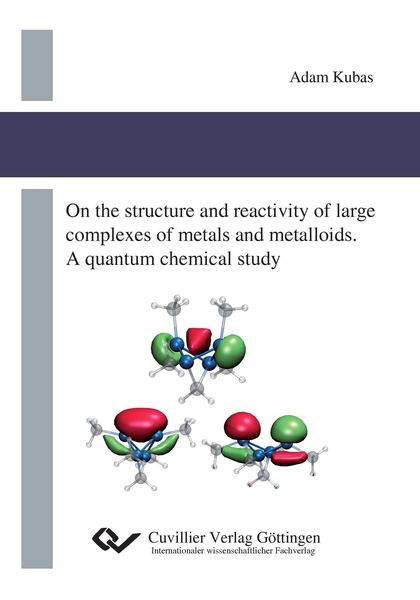
On the structure and reactivity of large complexes of metals and metalloids. A quantum chemical study
-
- Taschenbuch ausgewählt
- eBook
-
Sprache:Englisch
Fr. 31.90
inkl. gesetzl. MwSt.,
Beschreibung
Produktdetails
Einband
Paperback
Erscheinungsdatum
30.07.2012
Verlag
Cuvillier VerlagSeitenzahl
138
Maße (L/B/H)
21/14.8/0.8 cm
Gewicht
189 g
Auflage
1. Auflage
Sprache
Englisch
ISBN
978-3-95404-175-6
In this thesis four challenging problems concerning metal- or metalloid-containing systems were carefully studied in order to explain their properties, reactivities and selectivities. The first project focused on the dialkylzinc additions to unsaturated aldehydes. The reaction was proved to have bimetallic intermediates. The experimentally observed non-linear effect was addressed to the differences in stability of various zinc-ligand aggregates. Furthermore, the differences in regioselectivity between cinnamaldehyde and N-formylbenzylimine were traced back to the differences in the π-conjugation of both compounds. In contrary, the stereoselectivity of the reaction was controlled by the paracyclophane unit as well as by bulky substituents in the side-chain of the ligand. Based on these findings, a set of modifications for the ligand system were proposed and tested in silico. One of the compounds is expected to be superior to any previous catalysts. An important outcome from this study is the survey of methods used in calculations of reaction barrier heights. It is shown that economic DFT calculations, when extended by empirical dispersion corrections allow for the prediction of stereoselectivities. However, the prediction of the regioselectivities is a much more demanding task and only a consistent treatment of electron correlation can yield qualitative agreement with experimental findings. In this case, the computationally more expensive – but even for large systems still applicable – LPNO-CEPA/1 approach seems to be an efficient and reliable choice.
In the second project systems with significantly elongated bonds were studied. Germanium (Ge14[Si(SiMe3)3]5Li3(THF)6) and tin (Sn4Si[Si(SiMe3)3]4(SiMe3)2) cluster compounds appeared to be interesting examples of stable molecules with a number of undercoordinated atoms (three instead of four coordination partners for Ge or Sn) that are too far from each other to form a normal bond but are close enough to expect some kind of interaction. In both systems rhombic M4R6 (M = Ge, Sn; R – ligand) entities were found and the spin situation between two bridgehead atoms is best described as singlet biradicaloid. Moreover, an important contribution of the quantum-chemical studies was the demonstration that the stretching of the bond is not solely responsible for the observed biradicaloid character because the orientation and size of the ligands can also cause transitions between a radicaloid, a simple bounded system and a biradical with a quasi-degenerate singlet and triplet state. Furthermore, these calculations clearly show the limit of the applicability of single reference methods like DFT. Indeed, a more sophisticated treatment of static correlation, e.g. by using CASSCF wave functions is needed in order to describe the electronic state of such systems properly.
Smaller cluster compounds of nickel were considered in the next step. Experimental measurements concerning the dimer and the trimer are rather limited and are inconsistent with many theoretical findings. Within this work a benchmark study was performed on the Ni2 molecule, and the bond length was calculated to be 2.22 Å with a corresponding vibrational frequency of 286 cm-1. The NEVPT2 method was shown to provide data that is in excellent agreement with MRACPF results. The perturbation approach was used to estimate the electronic ground state including spin-orbit interactions. It was found to be 0+ in agreement with experiment. Moreover, it was pointed out that the TPSSh functional when combined with a broken symmetry approach provides bond lengths similar to those obtained with the NEVPT2 method. According to the literature, the bond is elongated by 0.1 Å upon electron attachment to the nickel dimer. This effect was observed both at the NEVPT2 and the TPSSh level and the bond expansion was addressed to the occupation of a * orbital by the excess electron. A similar analysis was performed in the case of the nickel trimer. The NEVPT2 and TPSSh calculations agree that the ground state of the neutral cluster has a triangular geometry and a quintet spin state. However, at the NEVPT2 level the anion has clearly a linear form while the TPSSh functional shows linear and triangular isomers to be nearly equal in energy. The final distinction can be made by measuring the O-H stretching vibration in the systems where the nickel cluster is solvated by two ethanol molecule. According to TPSSh calculations, the difference between the O-H stretching frequencies of the two ethanol molecules will be much smaller (~15 cm-1) for the linear isomer than for the triangular geometry (~90 cm-1). Upcoming experimental IR studies should clearly be able to distinguish between these two forms.
Similar problems with DFT methods were encountered in the last application covered by this work. The aim was to analyse the molecular oxygen activation process by cobalt(II) diketonate complexes like bis[trifluoroacetylacetonato(−1)]cobalt(II) [Co(tfa)2]. This reaction is the first step in a mild and cheap aerobic oxidation of alkenols into functionalized tetrahydrofurans (molecules of high biological activity). However, various mechanisms can be proposed depending on the electronic structure of the adduct. We found, that the isolated catalyst with one water molecule [Co(tfa)2(H2O)] has a high spin quartet state. As dioxygen approaches the cobalt atom, the quartet state couples with a triplet dioxygen molecule and forms a sextet, a quartet, and a doublet spin state with the high-spin state being the lowest in energy. At the equilibrium Co–O2 distance of 1.9 Å, Co(tfa)2(H2O)(O2) has a doublet superoxo Co(III) ground state with the unpaired electron residing on the oxygen moiety, in a nearly unchanged O2 π* orbital. Here, it should be emphasised that even if DFT properly describes the electronic ground states of the catalyst and adduct, the relative spin state energies are, however, highly dependent on the functional used. A clear distinction would not be possible without NEVPT2 multireference calculations.
The calculations presented in this work established a solid base for further investigations concerning large metal- and metalloid-containing systems. The results evidently show that there is a great need to go beyond DFT in such computations. Elongated bonds or neardegeneracy problems within 3d transition metals are certainly the limit of single reference methods. In such cases, the CASSCF approach together with an inexpensive estimation of the remaining correlation energy (NEVPT2) was proven to be as reliable as the CI-based methods. Moreover, the regioselectivity prediction in reactions involving only closed shell species requires a consistent treatment of electron correlation in the transition states which can have very different structures. The progress made with efficient and accurate approximations permits the use of high-level wave function based methods like CEPA for molecules with over 100 atoms, even with a decent basis set. Through the careful evaluation of our calculations, the stereoselectivity was shown to be properly described with most of the modern DFT functionals when augmented with dispersion corrections. In this work also a number of predictions concerning the chemical structures and their reactivities have been made. The provided quantitative data can be directly compared to the perspective experimental studies what will certainly assist the deep understanding of the metal-based catalytic processes.
In the second project systems with significantly elongated bonds were studied. Germanium (Ge14[Si(SiMe3)3]5Li3(THF)6) and tin (Sn4Si[Si(SiMe3)3]4(SiMe3)2) cluster compounds appeared to be interesting examples of stable molecules with a number of undercoordinated atoms (three instead of four coordination partners for Ge or Sn) that are too far from each other to form a normal bond but are close enough to expect some kind of interaction. In both systems rhombic M4R6 (M = Ge, Sn; R – ligand) entities were found and the spin situation between two bridgehead atoms is best described as singlet biradicaloid. Moreover, an important contribution of the quantum-chemical studies was the demonstration that the stretching of the bond is not solely responsible for the observed biradicaloid character because the orientation and size of the ligands can also cause transitions between a radicaloid, a simple bounded system and a biradical with a quasi-degenerate singlet and triplet state. Furthermore, these calculations clearly show the limit of the applicability of single reference methods like DFT. Indeed, a more sophisticated treatment of static correlation, e.g. by using CASSCF wave functions is needed in order to describe the electronic state of such systems properly.
Smaller cluster compounds of nickel were considered in the next step. Experimental measurements concerning the dimer and the trimer are rather limited and are inconsistent with many theoretical findings. Within this work a benchmark study was performed on the Ni2 molecule, and the bond length was calculated to be 2.22 Å with a corresponding vibrational frequency of 286 cm-1. The NEVPT2 method was shown to provide data that is in excellent agreement with MRACPF results. The perturbation approach was used to estimate the electronic ground state including spin-orbit interactions. It was found to be 0+ in agreement with experiment. Moreover, it was pointed out that the TPSSh functional when combined with a broken symmetry approach provides bond lengths similar to those obtained with the NEVPT2 method. According to the literature, the bond is elongated by 0.1 Å upon electron attachment to the nickel dimer. This effect was observed both at the NEVPT2 and the TPSSh level and the bond expansion was addressed to the occupation of a * orbital by the excess electron. A similar analysis was performed in the case of the nickel trimer. The NEVPT2 and TPSSh calculations agree that the ground state of the neutral cluster has a triangular geometry and a quintet spin state. However, at the NEVPT2 level the anion has clearly a linear form while the TPSSh functional shows linear and triangular isomers to be nearly equal in energy. The final distinction can be made by measuring the O-H stretching vibration in the systems where the nickel cluster is solvated by two ethanol molecule. According to TPSSh calculations, the difference between the O-H stretching frequencies of the two ethanol molecules will be much smaller (~15 cm-1) for the linear isomer than for the triangular geometry (~90 cm-1). Upcoming experimental IR studies should clearly be able to distinguish between these two forms.
Similar problems with DFT methods were encountered in the last application covered by this work. The aim was to analyse the molecular oxygen activation process by cobalt(II) diketonate complexes like bis[trifluoroacetylacetonato(−1)]cobalt(II) [Co(tfa)2]. This reaction is the first step in a mild and cheap aerobic oxidation of alkenols into functionalized tetrahydrofurans (molecules of high biological activity). However, various mechanisms can be proposed depending on the electronic structure of the adduct. We found, that the isolated catalyst with one water molecule [Co(tfa)2(H2O)] has a high spin quartet state. As dioxygen approaches the cobalt atom, the quartet state couples with a triplet dioxygen molecule and forms a sextet, a quartet, and a doublet spin state with the high-spin state being the lowest in energy. At the equilibrium Co–O2 distance of 1.9 Å, Co(tfa)2(H2O)(O2) has a doublet superoxo Co(III) ground state with the unpaired electron residing on the oxygen moiety, in a nearly unchanged O2 π* orbital. Here, it should be emphasised that even if DFT properly describes the electronic ground states of the catalyst and adduct, the relative spin state energies are, however, highly dependent on the functional used. A clear distinction would not be possible without NEVPT2 multireference calculations.
The calculations presented in this work established a solid base for further investigations concerning large metal- and metalloid-containing systems. The results evidently show that there is a great need to go beyond DFT in such computations. Elongated bonds or neardegeneracy problems within 3d transition metals are certainly the limit of single reference methods. In such cases, the CASSCF approach together with an inexpensive estimation of the remaining correlation energy (NEVPT2) was proven to be as reliable as the CI-based methods. Moreover, the regioselectivity prediction in reactions involving only closed shell species requires a consistent treatment of electron correlation in the transition states which can have very different structures. The progress made with efficient and accurate approximations permits the use of high-level wave function based methods like CEPA for molecules with over 100 atoms, even with a decent basis set. Through the careful evaluation of our calculations, the stereoselectivity was shown to be properly described with most of the modern DFT functionals when augmented with dispersion corrections. In this work also a number of predictions concerning the chemical structures and their reactivities have been made. The provided quantitative data can be directly compared to the perspective experimental studies what will certainly assist the deep understanding of the metal-based catalytic processes.
Noch keine Bewertungen vorhanden
Verfassen Sie die erste Bewertung zu diesem Artikel
Helfen Sie anderen Kundinnen und Kunden durch Ihre Meinung.