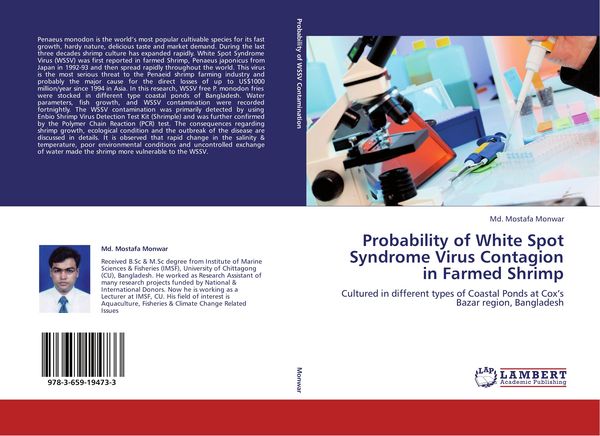
Probability of White Spot Syndrome Virus Contagion in Farmed Shrimp Cultured in different types of Coastal Ponds at Cox s Bazar region, Bangladesh
-
- Englisch ausgewählt
Fr. 67.90
inkl. gesetzl. MwSt.,
Beschreibung
Produktdetails
Einband
Taschenbuch
Erscheinungsdatum
08.09.2012
Verlag
LAP LAMBERT Academic PublishingSeitenzahl
108
Maße (L/B/H)
22/15/0.7 cm
Gewicht
161 g
Sprache
Englisch
ISBN
978-3-659-19473-3
Penaeus monodon is the world's most popular cultivable species for its fast growth, hardy nature, delicious taste and market demand. During the last three decades shrimp culture has expanded rapidly. White Spot Syndrome Virus (WSSV) was first reported in farmed Shrimp, Penaeus japonicus from Japan in 1992-93 and then spread rapidly throughout the world. This virus is the most serious threat to the Penaeid shrimp farming industry and probably the major cause for the direct losses of up to US$1000 million/year since 1994 in Asia. In this research, WSSV free P. monodon fries were stocked in different type coastal ponds of Bangladesh. Water parameters, fish growth, and WSSV contamination were recorded fortnightly. The WSSV contamination was primarily detected by using Enbio Shrimp Virus Detection Test Kit (Shrimple) and was further confirmed by the Polymer Chain Reaction (PCR) test. The consequences regarding shrimp growth, ecological condition and the outbreak of the disease are discussed in details. It is observed that rapid change in the salinity & temperature, poor environmental conditions and uncontrolled exchange of water made the shrimp more vulnerable to the WSSV.
Noch keine Bewertungen vorhanden
Verfassen Sie die erste Bewertung zu diesem Artikel
Helfen Sie anderen Kundinnen und Kunden durch Ihre Meinung.