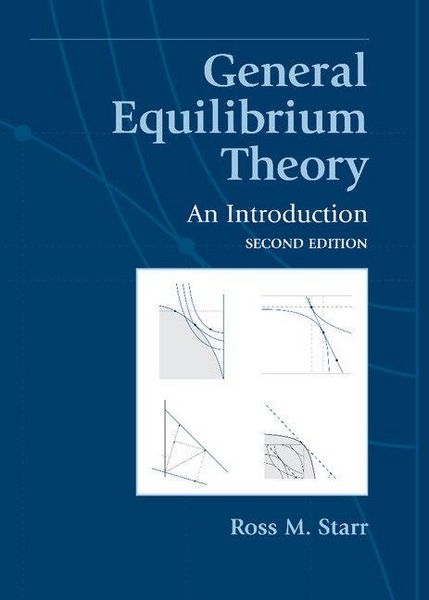
General Equilibrium Theory An Introduction
-
- Hardcover ausgewählt
- Taschenbuch
- eBook
-
Sprache:Englisch
Fr. 158.00
inkl. gesetzl. MwSt.,
Beschreibung
Produktdetails
Einband
Gebundene Ausgabe
Erscheinungsdatum
03.02.2014
Verlag
Cambridge AcademicSeitenzahl
380
Maße (L/B/H)
26/18.3/2.5 cm
Gewicht
880 g
Sprache
Englisch
ISBN
978-0-521-82645-7
"General Equilibrium Theory: An Introduction presents the mathematical economic theory of price determination and resource allocation from elementary to advanced levels, suitable for advanced undergraduates and graduate students of economics. This Arrow-Debreu model (known for two of its most prominent founders, both Nobel Laureates) is the basis of modern price theory and of a wide range of applications. The text starts with elementary models: Robinson Crusoe, the Edgeworth Box, and a 2-commodity 2-household 2-firm model. It gives a brief introduction to the mathematics used in the field (continuity, convexity, separation theorems, Brouwer fixed-point theorem, point-to-set mappings, and Shapley-Folkman theorem). It then presents the mathematical generalequilibrium model in progressively more general settings, including point-valued, set-valued, and non-convex set-valued demand and supply. Existence of general equilibrium, fundamental theorems of welfare economics, core convergence, and futures markets with time and uncertainty are treated fully. The new edition updates discussion throughout and expands the number and variety of exercises. It offers a revised and extended treatment of core convergence, including the case of non-convex preferences, and introduces the investigation of approximate equilibrium with U-shaped curves and non-convex preferences"--
Noch keine Bewertungen vorhanden
Verfassen Sie die erste Bewertung zu diesem Artikel
Helfen Sie anderen Kundinnen und Kunden durch Ihre Meinung.