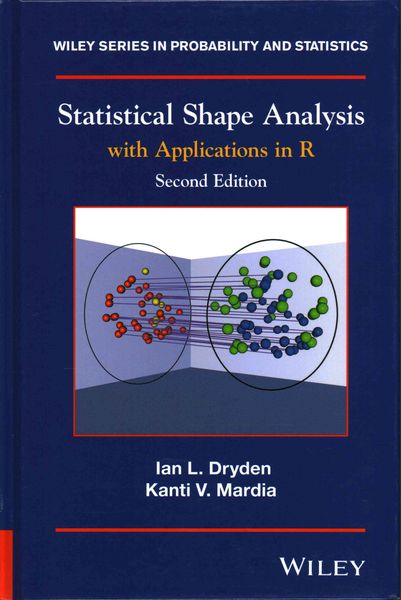
Produktbild: Statistical Shape Analysis
Band 319

Statistical Shape Analysis With Applications in R

Fr. 123.00

inkl. gesetzl. MwSt., Versandkostenfrei


Beschreibung

Produktdetails

Einband

Gebundene Ausgabe

Erscheinungsdatum

13.09.2016

Verlag

John Wiley & Sons Inc

Seitenzahl

496

Maße (L/B/H)

23.8/16.4/3.7 cm

Gewicht

815 g

Auflage

2nd Revised edition

Sprache

Englisch

ISBN

978-0-470-69962-1

Beschreibung

Produktdetails

Einband

Gebundene Ausgabe

Erscheinungsdatum

13.09.2016

Verlag

John Wiley & Sons Inc

Seitenzahl

496

Maße (L/B/H)

23.8/16.4/3.7 cm

Gewicht

815 g

Auflage

2nd Revised edition

Sprache

Englisch

ISBN

978-0-470-69962-1

Herstelleradresse

Libri GmbH
Europaallee 1
36244 Bad Hersfeld
DE

Email: GPSR Kontakt

Noch keine Bewertungen vorhanden

Verfassen Sie die erste Bewertung zu diesem Artikel

Helfen Sie anderen Kundinnen und Kunden durch Ihre Meinung.

Kundinnen und Kunden meinen

Bewertungen (0)

Die Leseprobe wird geladen.
  • Produktbild: Statistical Shape Analysis
  • 1 Introduction 1
    1.1 Definition and Motivation 1
    1.2 Landmarks 3
    1.3 The shapes package in R 6
    1.4 Practical Applications 8
    1.4.1 Biology: Mouse vertebrae 8
    1.4.2 Image analysis: Postcode recognition 11
    1.4.3 Biology: Macaque skulls 12
    1.4.4 Chemistry: Steroid molecules 15
    1.4.5 Medicine: SchizophreniaMR images 16
    1.4.6 Medicine and law: Fetal Alcohol Spectrum Disorder 16
    1.4.7 Pharmacy: DNA molecules 18
    1.4.8 Biology: Great ape skulls 19
    1.4.9 Bioinformatics: Protein matching 22
    1.4.10 Particle science: Sand grains 22
    1.4.11 Biology: Rat skull growth 24
    1.4.12 Biology: Sooty mangabeys 25
    1.4.13 Physiotherapy: Human movement data 25
    1.4.14 Genetics: Electrophoretic gels 26
    1.4.15 Medicine: Cortical surface shape 26
    1.4.16 Geology:Microfossils 28
    1.4.17 Geography: Central Place Theory 29
    1.4.18 Archaeology: Alignments of standing stones 32
    2 Size measures and shape coordinates 33
    2.1 History 33
    2.2 Size 35
    2.2.1 Configuration space 35
    2.2.2 Centroid size 35
    2.2.3 Other size measures 38
    2.3 Traditional shape coordinates 41
    2.3.1 Angles 41
    2.3.2 Ratios of lengths 42
    2.3.3 Penrose coefficent 43
    2.4 Bookstein shape coordinates 44
    2.4.1 Planar landmarks 44
    2.4.2 Bookstein-type coordinates for three dimensional data 49
    2.5 Kendall's shape coordinates 51
    2.6 Triangle shape co-ordinates 53
    2.6.1 Bookstein co-ordinates for triangles 53
    2.6.2 Kendall's spherical coordinates for triangles 56
    2.6.3 Spherical projections 58
    2.6.4 Watson's triangle coordinates 58
    3 Manifolds, shape and size-and-shape 61
    3.1 Riemannian Manifolds 61
    3.2 Shape 63
    3.2.1 Ambient and quotient space 63
    3.2.2 Rotation 63
    3.2.3 Coincident and collinear points 65
    3.2.4 Filtering translation 65
    3.2.5 Pre-shape 65
    3.2.6 Shape 66
    3.3 Size-and-shape 67
    3.4 Reflection invariance 68
    3.5 Discussion 69
    3.5.1 Standardizations 69
    3.5.2 Over-dimensioned case 69
    3.5.3 Hierarchies 70
    4 Shape space 71
    4.1 Shape space distances 71
    4.1.1 Procrustes distances 71
    4.1.2 Procrustes 74
    4.1.3 Differential geometry 74
    4.1.4 Riemannian distance 76
    4.1.5 Minimal geodesics in shape space 77
    4.1.6 Planar shape 77
    4.1.7 Curvature 79
    4.2 Comparing shape distances 79
    4.2.1 Relationships 79
    4.2.2 Shape distances in R 79
    4.2.3 Further discussion 82
    4.3 Planar case 84
    4.3.1 Complex arithmetic 84
    4.3.2 Complex projective space 85
    4.3.3 Kent's polar pre-shape coordinates 87
    4.3.4 Triangle case 88
    4.4 Tangent space co-ordinates 90
    4.4.1 Tangent spaces 90
    4.4.2 Procrustes tangent co-ordinates 91
    4.4.3 Planar Procrustes tangent co-ordinates 93
    4.4.4 Higher dimensional Procrustes tangent co-ordinates 97
    4.4.5 Inverse exponential map tangent-coordinates 98
    4.4.6 Procrustes residuals 98
    4.4.7 Other tangent co-ordinates 99
    4.4.8 Tangent space coordinates in R 99
    5 Size-and-shape space 101
    5.1 Introduction 101
    5.2 RMSD measures 101
    5.3 Geometry 102
    5.4 Tangent co-ordinates for size-and-shape space 105
    5.5 Geodesics 105
    5.6 Size-and-shape co-ordinates 106
    5.6.1 Bookstein-type coordinates for size-and-shape analysis 106
    5.6.2 Goodall-Mardia QR size-and-shape co-ordinates 107
    5.7 Allometry 108
    6 Manifold means 111
    6.1 Intrinsic and extrinsic means 111
    6.2 Population mean shapes 112
    6.3 Sample mean shape 113
    6.4 Comparing mean shapes 115
    6.5 Calculation of mean shapes in R 117
    6.6 Shape of the means 120
    6.7 Means in size-and-shape space 120
    6.7.1 Fr´echet and Karcher means 120
    6.7.2 Size-and-shape of the means 121
    6.8 Principal geodesic mean 121
    6.9 Riemannian barycentres 122
    7 Procrustes analysis 123
    7.1 Introduction 123
    7.2 Ordinary Procrustes analysis 124
    7.2.1 Full ordinary Procrustes analysis 124
    7.2.2 Ordinary Procrustes analysis in R 127
    7.2.3 Ordinary partial Procrustes 129
    7.2.4 Reflection Procrustes 130
    7.3 Generalized Procrustes analysis 131
    7.3.1 Introduction 131
    7.4 Generalized Procrustes algorithms for shape analysis 135
    7.4.1 Algorithm: GPA-Shape-1 135
    7.4.2 Algorithm: GPA-Shape-2 137
    7.4.3 GPA in R 137
    7.5 Generalized Procrustes algorithms for size-and-shape analysis 140
    7.5.1 Algorithm: GPA-Size-and-Shape-1 140
    7.5.2 Algorithm: GPA-Size-and-Shape-2 141
    7.5.3 Partial generalized Procrustes analysis in R 141
    7.5.4 Reflection generalized Procrustes analysis in R 141
    7.6 Variants of generalized Procrustes Analysis 142
    7.6.1 Summary 142
    7.6.2 Unit size partial Procrustes 142
    7.6.3 Weighted Procrustes analysis 143
    7.7 Shape variability: principal components analysis 147
    7.7.1 Shape PCA 147
    7.7.2 Kent's shape PCA 149
    7.7.3 Shape PCA in R 149
    7.7.4 Point distribution models 162
    7.7.5 PCA in shape analysis and multivariate analysis 164
    7.8 PCA for size-and-shape 164
    7.9 Canonical variate analysis 165
    7.10 Discriminant analysis 167
    7.11 Independent components analysis 168
    7.12 Bilateral symmetry 170
    8 2D Procrustes analysis using complex arithmetic 173
    8.1 Introduction 173
    8.2 Shape distance and Procrustes matching 173
    8.3 Estimation of mean shape 176
    8.4 Planar shape analysis in R 178
    8.5 Shape variability 179
    9 Tangent space inference 185
    9.1 Tangent space small variability inference for mean shapes 185
    9.1.1 One sample Hotelling's T 2 test 185
    9.1.2 Two independent sample Hotelling's T 2 test 188
    9.1.3 Permutation and bootstrap tests 193
    9.1.4 Fast permutation and bootstrap tests 194
    9.1.5 Extensions and regularization 196
    9.2 Inference using Procrustes statistics under isotropy 196
    9.2.1 One sample Goodall's F test 197
    9.2.2 Two independent sample Goodall's F test 199
    9.2.3 Further two sample tests 203
    9.2.4 One way analysis of variance 204
    9.3 Size-and-shape tests 205
    9.3.1 Tests using Procrustes size-and-shape tangent space 205
    9.3.2 Case-study: Size-and-shape analysis and mutation 207
    9.4 Edge-based shape coordinates 210
    9.5 Investigating allometry 212
    10 Shape and size-and-shape distributions 217
    10.1 The Uniform distribution 217
    10.2 Complex Bingham distribution 219
    10.2.1 The density 219
    10.2.2 Relation to the complex normal distribution 220
    10.2.3 Relation to real Bingham distribution 220
    10.2.4 The normalizing constant 221
    10.2.5 Properties 221
    10.2.6 Inference 223
    10.2.7 Approximations and computation 224
    10.2.8 Relationship with the Fisher-von Mises distribution 225
    10.2.9 Simulation 226
    10.3 ComplexWatson distribution 226
    10.3.1 The density 226
    10.3.2 Inference 227
    10.3.3 Large concentrations 228
    10.4 Complex Angular central Gaussian distribution 230
    10.5 Complex Bingham quartic distribution 230
    10.6 A rotationally symmetric shape family 230
    10.7 Other distributions 231
    10.8 Bayesian inference 232
    10.9 Size-and-shape distributions 234
    10.9.1 Rotationally symmetric size-and-shape family 234
    10.9.2 Central complex Gaussian distribution 236
    10.10Size-and-shape versus shape 236
    11 Offset normal shape distributions 237
    11.1 Introduction 237
    11.1.1 Equal mean case in two dimensions 237
    11.1.2 The isotropic case in two dimensions 242
    11.1.3 The triangle case 246
    11.1.4 Approximations: Large and small variations 247
    11.1.5 Exact Moments 249
    11.1.6 Isotropy 249
    11.2 Offset normal shape distributions with general covariances 250
    11.2.1 The complex normal case 251
    11.2.2 General covariances: small variations 251
    11.3 Inference for offset normal distributions 253
    11.3.1 General MLE 253
    11.3.2 Isotropic case 253
    11.3.3 Exact istropic MLE in R 256
    11.3.4 EM algorithm and extensions 256
    11.4 Practical Inference 257
    11.5 Offset normal size-and-shape distributions 257
    11.5.1 The isotropic case 258
    11.5.2 Inference using the offset normal size-and-shape model 260
    11.6 Distributions for higher dimensions 262
    11.6.1 Introduction 262
    11.6.2 QR Decomposition 262
    11.6.3 Size-and-shape distributions 263
    11.6.4 Multivariate approach 264
    11.6.5 Approximations 265
    12 Deformations for size and shape change 267
    12.1 Deformations 267
    12.1.1 Introduction 267
    12.1.2 Definition and desirable properties 268
    12.1.3 D'Arcy Thompson's transformation grids 268
    12.2 Affine transformations 270
    12.2.1 Exact match 270
    12.2.2 Least squares matching: Two objects 270
    12.2.3 Least squares matching: Multiple objects 272
    12.2.4 The triangle case: Bookstein's hyperbolic shape space 275
    12.3 Pairs of Thin-plate Splines 277
    12.3.1 Thin-plate splines 277
    12.3.2 Transformation grids 279
    12.3.3 Thin-plate splines in R 282
    12.3.4 Principal and partial warp decompositions 287
    12.3.5 Principal component analysis with non-Euclidean metrics 296
    12.3.6 Relative warps 299
    12.4 Alternative approaches and history 303
    12.4.1 Early transformation grids 303
    12.4.2 Finite element analysis 306
    12.4.3 Biorthogonal grids 309
    12.5 Kriging 309
    12.5.1 Universal kriging 309
    12.5.2 Deformations 311
    12.5.3 Intrinsic kriging 311
    12.5.4 Kriging with derivative constraints 313
    12.5.5 Smoothed matching 313
    12.6 Diffeomorphic transformations 315
    13 Non-parametric inference and regression 317
    13.1 Consistency 317
    13.2 Uniqueness of intrinsic means 318
    13.3 Non-parametric inference 321
    13.3.1 Central limit theorems and non-parametric tests 321
    13.3.2 M-estimators 323
    13.4 Principal geodesics and shape curves 323
    13.4.1 Tangent space methods and longitudinal data 323
    13.4.2 Growth curve models for triangle shapes 325
    13.4.3 Geodesic hypothesis 325
    13.4.4 Principal geodesic analysis 326
    13.4.5 Principal nested spheres and shape spaces 327
    13.4.6 Unrolling and unwrapping 328
    13.4.7 Manifold splines 331
    13.5 Statistical shape change 333
    13.5.1 Geometric components of shape change 334
    13.5.2 Paired shape distributions 336
    13.6 Robustness 336
    13.7 Incomplete Data 340
    14 Unlabelled size-and-shape and shape analysis 341
    14.1 The Green-Mardia model 342
    14.1.1 Likelihood 342
    14.1.2 Prior and posterior distributions 343
    14.1.3 MCMC simulation 344
    14.2 Procrustes model 346
    14.2.1 Prior and posterior distributions 347
    14.2.2 MCMC Inference 347
    14.3 Related methods 349
    14.4 Unlabelled Points 350
    14.4.1 Flat triangles and alignments 350
    14.4.2 Unlabelled shape densities 351
    14.4.3 Further probabilistic issues 351
    14.4.4 Delaunay triangles 352
    15 Euclidean methods 355
    15.1 Distance-based methods 355
    15.2 Multidimensional scaling 355
    15.2.1 Classical MDS 355
    15.2.2 MDS for size-and-shape 356
    15.3 MDS shape means 356
    15.4 EDMA for size-and-shape analysis 359
    15.4.1 Mean shape 359
    15.4.2 Tests for shape difference 360
    15.5 Log-distances and multivariate analysis 362
    15.6 Euclidean shape tensor analysis 363
    15.7 Distance methods versus geometrical methods 363
    16 Curves, surfaces and volumes 365
    16.1 Shape factors and random sets 365
    16.2 Outline data 366
    16.2.1 Fourier series 366
    16.2.2 Deformable template outlines 367
    16.2.3 Star-shaped objects 368
    16.2.4 Featureless outlines 369
    16.3 Semi-landmarks 370
    16.4 Square root velocity function 371
    16.4.1 SRVF and quotient space for size-and-shape 371
    16.4.2 Quotient space inference 372
    16.4.3 Ambient space inference 373
    16.5 Curvature and torsion 375
    16.6 Surfaces 376
    16.7 Curvature, ridges and solid shape 376
    17 Shape in images 379
    17.1 Introduction 379
    17.2 High-level Bayesian image analysis 380
    17.3 Prior models for objects 381
    17.3.1 Geometric parameter approach 382
    17.3.2 Active shape models and active appearance models 382
    17.3.3 Graphical templates 383
    17.3.4 Thin-plate splines 383
    17.3.5 Snake 384
    17.3.6 Inference 384
    17.4 Warping and image averaging 384
    17.4.1 Warping 384
    17.4.2 Image averaging 385
    17.4.3 Merging images 386
    17.4.4 Consistency of deformable models 392
    17.4.5 Discussion 392
    18 Object data and manifolds 395
    18.1 Object oriented data analysis 395
    18.2 Trees 396
    18.3 Topological data analysis 397
    18.4 General shape spaces and generalized Procrustes methods 397
    18.4.1 Definitions 397
    18.4.2 Two object matching 398
    18.4.3 Generalized matching 399
    18.5 Other types of shape 399
    18.6 Manifolds 400
    18.7 Reviews 400
    19 Exercises 403
    20 Bibliography 409
    References 409