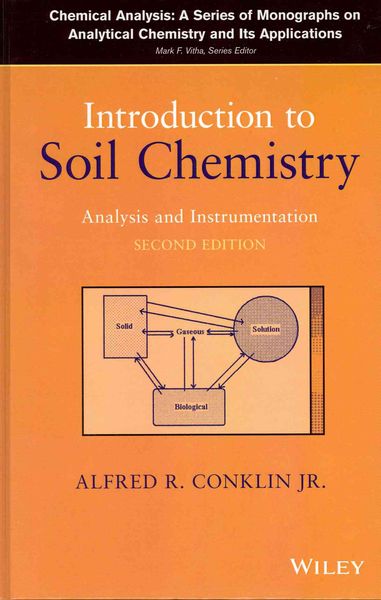
Introduction to Soil Chemistry Analysis and Instrumentation
Fr. 173.00
inkl. gesetzl. MwSt.,
Beschreibung
Produktdetails
Einband
Gebundene Ausgabe
Erscheinungsdatum
17.02.2014
Herausgeber
Mark F. VithaVerlag
John Wiley & Sons IncSeitenzahl
376
Maße (L/B/H)
24/16.1/2.4 cm
Gewicht
721 g
Auflage
2nd Revised edition
Sprache
Englisch
ISBN
978-1-118-13514-3
Provides the tools needed to explore the incredible complexities of the earth's soils
Now in its Second Edition, this highly acclaimed text fully equips readers with the skills and knowledge needed to analyze soil and correctly interpret the results. Due to the highly complex nature of soil, the author carefully explains why unusual results are routinely obtained during soil analyses, including the occurrence of methane in soil under oxidative conditions. The text also assists readers in developing their own analytical techniques in order to analyze particular samples or test for particular compounds or properties.
The Second Edition of Introduction to Soil Chemistry features four new chapters. Moreover, the entire text has been thoroughly updated and revised. It begins with a review of the history of soil chemistry, introducing fundamental concepts that apply to all soils. Next, the text explores:
* Basic soil characteristics, horizonation, texture, clay, air, water, solids, organic matter, organisms, and fundamental chemical concepts essential to soil chemistry
* Tested and proven sampling techniques for soil analysis that provide reliable analytical results
* Basic soil measurement techniques and extraction procedures
* Instrumentation to isolate and identify soil chemicals, including plant nutrients and contaminants
Detailed examples and figures throughout the text help readers successfully perform soil sampling and analytical methods as well as better understand soil's chemical characteristics. At the end of each chapter, a bibliography and list of references lead to additional resources to explore individual topics in greater depth. Each chapter also offers problem sets, encouraging readers to put their newfound skills into practice.
Reflecting the latest research findings and best practices, the Second Edition of Introduction to Soil Chemistry is ideal for both students and soil chemists who want to explore the incredible complexities of the earth's soils.
Now in its Second Edition, this highly acclaimed text fully equips readers with the skills and knowledge needed to analyze soil and correctly interpret the results. Due to the highly complex nature of soil, the author carefully explains why unusual results are routinely obtained during soil analyses, including the occurrence of methane in soil under oxidative conditions. The text also assists readers in developing their own analytical techniques in order to analyze particular samples or test for particular compounds or properties.
The Second Edition of Introduction to Soil Chemistry features four new chapters. Moreover, the entire text has been thoroughly updated and revised. It begins with a review of the history of soil chemistry, introducing fundamental concepts that apply to all soils. Next, the text explores:
* Basic soil characteristics, horizonation, texture, clay, air, water, solids, organic matter, organisms, and fundamental chemical concepts essential to soil chemistry
* Tested and proven sampling techniques for soil analysis that provide reliable analytical results
* Basic soil measurement techniques and extraction procedures
* Instrumentation to isolate and identify soil chemicals, including plant nutrients and contaminants
Detailed examples and figures throughout the text help readers successfully perform soil sampling and analytical methods as well as better understand soil's chemical characteristics. At the end of each chapter, a bibliography and list of references lead to additional resources to explore individual topics in greater depth. Each chapter also offers problem sets, encouraging readers to put their newfound skills into practice.
Reflecting the latest research findings and best practices, the Second Edition of Introduction to Soil Chemistry is ideal for both students and soil chemists who want to explore the incredible complexities of the earth's soils.
Kundinnen und Kunden meinen
Verfassen Sie die erste Bewertung zu diesem Artikel
Helfen Sie anderen Kund*innen durch Ihre Meinung