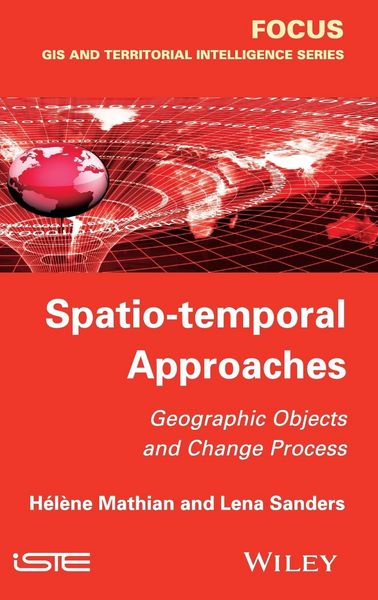
Spatio-temporal Approaches Geographic Objects and Change Process
Fr. 195.00
inkl. gesetzl. MwSt.,
Beschreibung
Produktdetails
Einband
Gebundene Ausgabe
Erscheinungsdatum
12.01.2015
Verlag
John Wiley & SonsSeitenzahl
176
Maße (L/B/H)
24/16.1/1.4 cm
Gewicht
437 g
Auflage
1. Auflage
Sprache
Englisch
ISBN
978-1-84821-552-8
Spatio-temporal Approaches presents a well-built set of concepts, methods and approaches, in order to represent and understand the evolution of social and environmental phenomena within the space. It is basedon examples in human geography and archeology (which will enable us to explore questions regarding various temporalities) and tackles social and environmental phenomena. Chapter 1 discusses how to apprehend change: objects, attributes, relations, processes.
Chapter 2 introduces multiple points of view about modeling and the authors try to shed a new light on the different, but complementary approaches of geomaticians and thematicians. Chapter 3 is devoted to the construction of spatio-temporal indicators, to various measurements of the change, while highlighting the advantage of an approach crossing several points of view, in order to understand the phenomenon at hand. Chapter 4 presents different categories of simulation model in line with complexity sciences. These models rely notably on the concepts of emergence and self-organization and allow us to highlight the roles of interaction within change. Chapter 5 provides ideas on research concerning the various construction approaches of hybrid objects and model couplings.
Chapter 2 introduces multiple points of view about modeling and the authors try to shed a new light on the different, but complementary approaches of geomaticians and thematicians. Chapter 3 is devoted to the construction of spatio-temporal indicators, to various measurements of the change, while highlighting the advantage of an approach crossing several points of view, in order to understand the phenomenon at hand. Chapter 4 presents different categories of simulation model in line with complexity sciences. These models rely notably on the concepts of emergence and self-organization and allow us to highlight the roles of interaction within change. Chapter 5 provides ideas on research concerning the various construction approaches of hybrid objects and model couplings.
Noch keine Bewertungen vorhanden
Verfassen Sie die erste Bewertung zu diesem Artikel
Helfen Sie anderen Kundinnen und Kunden durch Ihre Meinung.