Gutscheinbedingungen

*Gültig bis 05.07.2026 auf (fast) alles. Ausgeschlossen sind Smartboxen, Zeitschriften, Tickets, Lebensmittel, Gaming-Elektroartikel, Tinte/Toner, Gutscheine, Geschenkkarten, Blumen und Abos | Einlösbar in allen Buchhandlungen von Orell Füssli, Barth Bücher, Buchladen Rapunzel, Papeterie Köhler, Schuler Orell Füssli, Stauffacher und ZAP unter Vorweisung des Gutscheins, auf www.orellfüssli.ch durch Eingabe des Gutscheincodes. Beim Service „eBooks verschenken“ und bei eBook-Käufen via eReader nicht einlösbar | Mindesteinkaufswert: Fr. 30.- | Nicht mit anderen Rabatten kumulierbar.

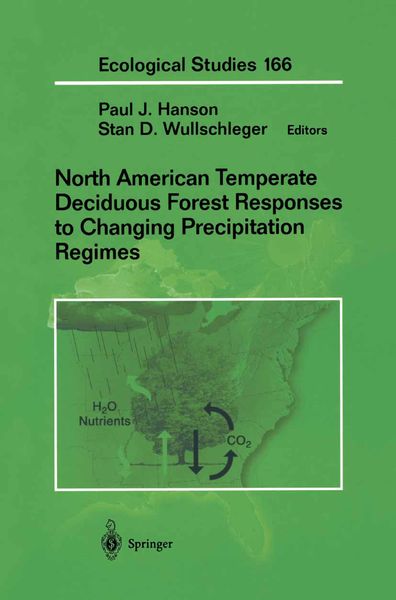
Produktbild: North American Temperate Deciduous Forest Responses to Changing Precipitation Regimes
Band 166

North American Temperate Deciduous Forest Responses to Changing Precipitation Regimes

Aus der Reihe Ecological Studies

Fr. 138.00

inkl. gesetzl. MwSt., Versandkostenfrei


Portrait

Large-scale experimentation allows scientists to test the specific
responses of ecosystems to changing environmental conditions. This
volume synthesizes mechanisms of forest ecosystem response to changing
hydrologic budgets associated with climatic change drivers. The
authors explain the implications of changes at both the plant and
stand levels, and they extrapolate the data to ecosystem-level
responses, such as changes in nutrient cycling, biodiversity and
carbon sequestration. In analyzing data, they also discuss
similarities and differences with other temperate deciduous forests.

Produktdetails

Einband

Taschenbuch

Erscheinungsdatum

17.09.2012

Herausgeber

Paul Hanson + weitere

Verlag

Springer Us

Seitenzahl

472

Maße (L/B/H)

23.5/15.5/2.8 cm

Gewicht

765 g

Auflage

Softcover reprint of the original 1st ed. 2003

Sprache

Englisch

ISBN

978-1-4612-6506-1

Portrait

Produktdetails

Einband

Taschenbuch

Erscheinungsdatum

17.09.2012

Herausgeber

Verlag

Springer Us

Seitenzahl

472

Maße (L/B/H)

23.5/15.5/2.8 cm

Gewicht

765 g

Auflage

Softcover reprint of the original 1st ed. 2003

Sprache

Englisch

ISBN

978-1-4612-6506-1

Herstelleradresse

Springer-Verlag GmbH
Tiergartenstr. 17
69121 Heidelberg
DE

Email: GPSR Kontakt

Noch keine Bewertungen vorhanden

Verfassen Sie die erste Bewertung zu diesem Artikel

Helfen Sie anderen Kundinnen und Kunden durch Ihre Meinung.

Kundinnen und Kunden meinen

Bewertungen (0)

Weitere Artikel finden Sie in

  • Produktbild: North American Temperate Deciduous Forest Responses to Changing Precipitation Regimes
  • Section 1. Introduction.- 1. Introduction.- 2. Walker Branch Throughfall Displacement Experiment.- Section 2. Carbon-Cycle Processes.- 3. Deciduous Hardwood Photosynthesis: Species Differences, Temporal Patterns, and Responses to Soil-Water Deficits.- 4. Aboveground Autotrophic Respiration.- 5. Dormant-Season Nonstructural Carbohydrate Storage.- Section 3. Water-Cycle Processes.- 6. Sensitivity of Sapling and Mature-Tree Water Use to Altered Precipitation Regimes.- 7. Stomatal Behavior of Forest Trees in Relation to Hydraulic, Chemical, and Environmental Factors.- 8. Leaf Water Potential, Osmotic Potential, and Solute Accumulation of Several Hardwood Species as Affected by Manipulation of Throughfall Precipitation in an Upland Quercus Forest.- 9.180 and 13C in Leaf Litter Versus Tree-Ring Cellulose as Proxy Isotopic Indicators of Climate Change.- Section 4. Decomposition and Soil Carbon Turnover.- 10. Soil Respiration and Litter Decomposition.- 11. Soil Carbon Turnover.- 12. Rates of Coarse-Wood Decomposition.- Section 5. Plant Growth and Mortality.- 13. Tree Seedling Recruitment in a Temperate Deciduous Forest: Interactive Effects of Soil Moisture, Light, and Slope Position.- 14. Response of Understory Tree Seedling Populations to Spatiotemporal Variation in Soil Moisture.- 15. Tree and Sapling Growth and Mortality.- 16. Fine Root Growth Response.- 17. Canopy Production.- Section 6. Response of Other Organisms.- 18. Foliar Chemistry and Herbivory.- 19. Opportunistically Pathogenic Root Rot Fungi: Armillaria Species.- 20. The Influence of Precipitation Change on Spiders as Top Predators in the Detrital Community.- Section 7. Forest Stand-Level Syntheses.- 21. Forest Water Use and the Influence of Precipitation Change.- 22. Estimating the Net Primary and Net Ecosystem Production of a Southeastern Upland Quercus Forest from an 8-Year Biometric Record.- 23. Nutrient Availability and Cycling.- Section 8. Extrapolations.- 24. Long-Term Forest Dynamics and Tree Growth at the TDE Site on Walker Branch Watershed.- 25. Simulated Patterns of Forest Succession and Productivity as a Consequence of Altered Precipitation.- 26. Regional Implications of the Throughfall Displacement Experiment on Forest Productivity.- Appendix. List of Scientific and Common Species Names.