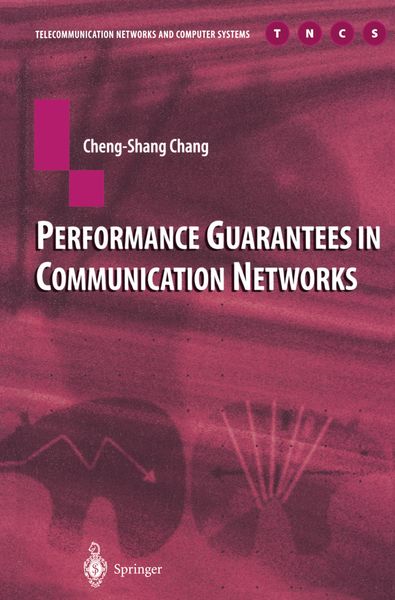

Performance Guarantees in Communication Networks
Aus der Reihe
Telecommunication Networks and Computer Systems
-
- Hardcover
- Taschenbuch ausgewählt
- eBook
-
Sprache:Englisch
Fr. 191.00
inkl. gesetzl. MwSt.,
Beschreibung
Produktdetails
Einband
Taschenbuch
Erscheinungsdatum
04.10.2012
Verlag
Springer LondonSeitenzahl
392
Maße (L/B/H)
23.5/15.5/2.3 cm
Gewicht
628 g
Auflage
Softcover reprint of the original 1st ed. 2000
Sprache
Englisch
ISBN
978-1-4471-1147-4
Providing performance guarantees is one of the most important issues for future telecommunication networks. This book describes theoretical developments in performance guarantees for telecommunication networks from the last decade. Written for the benefit of graduate students and scientists interested in telecommunications-network performance this book consists of two parts. The first introduces the recently-developed filtering theory for providing deterministic (hard) guarantees, such as bounded delay and queue length. The filtering theory is developed under the min-plus algebra, where one replaces the usual addition with the min operator and the usual multiplication with the addition operator. As in the classical linear system theory, the filtering theory treats an arrival process (or a departure process ) as a signal and a network element as a system. Network elements, including traffic regulators and servers, can be modelled as linear filters under the min-plus algebra, and they can be joined by concatenation, "filter bank summation", and feedback to form a composite network element. The problem of providing deterministic guarantees is equivalent to finding the impulse response of composite network elements. This section contains material on:
- (s, r)-calculus
- Filtering theory for deterministic traffic regulation, service guarantees and networks with variable-length packets - Traffic specification
- Networks with multiple inputs and outputs
- Constrained traffic regulation
The second part of the book addresses stochastic (soft) guarantees, focusing mainly on tail distributions of queue lengths and packet loss probabilities and contains material on:
- (s(q), r(q))-calculus and q-envelope rates
- The large deviation principle
- The theory of effective bandwidth
The mathematical theory for stochastic guarantees is the theory of effective bandwidth. Based on the large deviation principle, the theory of effective bandwidth provides approximations for the bandwidths required to meet stochastic guarantees for both short-range dependent inputs and long-range dependent inputs.
- (s, r)-calculus
- Filtering theory for deterministic traffic regulation, service guarantees and networks with variable-length packets - Traffic specification
- Networks with multiple inputs and outputs
- Constrained traffic regulation
The second part of the book addresses stochastic (soft) guarantees, focusing mainly on tail distributions of queue lengths and packet loss probabilities and contains material on:
- (s(q), r(q))-calculus and q-envelope rates
- The large deviation principle
- The theory of effective bandwidth
The mathematical theory for stochastic guarantees is the theory of effective bandwidth. Based on the large deviation principle, the theory of effective bandwidth provides approximations for the bandwidths required to meet stochastic guarantees for both short-range dependent inputs and long-range dependent inputs.
Noch keine Bewertungen vorhanden
Verfassen Sie die erste Bewertung zu diesem Artikel
Helfen Sie anderen Kundinnen und Kunden durch Ihre Meinung.