Gutscheinbedingungen

*Gültig bis 05.07.2026 auf (fast) alles. Ausgeschlossen sind Smartboxen, Zeitschriften, Tickets, Lebensmittel, Gaming-Elektroartikel, Tinte/Toner, Gutscheine, Geschenkkarten, Blumen und Abos | Einlösbar in allen Buchhandlungen von Orell Füssli, Barth Bücher, Buchladen Rapunzel, Papeterie Köhler, Schuler Orell Füssli, Stauffacher und ZAP unter Vorweisung des Gutscheins, auf www.orellfüssli.ch durch Eingabe des Gutscheincodes. Beim Service „eBooks verschenken“ und bei eBook-Käufen via eReader nicht einlösbar | Mindesteinkaufswert: Fr. 30.- | Nicht mit anderen Rabatten kumulierbar.

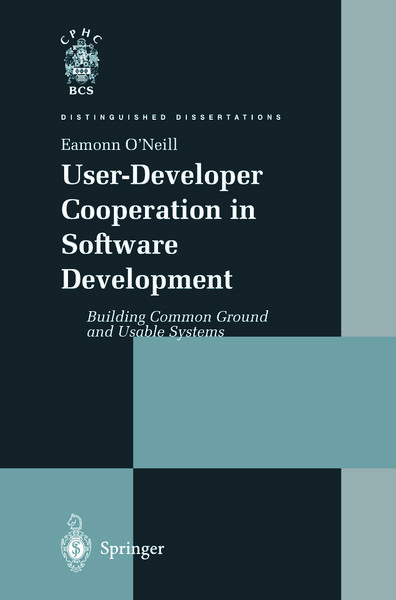
  • Produktbild: User-Developer Cooperation in Software Development
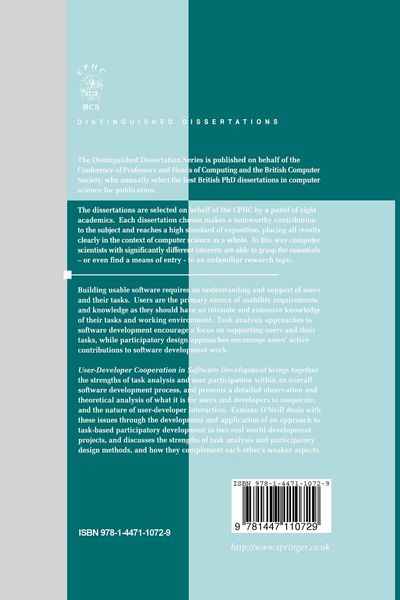
  • Produktbild: User-Developer Cooperation in Software Development

User-Developer Cooperation in Software Development Building Common Ground and Usable Systems

Fr. 137.00

inkl. gesetzl. MwSt., Versandkostenfrei


Beschreibung

Produktdetails

Einband

Taschenbuch

Erscheinungsdatum

02.10.2012

Verlag

Springer London

Seitenzahl

317

Maße (L/B/H)

23.5/15.5/1.9 cm

Gewicht

516 g

Auflage

Softcover reprint of the original 1st ed. 2001

Sprache

Englisch

ISBN

978-1-4471-1072-9

Beschreibung

Produktdetails

Einband

Taschenbuch

Erscheinungsdatum

02.10.2012

Verlag

Springer London

Seitenzahl

317

Maße (L/B/H)

23.5/15.5/1.9 cm

Gewicht

516 g

Auflage

Softcover reprint of the original 1st ed. 2001

Sprache

Englisch

ISBN

978-1-4471-1072-9

Herstelleradresse

Springer-Verlag KG
Sachsenplatz 4-6
1201 Wien
AT

Email: GPSR Kontakt

Noch keine Bewertungen vorhanden

Verfassen Sie die erste Bewertung zu diesem Artikel

Helfen Sie anderen Kundinnen und Kunden durch Ihre Meinung.

Kundinnen und Kunden meinen

Bewertungen (0)

  • Produktbild: User-Developer Cooperation in Software Development
  • Produktbild: User-Developer Cooperation in Software Development
  • 1: Introduction.- 1.1 Background.- 1.2 Problem Statement.- 1.3 Research Approach.- 1.4 Results and Contributions Made.- 1.5 Outline of Chapters.- 2: A Longitudinal View on Software Development and Participation.- 2.1 Computer Systems Development: Changing Constraints.- 2.1.1 Phase I Systems Development.- 2.1.2 Phase II Systems Development.- 2.1.3 Phase III Systems Development.- 2.2 Participatory Design.- 2.3 Giving the Users What They Want: Effective HCI.- 2.3.1 Evolution in HCI.- 2.3.2 Task Analysis and Participatory Design.- 2.4 Where Are We Now?.- 2.4.1 Listening to Developers.- 2.4.2 We Are Here.- 2.5 Research Questions Raised.- 3: The Projects and Their Analysis.- 3.1 The Development Method.- 3.2 The Development Projects Studied.- 3.2.1 Pilot Project Overview.- 3.2.2 CI Project Overview.- 3.2.3 CS Project Overview.- 3.3 Data Available from the Projects.- 3.4 Research Method.- 3.4.1 Analysing Interaction.- 3.4.2 Approaches to the Research Questions.- 3.4.3 Issues in Performing Video-Based Analysis.- 3.4.4 On Researcher Involvement in the Projects.- 4: Towards a Theory of User-Developer Cooperation.- 4.1 Developing Interaction Analysis.- 4.1.1 Identifying Process in Cooperative Development.- 4.1.2 Exploring Artefacts and Relations in Cooperative Development.- 4.1.3 Process Revisited.- 4.2 The Construction of Shared Understandings.- 4.3 Cooperative Development and Common Ground.- 4.4 Conclusion.- 5: Effective Participation: Contributing to Discourse and Artefacts.- 5.1 The Nature of Participation: Contributing to Discourse.- 5.1.1 Making a Contribution.- 5.1.2 Types of Contribution.- 5.2 Were the Studied Projects Participatory.- 5.2.1 Expected User Contributions to User-Developer Collaboration.- 5.2.2 Methodology in Assessing Contributions.- 5.2.3 Observed User Contributions to User-Developer Collaboration.- 5.2.4 Conclusions on Participation.- 5.3 Effective Participation: Contributing to Artefacts.- 5.3.1 Contributions and Evidence of Effectiveness.- 5.3.2 Effectiveness of User Participation in the Projects.- 5.4 Conclusion.- 6: User Participation and Software Usability.- 6.1 Evaluating the Software.- 6.1.1 Recruiting Subjects.- 6.1.1.1 CI Subjects.- 6.1.1.2 CS Subjects.- 6.1.2 Defining Tasks.- 6.1.2.1 CI Tasks.- 6.1.2.2 CS Tasks.- 6.1.3 Running Evaluations.- 6.1.3.1 CI Evaluation.- 6.1.3.2 CS Evaluation.- 6.2 Summary of the Usability Evaluation Results.- 6.2.1 Summary of the CI Evaluation Results.- 6.2.2 Summary of the CS Evaluation Results.- 6.3 Tracing Relationships Between Contributions, Software Features and Usability.- 6.3.1 Tracing Upstream.- 6.3.2 Tracing Downstream.- 6.4 Results of Tracing Analysis.- 6.4.1 Results of Upstream Tracing.- 6.4.2 Results of Downstream Tracing.- 6.4.2.1 Results of Tracing Downstream from Work Analysis Activity.- 6.4.2.2 Results of Tracing Downstream from Work Design Activity.- 6.4.2.3 Results of Tracing Downstream from Software Design Activity.- 6.5 Discussion.- 6.5.1 Deus ex Machina.- 6.5.2 Technology.- 6.5.3 Standard Flow.- 6.5.4 Ineffective Contributions.- 6.5.5 Unvalued Contributions.- 6.5.6 Unrequested Features.- 6.5.7 False Absence.- 6.6 Conclusion.- 7: Task-Based Cooperative Development: Conclusions.- 7.1 Summary.- 7.2 Lessons and Limitations.- 7.2.1 Building Theory.- 7.2.2 On Research Methodology.- 7.2.3 Improving Practice.- 7.3 Future Work.