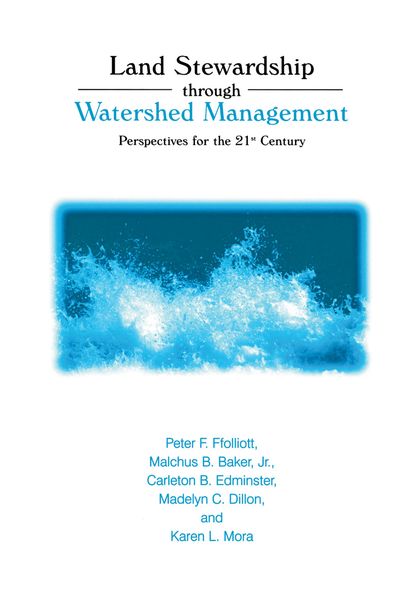
Land Stewardship through Watershed Management Perspectives for the 21st Century
-
- Hardcover
- Taschenbuch ausgewählt
-
Sprache:Englisch
Fr. 137.00
inkl. gesetzl. MwSt.,
Beschreibung
Produktdetails
Einband
Taschenbuch
Erscheinungsdatum
20.09.2012
Herausgeber
Peter F. Ffolliott + weitereVerlag
Springer UsSeitenzahl
137
Maße (L/B/H)
25.4/17.8/0.9 cm
Gewicht
301 g
Auflage
Softcover reprint of the original 1st ed. 2002
Sprache
Englisch
ISBN
978-1-4613-5146-7
We must enhance the effectiveness ofland stewardship and management of the world's natural resources to meet a growing global population's need for conservation, sustainable development, and use of land, water, and other natural resources. Ecosystem-based, mul tiple-use land stewardship is necessary when considering the present and future uses ofland, water, and other natural resources on an operationally efficient scale. We need holistically planned and carefully implemented watershed management practices, projects, and pro grams to accommodate the increasing demand for commodities and amenities, clear water, open space, and uncluttered landscapes. An international conference in Tucson, Arizona, from March 13 to 16, 2000, examined these needs and increased people's awareness of the contributions that ecosystem-based, multiple-use watershed management can make to future land stewardship. The conference was sponsored by the School of Renewable Natural Resources, University of Arizona; the College of Agriculture, University of Arizona; the Rocky Mountain Research Station, USDA Forest Service; the Research Center for Conservation of Water Resources and Disaster Pre vention, National Chung-Hsing University, Taiwan; the Department of Forest Resources, University of Minnesota; the Center for Integrated Natural Resources and Agriculture Man agement, University of Minnesota; the Centro de Investigaciones Biologicas del Noreste, Mexico; the International Arid Lands Consortium; the USDA Natural Resources Conserva tion Service; the Bureau of Land Management of the Department of the Interior; the Salt River Project, Phoenix, Arizona; the Southern Arizona Chapter, Southwestern Section of the Society of American Foresters; and IUFRO Working Party 8. 04. 04, Erosion Controlby Watershed Management.
Noch keine Bewertungen vorhanden
Verfassen Sie die erste Bewertung zu diesem Artikel
Helfen Sie anderen Kundinnen und Kunden durch Ihre Meinung.