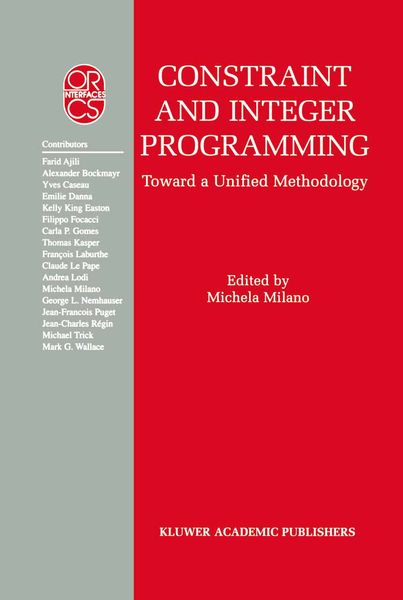
Produktbild: Constraint and Integer Programming
Band 27

Constraint and Integer Programming Toward a Unified Methodology

Fr. 192.00

inkl. gesetzl. MwSt., Versandkostenfrei


Beschreibung

Produktdetails

Einband

Taschenbuch

Erscheinungsdatum

28.09.2012

Herausgeber

Michela Milano

Verlag

Springer Us

Seitenzahl

370

Maße (L/B/H)

23.5/15.5/2.3 cm

Gewicht

616 g

Auflage

Softcover reprint of the original 1st ed. 2004

Sprache

Englisch

ISBN

978-1-4613-4719-4

Beschreibung

Produktdetails

Einband

Taschenbuch

Erscheinungsdatum

28.09.2012

Herausgeber

Michela Milano

Verlag

Springer Us

Seitenzahl

370

Maße (L/B/H)

23.5/15.5/2.3 cm

Gewicht

616 g

Auflage

Softcover reprint of the original 1st ed. 2004

Sprache

Englisch

ISBN

978-1-4613-4719-4

Herstelleradresse

Springer-Verlag KG
Sachsenplatz 4-6
1201 Wien
AT

Email: ProductSafety@springernature.com

Kundinnen und Kunden meinen

0 Bewertungen

Informationen zu Bewertungen

Zur Abgabe einer Bewertung ist eine Anmeldung im Konto notwendig. Die Authentizität der Bewertungen wird von uns nicht überprüft. Wir behalten uns vor, Bewertungstexte, die unseren Richtlinien widersprechen, entsprechend zu kürzen oder zu löschen.

Die Bewertungen sind nach Format, Anzahl Sterne und Datum sortiert.

Verfassen Sie die erste Bewertung zu diesem Artikel

Helfen Sie anderen Kund*innen durch Ihre Meinung

Kundinnen und Kunden meinen

0 Bewertungen filtern

  • Produktbild: Constraint and Integer Programming
  • List of Figures. List of Tables. Preface. Contributing Authors.
    Foreword; J. Hooker.
    1: Constraint and Integer Programming; M. Milano, M. Trick. 1. Introduction. 2. CP(FD) Basic Concepts. 3. Integer Linear Programming Basic Concepts. 4. Incomplete search strategies. 5. Conclusion. References.
    2: Two Generic Schemes for Efficient and Robust Cooperative Algorithms; E. Danna, C. Le Pape. 1. Introduction. 2. Operations Research Algorithms and Constraint Programming. 3. Operations Research Algorithms and Mixed Integer Programming. 4. Constraint Programming and Mixed Integer Programming. 5. Operations Research Algorithms and Local Search. 6. Mixed Integer Programming and Local Search. 7. Constraint Programming and Local Search. References.
    3: Branch-and-Infer; A. Bockmayr, T. Kasper. 1. Introduction. 2. Modeling in CP and IP. 3. An illustrating example: discrete tomography. 4. Branch and Infer. 5. Symbolic constraints in IP. 6. Example: Symbolic constraints for supply chain planning. 7. Summary. References.
    4: Global Constraints and Filtering Algorithms; J.-C. Régin. 1. Introduction. 2. Global Constraints. 3. Filtering Algorithms. 4. Two Successful Filtering Algorithms. 5. Global Constraints and Over-constrained Problems. 6. Quality of Filtering Algorithms. 7. Discussion. 8. Conclusion. References.
    5:Exploiting relaxations in CP; F. Focacci, A. Lodi, M. Milano. 1. Introduction and Motivation. 2. Integer Linear Programming and Relaxations. 3. Integrating Relaxations in CP. 4. Relax to propagate. 5. Relax to guide the search. 6. A case study: global optimization constraints for a Path constraint.
    6: Hybrid Problem Solving in ECLiPSe; F. Ajili, M.G. Wallace. 1. Introduction. 2. Integration of Constraints and Operations Research. 3. Language Ingredients for Hybrid Solvers. 4. ECLiPSe as a Platform for Building Hybrid Algorithms. 5. Programming a Hybrid Search in ECLiPSe. 6. Conclusion. References.
    7: CP Based Branch-and-Price; K. Easton, G. Nemhauser, M. Trick. 1. Introduction. 2. Three Illustrative Examples. 3. Implementation Issues. 4. Future Directions for CP Based Branch-and-Price. References.
    8: Randomized Backtrack Search; C.P. Gomes. 1. Introduction. 2. Randomization of Backtrack Search Methods. 3. Formal Models of Heavy-Tailed Behavior. 4. Heavy and Fat-Tailed Distributions. 5. Heavy and Fat-Tailed Distributions in Backtrack Search. 6. Restart Strategies. 7. Portfolio Strategies. 8. Conclusions. References.
    9: Local Search and Constraint Programming: LS and CP illustrated on a transportation Problem; F. Focacci, F. Laburthe, A. Lodi. 1. Introduction. 2. A didactic transportation problem. 3. A CP approach