
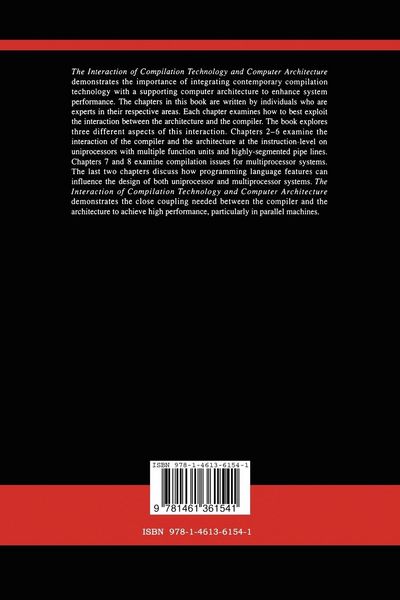
The Interaction of Compilation Technology and Computer Architecture
-
- Hardcover
- Taschenbuch ausgewählt
-
Sprache:Englisch
Fr. 137.00
inkl. gesetzl. MwSt.,
Beschreibung
Produktdetails
Einband
Taschenbuch
Erscheinungsdatum
04.10.2012
Abbildungen
VIII, 285 p.
Herausgeber
David J. Lilja + weitereVerlag
Springer UsSeitenzahl
285
Maße (L/B/H)
23.5/15.5/1.7 cm
Gewicht
452 g
Auflage
Softcover reprint of the original 1st ed. 1994
Sprache
Englisch
ISBN
978-1-4613-6154-1
In brief summary, the following results were presented in this work: • A linear time approach was developed to find register requirements for any specified CS schedule or filled MRT. • An algorithm was developed for finding register requirements for any kernel that has a dependence graph that is acyclic and has no data reuse on machines with depth independent instruction templates. • We presented an efficient method of estimating register requirements as a function of pipeline depth. • We developed a technique for efficiently finding bounds on register require ments as a function of pipeline depth. • Presented experimental data to verify these new techniques. • discussed some interesting design points for register file size on a number of different architectures. REFERENCES [1] Robert P. Colwell, Robert P. Nix, John J O'Donnell, David B Papworth, and Paul K. Rodman. A VLIW Architecture for a Trace Scheduling Com piler. In Architectural Support for Programming Languages and Operating Systems, pages 180-192, 1982. [2] C. Eisenbeis, W. Jalby, and A. Lichnewsky. Compile-Time Optimization of Memory and Register Usage on the Cray-2. In Proceedings of the Second Workshop on Languages and Compilers, Urbana l/inois, August 1989. [3] C. Eisenbeis, William Jalby, and Alain Lichnewsky. Squeezing More CPU Performance Out of a Cray-2 by Vector Block Scheduling. In Proceedings of Supercomputing '88, pages 237-246, 1988. [4] Michael J. Flynn. Very High-Speed Computing Systems. Proceedings of the IEEE, 54:1901-1909, December 1966.
Noch keine Bewertungen vorhanden
Verfassen Sie die erste Bewertung zu diesem Artikel
Helfen Sie anderen Kundinnen und Kunden durch Ihre Meinung.